
Bocas del Toro between rainforest and reef
Published on 09/14/2026 at 09:39 | Editorial responsibility: Rafael Müller, Editor-in-Chief AD HOC NEWS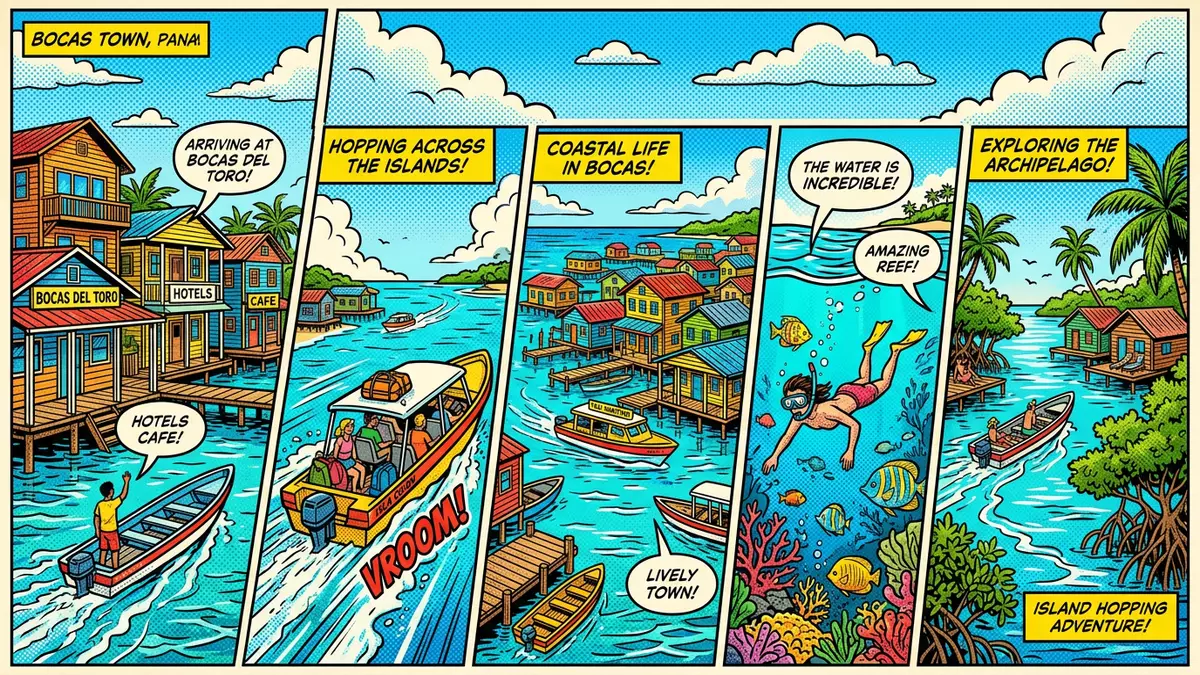
Bocas del Toro in north-western Panama is a place where a Caribbean archipelago, shallow lagoons and lowland rainforest meet, with the island town of Bocas del Toro as a compact capital at the centre of it all. The province carries the same name as its main town and covers both the islands scattered through Almirante Bay and Chiriquí Lagoon and the adjacent mainland along the Costa Rican border, giving the area a rare mix of marine and terrestrial landscapes in one coherent region.
Islands, lagoons and lowland rainforest
The heart of Bocas del Toro is the archipelago lying in the Caribbean Sea off Panama’s northern Caribbean coast, just south of the border with Costa Rica, a chain of islands and cays fringed by reefs and mangroves.the Bocas del Toro Archipelago is a chain of Caribbean islands The province itself is defined by the combination of this archipelago with Almirante Bay, Chiriquí Lagoon and the adjacent strip of mainland that rises towards the Cordillera Talamanca.the province consists of the Bocas del Toro Archipelago, Almirante Bay, Chiriquí Lagoon, and adjacent mainland The islands sit low above sea level, with elevations on the larger islands rising only modestly from the coast, and much of the shoreline edged by seagrass meadows and mangrove forest that ease the transition from land to water.elevation from 0 to 118 m and extensive mangrove habitat
Within the archipelago, Isla Colón, Bastimentos, Cristóbal, Popa, Solarte and Cayo Agua form a group of substantial islands, around which lie cays and smaller islets scattered through shallow, reef-filled water.major islands include Colón, Bastimentos, Cristóbal, Popa, Solarte and Cayo Agua The provincial capital, Bocas del Toro town, stands on the southern tip of Isla Colón as the main port and service centre for the surrounding islands.Bocas Town is the capital of the province and district on Isla Colón Away from the town’s waterfront streets, forested slopes rise on nearby islands, and the mainland behind Almirante Bay carries banana plantations, small settlements and stretches of protected rainforest tied into broader conservation areas that reach deep into the interior.
From Columbus’s anchorage to a banana port
Bocas del Toro’s recorded history reaches back to the early sixteenth century, when Christopher Columbus sailed through the region on his fourth voyage and named Isla Colón, leaving one of the earliest European place names on Panama’s Caribbean coast.Christopher Columbus visited the archipelago in 1502 and named Isla Colón For centuries afterwards the area lay on the fringes of Spanish colonial attention, with indigenous communities living around the bays and islands and occasional outside traders calling in for resources such as timber and turtle shell.Guaymi, Teribe and Bokota people inhabited the area before sustained colonial interest The town of Bocas del Toro on Isla Colón took shape in the early nineteenth century, established by immigrants arriving from Caribbean islands including Jamaica, San Andrés and Providencia, bringing with them languages, building traditions and trade connections that gave the town an outward-facing character from its beginnings.the town was founded in 1826 by immigrants from Jamaica, San Andrés and Providencia
In the late nineteenth century Bocas del Toro became deeply tied to the banana trade, first through companies such as the Snyder Brothers Banana Company and then through the United Fruit Company, which established operations in the region in 1899 and used Bocas del Toro as a key base during the expansion of its plantations.United Fruit Company began operations in Bocas del Toro in 1899 After Panama’s separation from Colombia in 1903, Bocas del Toro became the administrative centre of the newly formed province bearing the same name, anchoring provincial government in the island town.Bocas del Toro became the administrative centre of the province in 1903 The banana boom made the town and province economically important within Panama in the late nineteenth and early twentieth centuries, though plant disease and shifts in shipping later moved some export operations towards the mainland port of Almirante, leaving Bocas del Toro with a quieter role and preserving much of its wooden architecture and Caribbean small-town scale.
Marine parks, reefs and wildlife
The sea around Bocas del Toro is rich in marine life, with coral reefs, seagrass and mangrove channels forming varied habitats for fish, invertebrates and coastal birds amid warm Caribbean water.the archipelago has coral reefs, mangrove and seagrass meadows In 1988 Isla Bastimentos National Marine Park was established around parts of Bastimentos and surrounding waters, giving the province Panama’s first marine national park and protecting reefs, beaches and offshore cays as a formally designated area.Isla Bastimentos National Marine Park was created in 1988 Alongside this, conservation efforts on land include the vast La Amistad International Park in the interior, which covers large tracts of mountainous rainforest and adds a highland backdrop to the coastal scenery.La Amistad International Park is a UNESCO World Heritage Site covering much of the interior
On the water, the islands and cays around Bocas del Toro are ringed by shallow reefs and sandbars that create conditions for snorkelling and swimming, while the mangrove channels form sheltered routes where boats move between forested islets and open bay. On land, stretches of lowland forest near sea level host tropical species adapted to humid coastal conditions, and the gently rising terrain on some islands gives way to small hills from which views reach across lagoons, plantations and the Caribbean. The combination of protected marine areas, inland rainforest and accessible village life on Isla Colón allows visitors to encounter reef, jungle and small-town Caribbean culture within the same province.
Visiting Bocas del Toro: what travellers from Western Europe should know
- Bocas del Toro lies in north-western Panama, close to the border with Costa Rica; the provincial capital on Isla Colón is linked to the mainland across Almirante Bay by small boats and to Panama City by domestic flights using the island’s airstrip.
- The terrain combines low-lying islands and coastal mainland with short hills; approaches to viewpoints and village streets can involve stretches on foot, wooden walkways and piers, and occasional staircases rising from the waterfront.
- The surrounding province includes agricultural lowlands and protected rainforest, so journeys between the archipelago and inland areas may cross plantation landscapes and forested slopes as well as marine channels.
- Spanish is the official language and the currency is the Panamanian balboa, which circulates alongside the United States dollar.
- Entry requirements depend on your nationality; UK travellers can check the FCDO travel advice at gov.uk/foreign-travel-advice, Irish travellers the Department of Foreign Affairs at ireland.ie.
Searching for Bocas del Toro on social platforms
These links open searches for Bocas del Toro on each platform.
Frequently asked questions about Bocas del Toro
Where is Bocas del Toro?
Bocas del Toro is a province in north-western Panama, bordering Costa Rica, made up of a Caribbean archipelago, Almirante Bay, Chiriquí Lagoon and adjacent mainland.
What can visitors expect on a trip to Bocas del Toro?
Visits centre on the island town of Bocas del Toro on Isla Colón, with boat trips to nearby islands, encounters with reefs and mangroves, and excursions into coastal rainforest and agricultural lowlands.
What makes Bocas del Toro distinctive within Panama?
The province combines a coral-fringed archipelago, a small Caribbean capital, long ties to the banana trade and early marine conservation through Isla Bastimentos National Marine Park, all within one compact region.


