
Blue Nile Falls and the river’s sudden basalt drop
Published on 09/23/2026 at 17:08 | Editorial responsibility: Rafael Müller, Editor-in-Chief AD HOC NEWS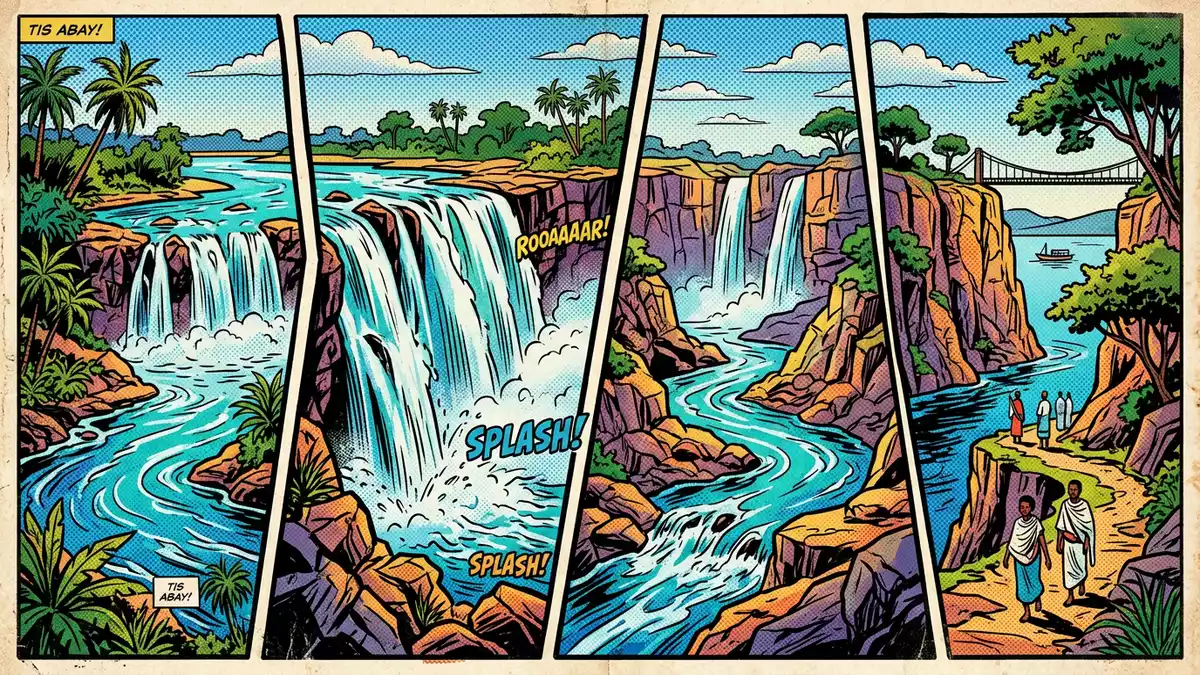
Blue Nile Falls is where the Blue Nile leaves the Lake Tana basin and drops over dark basalt near Bahir Dar. The waterfall is known locally as Tis Abay, or Tis Issat, names associated with smoke rising from the falling water. Its main character is visible in the landscape: a broad highland river narrows at the escarpment, breaks into separate streams and enters a gorge below.
Blue Nile Falls at the edge of Lake Tana
The falls lie in Ethiopia’s Amhara Region, about 30 km downstream from Bahir Dar and Lake Tana. The lake is the principal source of the Blue Nile, whose course continues south-west through the Ethiopian Highlands before reaching Sudan. At Blue Nile Falls, the river’s transition from lake outlet to gorge is concentrated in a single landscape of water, lava and cultivated highland terrain.
The waterfall drops roughly 37 to 45 m (121 to 148 ft), with its width changing as the river’s flow changes. In high water, the separate channels spread across the basalt edge. In lower flow, more of the dark rock becomes visible between the streams. This variation is part of the site’s physical identity, because the falls are not a single narrow ribbon but a broken curtain across the escarpment. The surrounding gorge contains layered volcanic rock from the Ethiopian Plateau, with the river confined below the main drop. Blue Nile Falls measurements place the height within this range and describe the changing channels.
Tis Abay, the smoking water
Tis Abay translates as “great smoke”, while Tis Issat is rendered as “smoking water”. Both names describe the visible spray around the gorge. The water breaks against the rock below the ledge, producing a veil that can hang above the river channel. The effect gives the falls a vocabulary distinct from the calmer surface of Lake Tana upstream.
The river’s setting also connects the waterfall with the wider Nile system. Lake Tana gathers water from the north-western Ethiopian Highlands, then releases the Blue Nile near Bahir Dar. The river crosses the basalt landscape before continuing towards Khartoum, where it joins the White Nile. Blue Nile Falls therefore belongs to a geographical sequence that begins with an inland lake and extends across national borders. the Lake Tana setting describes the falls as part of the river’s course from the lake through Ethiopia.
Basalt, gorge and a seventeenth-century bridge
The approach to the falls includes a historic stone bridge over the Blue Nile. The bridge dates from 1626, during the reign of Emperor Susenyos, and is associated with Portuguese-trained masons. Its masonry provides a human-made counterpoint to the volcanic cliff and the river below. The bridge remains part of the wider Tis Abay landscape rather than a separate attraction detached from the falls.
James Bruce described Blue Nile Falls in his eighteenth-century travel writings, placing the site within European accounts of the Nile’s geography. The waterfall itself is older than those accounts, formed by the river cutting through the Ethiopian Plateau. Its historical record combines local names, the bridge’s imperial-era masonry and the travel literature that carried descriptions of the upper Blue Nile beyond Ethiopia. the 1626 stone bridge is associated with Emperor Susenyos and Tis Abay.
Visiting Blue Nile Falls: what travellers from Western Europe should know
- Blue Nile Falls lies south-east of Bahir Dar in the Amhara Region. Road routes from the city lead towards Tis Abay, near the Blue Nile below Lake Tana.
- The approach includes uneven highland ground, a descent towards the gorge and a crossing of the historic stone bridge. The waterfall itself occupies a river valley shaped by basalt.
- The official language is Amharic and the currency is the Ethiopian birr.
- Entry requirements depend on your nationality; UK travellers can check the FCDO travel advice at gov.uk/foreign-travel-advice, Irish travellers the Department of Foreign Affairs at ireland.ie.
Searching for Blue Nile Falls on social platforms
These links open searches for Blue Nile Falls on each platform.
Frequently asked questions about Blue Nile Falls
Where is Blue Nile Falls?
Blue Nile Falls is on the Blue Nile in Ethiopia’s Amhara Region, about 30 km downstream from Bahir Dar and Lake Tana.
What can visitors expect at the waterfall?
The site combines a basalt gorge, a broken cascade, spray above the river and a historic stone bridge dating from 1626.
What makes Blue Nile Falls distinctive?
The waterfall marks the Blue Nile’s dramatic passage from Lake Tana’s basin over a basalt escarpment into a confined gorge.


