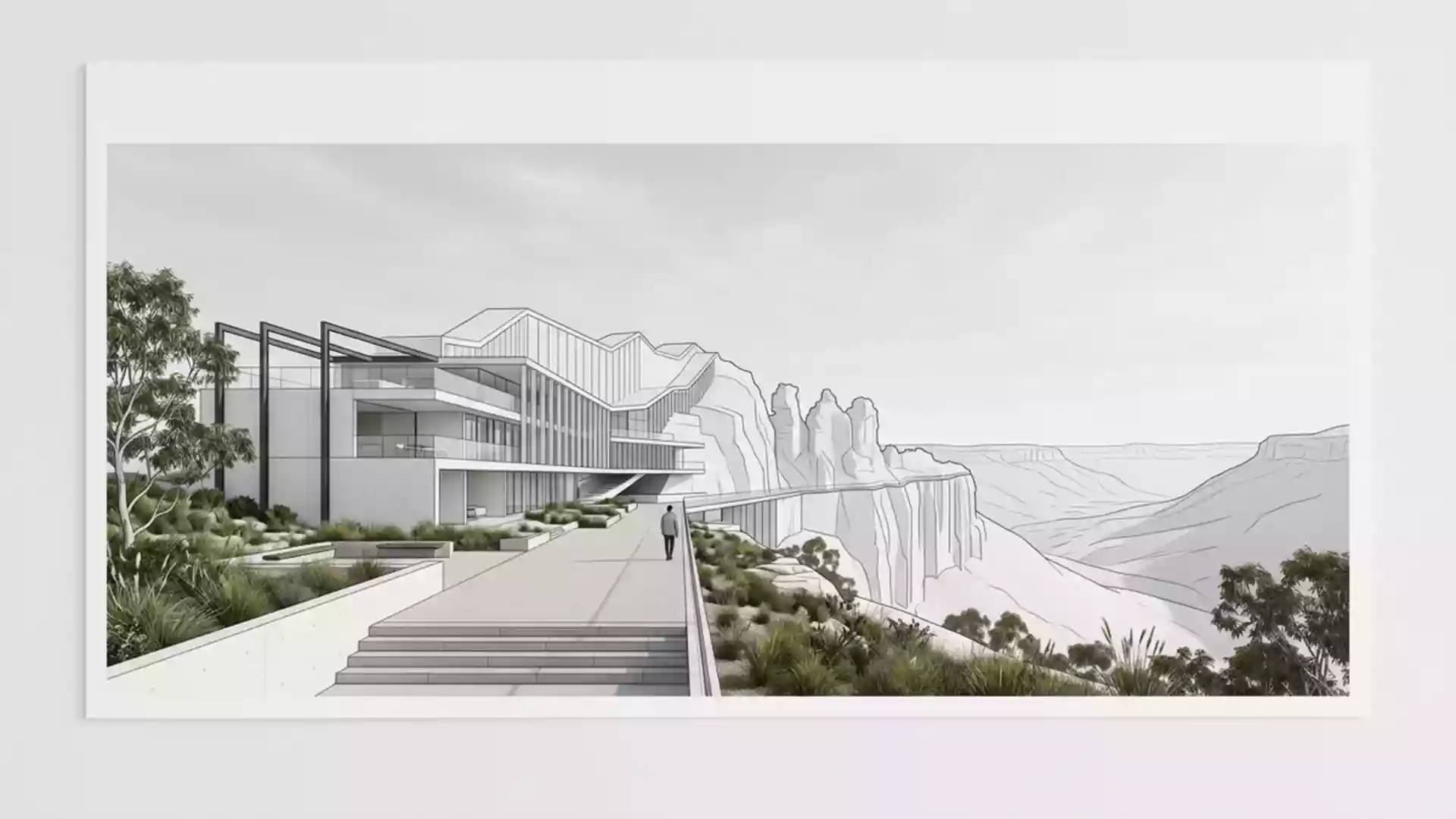
Blue Mountains sandstone cliffs and forests near Katoomba
Published on 09/14/2026 at 12:37 | Editorial responsibility: Rafael Müller, Editor-in-Chief AD HOC NEWS
West of Sydney, the Blue Mountains rise as a sandstone plateau cut by deep valleys and lined with cliffs, forming a vast forested landscape above towns such as Katoomba in New South Wales, Australia. The area is recognised as the Greater Blue Mountains Area, a World Heritage property inscribed in 2000 for its extensive eucalypt forests and dramatic landforms. Standing at Echo Point or another clifftop lookout, the scale of the plateau and the depth of the gorges set the tone for any visit to the Blue Mountains.
Sandstone plateau, cliffs and valleys
The defining feature of the Blue Mountains is a sandstone plateau incised by valleys and gorges that run for many kilometres across inland New South Wales. The Greater Blue Mountains Area covers over 1 million hectares of this landscape, stretching tens of kilometres north and south and more than 50 kilometres inland from Sydney, with elevations that bring cooler air and wide horizons over forested slopes.over 1.03 million hectares The cliffs are commonly described as sandstone, with faces dropping hundreds of metres into valleys that hold running water, cascades and stands of trees.
The World Heritage listing emphasises the deeply dissected nature of the plateau and its sandstone cliffs, gorges and tablelands, which together create a complex terrain of ridges and valleys.sandstone plateau and gorges In many places near Katoomba the cliff edge is accessible by formal lookouts, where visitors can see the layering of the rock and the way the plateau drops into wide valleys. From these points the contrast between flat tops and steep faces is clear, and the name “Blue Mountains” is linked to the blue-grey tone that hangs over the valleys, associated with fine vapour from eucalypt trees.
World Heritage forests and eucalypt diversity
Beyond the cliffs, the Blue Mountains are defined by temperate eucalypt forests that cover much of the plateau and its slopes. The Greater Blue Mountains Area was inscribed on the World Heritage List in 2000 under natural criteria that recognise exceptional biodiversity, especially the diversity of eucalypt species adapted to this dissected landscape.inscribed on the World Heritage List in 2000 The protected area includes several national parks and reserves, forming what is described as one of the largest tracts of protected bushland in south-eastern mainland Australia.one of the largest tracts of protected bushland
Walking tracks around Katoomba and other towns pass through stands of eucalypts, patches of heath and areas of temperate rainforest tucked into sheltered gullies. The World Heritage documentation notes that the Greater Blue Mountains include eight conservation reserves, among them Blue Mountains National Park, Wollemi National Park and Gardens of Stone National Park, linked across the plateau but divided by settled corridors and transport routes.eight protected areas in the World Heritage property For visitors, this translates into large areas of bushland where marked tracks, viewpoints and picnic areas offer access to forests without leaving the broader protected setting.
Katoomba and classic viewpoints
Katoomba stands as the main town in the City of Blue Mountains, serving as an administrative centre and as a base for travellers exploring the surrounding plateau and valleys.main town in the City of Blue Mountains It sits on the heights of the plateau, with streets leading out towards lookouts and bushland. Around the town, Blue Mountains National Park includes locations such as the clifftops above the Jamison Valley, where rock formations and waterfalls are visible from platforms set back from the edge.Blue Mountains National Park
One of the most recognised views from Katoomba is towards a group of sandstone pinnacles known as the Three Sisters, standing out from the cliff line above the Jamison Valley. Lookouts near the town frame these formations against the wider valley and the forest-covered slopes beyond. Around Katoomba, various walking tracks trace the top of the cliffs and drop partway down into the valley, meeting cascades and viewpoints. The combination of a town on the plateau and national park on its edge makes it straightforward to step from streets to cliff-top views and forest paths within a short walk or local journey.
Visiting Blue Mountains: what travellers from Western Europe should know
- The Blue Mountains lie west of Sydney in New South Wales, with Katoomba on the plateau and Blue Mountains National Park surrounding the town on several sides. Trains on the inter-city line run from Sydney’s Central Station to Katoomba, and roads link the town with other settlements along the ridge.
- Terrain around Katoomba includes clifftop paths, formal lookouts and bush tracks that may involve steep sections and stairways cut into the slopes. Some walks stay close to the plateau surface, while others descend towards valley floors, so footwear suitable for uneven ground is important.
- Several national parks and reserves form the Greater Blue Mountains Area around Katoomba and neighbouring towns, so visitors often move between different park sections when exploring waterfalls, lookouts and forest tracks near the plateau edge.
- The official language is English and the currency is the Australian dollar.
- Entry requirements depend on your nationality; UK travellers can check the FCDO travel advice at gov.uk/foreign-travel-advice, Irish travellers the Department of Foreign Affairs at ireland.ie.
Searching for Blue Mountains on social platforms
These links open searches for Blue Mountains on each platform.Frequently asked questions about Blue Mountains
Where are the Blue Mountains in relation to Katoomba?
The Blue Mountains form a sandstone plateau west of Sydney in New South Wales, and Katoomba is a town on the heights of this plateau.
What can visitors expect when exploring the Blue Mountains?
Visitors encounter sandstone cliffs, deep forested valleys and a mix of walking tracks and lookouts, with towns such as Katoomba providing access to nearby national park areas.
What makes the Blue Mountains distinctive among Australian landscapes?
The combination of extensive temperate eucalypt forests, dramatic sandstone cliffs and World Heritage recognition for the Greater Blue Mountains Area gives the region a distinctive character.