
Blue Mountains: Jamaica’s high spine above Kingston
Published on 09/17/2026 at 11:25 | Editorial responsibility: Rafael Müller, Editor-in-Chief AD HOC NEWS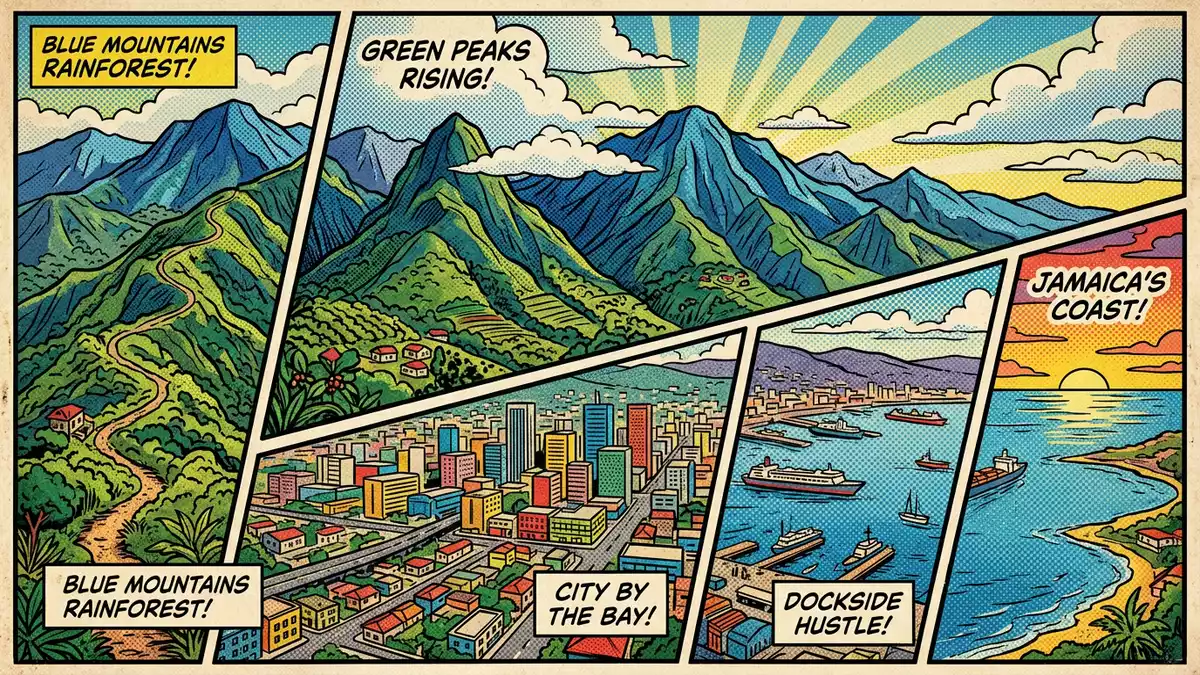
Rising behind Kingston, the Blue Mountains form a steep, forested spine that runs across eastern Jamaica and culminates in the island’s highest point, Blue Mountain Peak at 2,256 m (7,402 ft). Anyone looking north from the city sees the range as a continuous backdrop, its slopes changing from urban fringe to dense, misty woodland within a short climb. The mountains give Jamaica its most dramatic contrast between coastal lowland and upland ridge and have long shaped life in and around the capital.
Jamaica’s longest mountain range and its peak
The Blue Mountains are the longest mountain range in Jamaica, running eastwards from the hills above Kingston towards the Caribbean Sea and linking with the John Crow and Port Royal ranges to form a single highland system.longest mountain range in Jamaica The range extends for about 50 km (30 miles) from near Stony Hill north of Kingston to the far eastern tip of the island, rising steeply out of the coastal plain.extends for about 50 km
At its centre stands Blue Mountain Peak, Jamaica’s highest summit at 2,256 m (7,402 ft), set within the protected area of the Blue and John Crow Mountains National Park.Blue Mountain Peak at 2,256 metres The national park covers 41,198 hectares (101,313 acres) of primary forest and upland terrain, making it Jamaica’s only national park and a key refuge for native plants and wildlife.Jamaica’s only national park From Kingston, the higher slopes are visible as layers of ridges carrying thick vegetation, with the main crest marking the divide between the city’s basin and the north coast valleys beyond.
Forest, watersheds and a UNESCO-listed landscape
The upper Blue Mountains form part of the Blue and John Crow Mountains National Park, established in 1993 as Jamaica’s largest contiguous area of natural forest and later inscribed as a UNESCO World Heritage Site for its combined natural and cultural significance.largest contiguous area of natural forest The park protects a highland ecosystem with closed broad-leaf forest, steep ravines and a network of watersheds that feed rivers such as Buff Bay and Rio Grande, which cut northwards through the mountains.rivers on the north side
In 2015 the Blue and John Crow Mountains were designated a mixed World Heritage Site, the first of this type in the Caribbean, recognising both the biodiversity of the highland forests and the cultural heritage associated with Maroon communities who established settlements in the rugged terrain.inscribed as a UNESCO World Heritage Site in 2015 The park area covers a significant share of Jamaica’s land surface and forms an upland arc that encloses parts of the parishes of Portland, St Thomas, St Andrew and St Mary, giving the range a national importance that reaches beyond Kingston’s skyline.covers 4.5% of Jamaica’s land surface
Coffee farms, mountain roads and viewpoints above Kingston
For visitors based in Kingston, the lower slopes of the Blue Mountains are associated with coffee estates, hillside villages and viewpoints along winding roads that climb from the city’s eastern districts. Estates in areas such as Irish Town and Mavis Bank cultivate the high-altitude beans marketed as Jamaica Blue Mountain coffee, grown on steep plots within the cool, wet upland climate.estates producing coffee Travellers encounter a shift from concrete streets to narrow mountain lanes bordered by forest, terraced cultivation and occasional chapel towers or community centres.
Higher up, the landscape becomes more densely wooded, with sections of mist-shrouded forest and occasional clearings that offer views back over Kingston harbour and the plains beyond. Recreational areas such as Holywell and Portland Gap sit within the national park and serve as bases for shorter walks and picnics, while the trail to Blue Mountain Peak continues beyond them towards the summit crest.Holywell, Portland Gap and the Peak Trail The range’s slopes provide a cool counterpoint to the coastal heat, and the proximity to Kingston makes it a natural focus for day trips and longer hikes alike.
Visiting Blue Mountains: what travellers from Western Europe should know
- The Blue Mountains rise immediately north of Kingston on Jamaica’s eastern side, with access by road through districts such as Papine towards Irish Town and Newcastle.
- Mountain roads in the area are steep and narrow, with tight bends and changing gradients, and approaches to higher viewpoints or trailheads require sustained driving or organised transport.
- Walking routes on the upper slopes involve extended ascents on uneven paths, so sturdy footwear and comfort with prolonged uphill sections are important for exploring beyond the roadside viewpoints.
- English is the official language and the currency is the Jamaican dollar.
- Entry requirements depend on your nationality; UK travellers can check the FCDO travel advice at gov.uk/foreign-travel-advice, Irish travellers the Department of Foreign Affairs at ireland.ie.
Searching for Blue Mountains on social platforms
These links open searches for Blue Mountains on each platform.
Frequently asked questions about Blue Mountains
Where are the Blue Mountains in relation to Kingston?
The Blue Mountains rise directly north of Kingston, forming the high ridge that frames the city and extending eastwards across Jamaica’s eastern parishes.
What can visitors expect when exploring the Blue Mountains?
Visitors encounter steep mountain roads, coffee estates, forested slopes and viewpoints over Kingston, with higher areas lying inside the Blue and John Crow Mountains National Park.
What makes the Blue Mountains distinctive within Jamaica?
The Blue Mountains combine Jamaica’s highest peak, its only national park and a UNESCO-recognised highland landscape that links natural forest, watersheds and upland cultural history.


