

Biomuseo in Panama-Stadt: Frank Gehry’s colourful bridge to biodiversity
Published on 09/01/2026 at 16:18 | Editorial responsibility: Rafael Müller, Editor-in-Chief AD HOC NEWS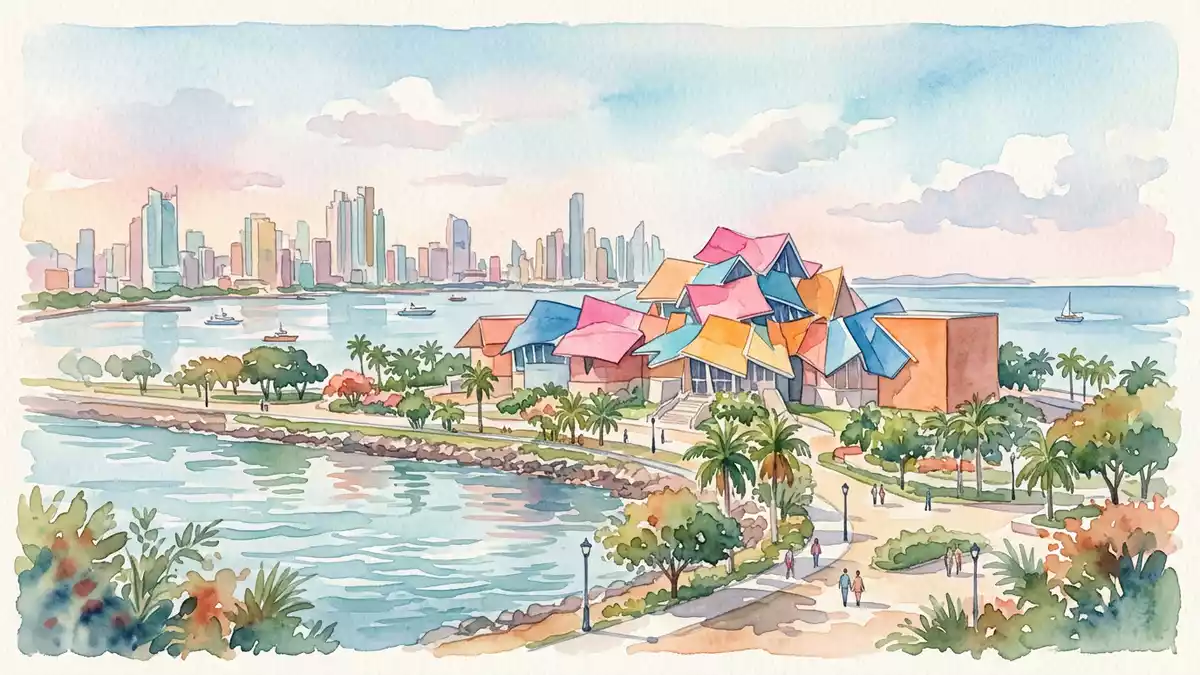
Biomuseo on the Amador Causeway in Panama-Stadt is a museum of biodiversity where architecture and natural history meet in a single colourful structure. Designed by Frank Gehry and opened in 2014, it introduces Panama’s role as a land bridge that reshaped the ecology of the Americas through a sequence of themed galleries.
A vivid Gehry landmark at the Pacific entrance to the canal
Biomuseo stands on the Amador Causeway at the Pacific entrance to the Panama Canal, a strip of land that reaches towards islands in the bay and frames views back to the city skyline and the Bridge of the Americas. The building was conceived as a landmark as much as a museum, with a composition of intersecting roof planes in bright colours that has become one of Panama-Stadt’s most recognisable silhouettes on the waterfront.museum focused on the natural history of Panama The overall footprint covers around 4,000 square metres (43,000 sq ft), allowing the exhibition sequence to unfold across several levels beneath the roof canopy.covers an area of about 4100 square meters
Frank Gehry’s authorship gives Biomuseo a clear place in contemporary architecture as his only completed building in Latin America and the tropics.designed by internationally renowned architect, Frank Gehry The sharp angles and overlapping forms of the roof recall his work elsewhere while responding to Panama’s intense light with saturated reds, yellows, blues and greens. Beneath this canopy, the structure incorporates open terraces, enclosed galleries and a central spine that draws visitors through the building.
Galleries tracing the story of Panama’s land bridge
Inside, Biomuseo presents eight permanent galleries that together narrate how the Isthmus of Panama emerged and altered life across the Western Hemisphere.There are 8 galleries in the space The spatial organisation revolves around a circulation route known as the Bridge of Life, an elevated walkway that links the different sections and offers views into the exhibitions and out towards the causeway.eight permanent galleries arranged along a central spine called the Bridge of Life
Each gallery approaches biodiversity from a different angle. One area functions as a showcase of species, bringing together specimens and models to illustrate the richness of Panama’s flora and fauna. Another, called Panamarama, uses multi-level projections to immerse visitors in the country’s ecosystems, surrounding them with images of forest, coast and ocean.Panamarama, a three-level projection space of Panamá’s ecosystems Further spaces explore geological formation, animal migrations between continents, human history and the division of the oceans, alongside an aquarium and a sculptural installation known as The Living Web.
Landscape, botanical park and the Amador waterfront
Biomuseo’s setting on the Amador Causeway connects its interior story of biodiversity with an outdoor landscape of water, planted areas and distant islands. The causeway itself runs out along a former breakwater that separates the open Pacific from the canal approach, so the museum stands where views take in shipping channels and coastal scenery at once.The Biomuseo is a museum that celebrates Panama's biological and cultural diversity Around the building, a botanical park extends the exhibition theme into the open air, with paths among native planting and outdoor displays.
The galleries and public atrium are complemented by a shop and café that look towards the waterfront, and large glazed areas frame views of the surrounding landscape. The combination of roof canopy, planted ground and water gives Biomuseo an atmosphere distinct from the business districts of Panama-Stadt, while remaining within reach of the city centre and the canal zone.4,000-square-meter space includes eight galleries, a public atrium, and a botanical park
Visiting Biomuseo: what travellers from Western Europe should know
- Biomuseo stands on the Amador Causeway at the Pacific entrance to the Panama Canal, south-west of central Panama-Stadt, and is reached by road, taxi or bus services that run from the Albrook transport hub.
- The museum interior is spread over several levels, with ramps, stairs and an elevated Bridge of Life walkway, and the surrounding botanical park involves walking on outdoor paths under the colourful roof canopy.
- The official language is Spanish and the currency is the Panamanian balboa, which circulates alongside the United States dollar.
- Entry requirements depend on your nationality; UK travellers can check the FCDO travel advice at gov.uk/foreign-travel-advice, Irish travellers the Department of Foreign Affairs at ireland.ie.
Searching for Biomuseo on social platforms
These links open searches for Biomuseo on each platform.
Frequently asked questions about Biomuseo
Where is Biomuseo located in Panama-Stadt?
Biomuseo is located on the Amador Causeway at the Pacific entrance to the Panama Canal, south-west of central Panama-Stadt, facing the bay and nearby islands.
What can visitors expect inside Biomuseo?
Visitors encounter eight permanent galleries connected by the Bridge of Life walkway, with projections, specimens, an aquarium, a sculptural installation and a botanical park outside.
What makes Biomuseo distinctive among museums?
Biomuseo combines Frank Gehry’s colourful, angular architecture with a focused narrative about Panama’s biodiversity and its role as a land bridge between continents.


