
Biomuseo in Panama-Stadt: Frank Gehry’s coloured canopy of biodiversity
Published on 09/22/2026 at 03:42 | Editorial responsibility: Rafael Müller, Editor-in-Chief AD HOC NEWS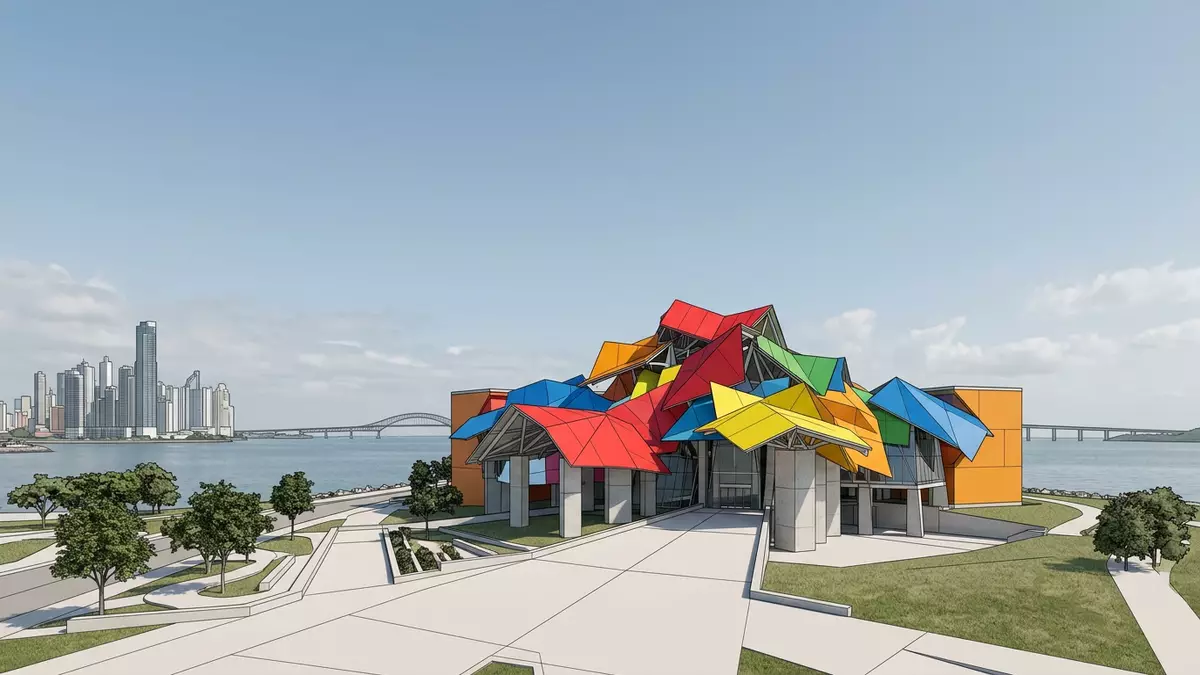
Biomuseo on the Amador Causeway in Panama-Stadt is a museum of biodiversity housed in a building by architect Frank Gehry, completed in 2014. Its brightly coloured steel canopies create a sculptural silhouette at the Pacific entrance to the Panama Canal, sheltering galleries that explore how the Isthmus of Panama reshaped life across the Americas.
Frank Gehry’s first Latin American museum
Biomuseo stands on the Amador Causeway, a waterside road built on a string of small islands that extend into the Pacific from the edge of Panama-Stadt. From this peninsula the museum faces the city skyline on one side and looks towards the southern entrance of the Panama Canal on the other, placing visitors between urban towers and transoceanic shipping lanes.Amador Causeway location
The building is the Museum of Biodiversity, conceived as a cultural centre dedicated to the ecological and geological history of Panama. Frank Gehry and his practice Gehry Partners led the architecture, working with collaborators including Bruce Mau Design on the exhibitions and landscape architect Edwina von Gal on the surrounding botanical park.Designed by Frank Gehry The project is described as Gehry’s first completed commission in Latin America, adding Panama-Stadt to a portfolio that already included the Guggenheim Museum Bilbao and the Walt Disney Concert Hall in Los Angeles.first completed building in Latin America
Coloured steel canopies and orthogonal galleries
The most striking feature of Biomuseo is its roofscape, a collision of angular metal canopies painted in saturated reds, yellows, blues and greens. These overlapping planes rise and fall above the museum in different directions, forming a jagged outline that is visible from ships, ferries and the shoreline along the causeway.multicoloured roof panels The canopies are supported by steel structures and shelter an open-air public atrium, giving the museum a covered outdoor space that remains visually connected to the canal and the city.
Beneath the roof, the museum is organised around a central atrium. Around this space, a sequence of galleries with more regular, box-like forms contains exhibitions on geology, ecology and human history. The permanent displays were developed by Bruce Mau Design and occupy several thousand square metres of interior space, alongside areas for temporary exhibitions, a shop, café and educational facilities.eight galleries and exhibition space Outside, paths lead through a botanical park planted with species that reflect Panama’s tropical environment, extending the museum’s themes into the landscape.
Telling the story of Panama’s land bridge
Biomuseo is dedicated to explaining how the Isthmus of Panama emerged from the sea and altered global biodiversity. The museum’s galleries address the geological formation of the isthmus, the mixing and migration of species between North and South America, and the environmental consequences of linking two continents while separating an ocean into different basins.Museum of Biodiversity in Panama
The mission statements published by Biomuseo describe an institution that presents Panama’s biological and cultural diversity and emphasises the country’s role as a crossroads for species and cultures.museum mission The exhibitions trace the appearance of the land bridge several million years ago and its impact on ecosystems across the Americas, connecting scientific research to accessible displays and installations.
Visiting Biomuseo: what travellers from Western Europe should know
- Biomuseo stands on the Amador Causeway south-west of central Panama-Stadt, at the Pacific entrance to the Panama Canal, and is reached by road and local bus services.
- The museum’s main interior spaces are arranged around a central atrium, with stairs and ramps linking the different gallery levels.
- Outside the building, paths in the botanical park run over gently sloping ground near the shoreline, with views towards the canal and the city.
- The official language is Spanish and the national currency is the Panamanian balboa, which circulates alongside the United States dollar.
- Entry requirements depend on your nationality; UK travellers can check the FCDO travel advice at gov.uk/foreign-travel-advice, Irish travellers the Department of Foreign Affairs at ireland.ie.
Searching for Biomuseo on social platforms
These links open searches for Biomuseo on each platform.Frequently asked questions about Biomuseo
Where is Biomuseo located in Panama-Stadt?
Biomuseo is located on the Amador Causeway, a peninsula extending into the Pacific at the southern entrance to the Panama Canal, south-west of central Panama-Stadt.
What can visitors expect inside Biomuseo?
Visitors encounter galleries arranged around a central atrium, with exhibitions on the geological formation of the Isthmus of Panama, biodiversity across the Americas and Panama’s cultural diversity.
What makes Biomuseo distinctive among museums?
Biomuseo combines Frank Gehry’s multicoloured steel canopies and atrium with a scientific focus on Panama’s land-bridge story, creating a museum where architecture and biodiversity themes are closely intertwined.


