
Biomuseo in Panama-Stadt and the colours of biodiversity
Published on 09/18/2026 at 20:26 | Editorial responsibility: Rafael Müller, Editor-in-Chief AD HOC NEWS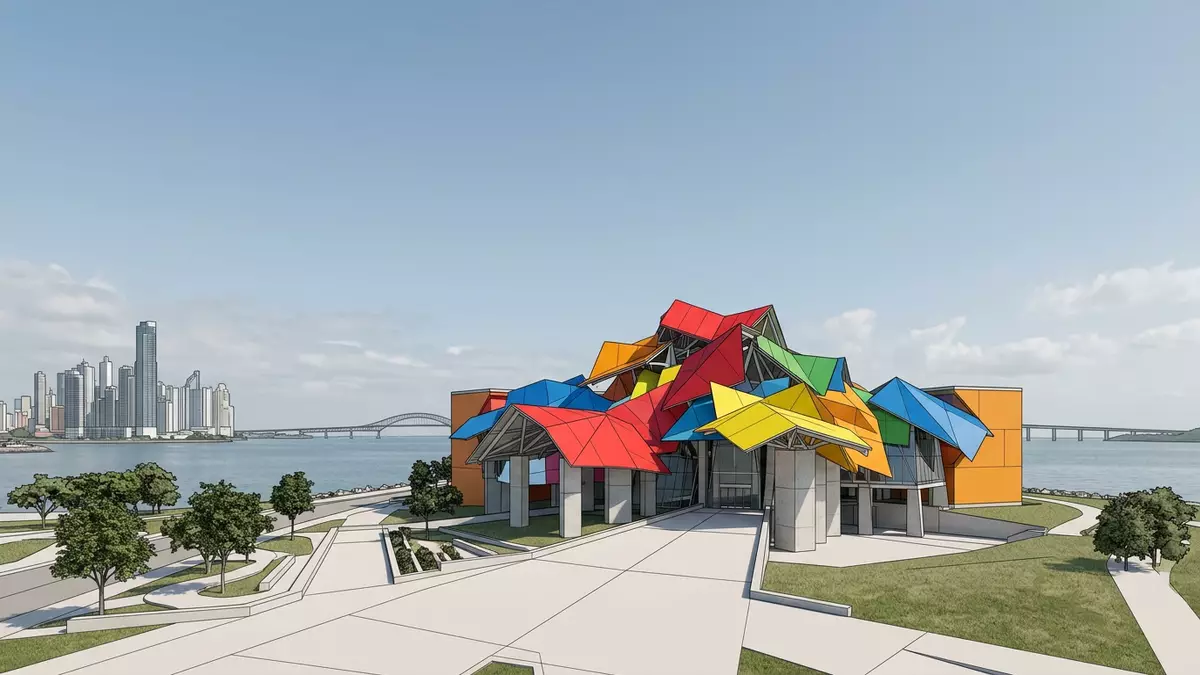
On the Amador Causeway at the Pacific entrance to the Panama Canal, Biomuseo in Panama-Stadt is a museum where colourful metal roof planes frame Panama’s biodiversity and geological story. Designed by Canadian-born architect Frank Gehry as his first building in Latin America, the museum opened in 2014 and has become a prominent landmark on this reclaimed peninsula.
Frank Gehry’s tropical museum on the canal
Biomuseo occupies a site on the Amador Causeway, a strip of land extending into the Pacific at the southern gateway to the Panama Canal, with views back to Panama-Stadt and towards the Bridge of the Americas. The building stands on ground that forms part of a peninsula at the canal entrance, giving the museum a direct relationship with the maritime setting and the shipping route that has shaped Panama’s modern identity.The Amador Causeway location places Biomuseo among promenades, viewing points and leisure spaces created along this shoreline.
The museum was commissioned to Frank Gehry, whose practice Gehry Partners worked with collaborators to realise the project after a concept dating from 1999, and construction led to a public opening in October 2014.The design was conceived in 1999 and opened in 2014, making Biomuseo part of the early twenty-first century wave of expressive museum architecture. Gehry is widely associated with the Guggenheim Museum Bilbao and other sculptural buildings, and Biomuseo brings that language into a tropical context with bright colours and irregular roof planes.
Explosive geometry and colour in metal
The most striking aspect of Biomuseo is its roof structure, formed by overlapping sheets of metal in saturated reds, yellows, blues and greens that create a jagged, multi-layered profile above the galleries. These planes appear to tilt and fold at different angles, giving the museum a kaleidoscopic silhouette that is visible along the shoreline of the Amador Causeway and from vessels entering or leaving the canal.Statement architecture in primary colours turns the building itself into a visual symbol of biodiversity and variety.
Beneath the roof, the museum’s plan unfolds in a series of indoor galleries and outdoor spaces connected to a botanical garden. The built area is on the order of 4,000 m², configured to house eight permanent exhibition galleries and additional space for temporary shows, with circulation areas that open towards terraces and planted zones.Galleries and garden spaces create a sequence in which exhibition rooms alternate with views of the surrounding landscape and canal waters. Inside, high volumes accommodate installations and large-format displays about geology, ecology and species.
Panama’s isthmus and a museum of biodiversity
Biomuseo is a natural history museum dedicated to explaining how the Isthmus of Panama rose from the sea and reshaped life on Earth. The galleries present the story of the isthmus emerging between the Pacific Ocean and the Caribbean Sea, connecting North and South America, splitting a larger ocean in two and altering currents and habitats in ways that affected biodiversity across the Western Hemisphere.The museum’s narrative centres on this geological event and its ecological consequences.
Displays and interpretive installations explore Panama’s species richness and its role as a land bridge between continents. Exhibition content has been developed to highlight the variety of ecosystems found in Panama, from tropical forests to coastal environments, and to relate them to broader patterns of migration and evolution. Aquariums within the museum show marine life from both the Pacific and the Caribbean, giving visitors a sense of the contrast between the two bodies of water that the isthmus divides.Permanent galleries and aquariums are arranged over multiple levels, creating varied vantage points on objects and graphics.
Visiting Biomuseo: what travellers from Western Europe should know
- Biomuseo stands on the Amador Causeway on the Pacific side of Panama-Stadt, at the canal’s southern entrance; it is reached by road from the city and by local bus routes serving Amador.
- Approaching the museum on foot involves walking along paved causeway promenades; inside, access to upper levels includes staircases and internal ramps between the exhibition spaces.
- Biomuseo lies outside the UK, Ireland and the EU. Entry requirements depend on your nationality; UK travellers can check the FCDO travel advice at gov.uk/foreign-travel-advice, Irish travellers the Department of Foreign Affairs at ireland.ie.
- The museum is in Panama, where the official language is Spanish and the currency is the Panamanian balboa, used alongside the US dollar.
- Nearby along the Amador Causeway are views towards the Bridge of the Americas and islands in the bay, as well as other leisure facilities and waterfront paths.
Searching for Biomuseo on social platforms
These links open searches for Biomuseo on each platform.
Frequently asked questions about Biomuseo
Where is Biomuseo located in Panama-Stadt?
Biomuseo is located on the Amador Causeway at the Pacific entrance to the Panama Canal, a short distance from central Panama-Stadt.
What can visitors expect inside Biomuseo?
Visitors encounter permanent galleries about Panama’s geology and biodiversity, aquariums showing marine life from two oceans, and outdoor botanical garden spaces connected to the building.
What makes Biomuseo distinctive among museums?
Biomuseo is distinctive for Frank Gehry’s brightly coloured metal roof composition and for its focused narrative on the formation of the Isthmus of Panama and its global ecological impact.


