
Biomuseo: Frank Gehry’s riot of colour on the Panama Canal
Published on 09/19/2026 at 09:53 | Editorial responsibility: Rafael Müller, Editor-in-Chief AD HOC NEWS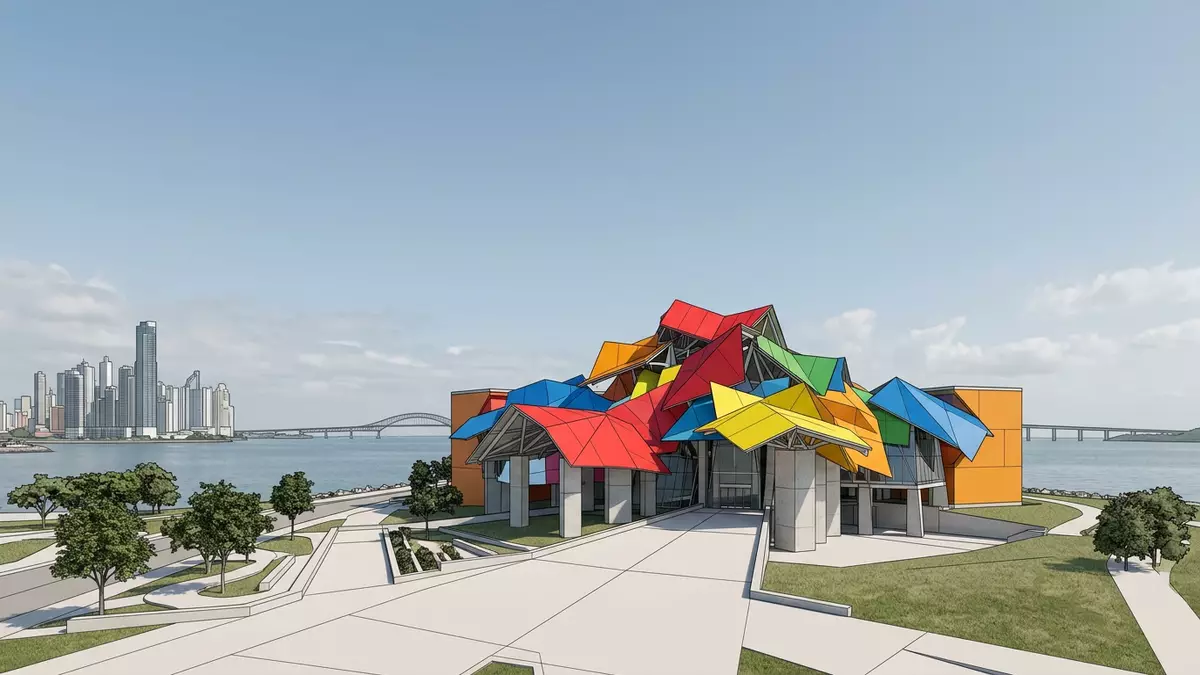
On the Amador Causeway in Panama-Stadt, Biomuseo rises above the waterfront as a cascade of brightly coloured metal roofs framing views towards the Panama Canal. Designed by architect Frank Gehry and opened to the public in 2014, the museum explores how the narrow isthmus of Panama transformed biodiversity across the Americas.
Frank Gehry’s first Latin American museum
Biomuseo is a natural history museum devoted to Panama’s biological and cultural diversity, housed in a building conceived by Canadian-born architect Frank Gehry, working with his practice Gehry Partners.natural history museum The project gave Gehry his first completed commission in Latin America, adding Panama-Stadt to a portfolio that already included the Guggenheim Museum Bilbao and the Walt Disney Concert Hall in Los Angeles.first work in Latin America
The design was developed in the early 2000s and the museum opened in October 2014 after an extended construction period lasting more than a decade.opened in October 2014 Gehry Partners collaborated with exhibition designers from Bruce Mau Design, structural engineers, mechanical consultants and a local Panamanian architect to bring the complex steel structure and interior galleries to completion.Gehry Partners and collaborators
A collision of vivid roofs and open spaces
From a distance, Biomuseo is defined by a group of overlapping, angular roof planes in saturated reds, blues, yellows, greens and other colours, set above a base of concrete and steel structural frames.folded metal canopies The roofscape creates a jagged silhouette against the tropical sky and the waters at the Pacific entrance to the Panama Canal, making the building legible from ships and from the city’s seafront drives.multicoloured roof arrangement
Beneath these canopies, a central open-air atrium forms the heart of Biomuseo, with exhibition galleries arranged around it.open-air atrium and galleries The structure stands on a relatively low-lying site along the causeway, surrounded by water on several sides, and is accompanied by an outdoor botanical park shaped by landscape architect Edwina von Gal, where planting echoes themes from the indoor displays.botanical park
Galleries about an isthmus that changed the world
Inside the museum, exhibitions explain how the rise of the Isthmus of Panama linked North and South America and divided the oceans, with far-reaching effects on climate, species migration and ecosystems. Eight galleries were master-planned by Bruce Mau Design to interpret this story using large-scale models, immersive installations and scientific displays.eight galleries The scientific content was developed in collaboration with scientists from the University of Panama and the Smithsonian Tropical Research Institute, ensuring that geological and biological narratives are anchored in contemporary research.scientists and designers
The galleries form a sequence that moves from the geological formation of the isthmus through the arrival and diversification of species, towards contemporary questions about conservation and environmental change. Large sculptural installations, including representations of extinct and living animals, occupy double-height spaces under the coloured roofs, linking the interior experience to the building’s expressive exterior. Text, models and multimedia elements emphasise Panama’s role as a bridge between continents and a crossroads of cultures, mirroring the country’s position on global shipping routes through the Canal.
Visiting Biomuseo: what travellers from Western Europe should know
- Biomuseo stands on the Amador Causeway, a strip of land projecting into the Pacific at the entrance to the Panama Canal, south-west of the historic core of Panama-Stadt. The site is reached by road from the city and is signposted along the causeway.
- The building is spread across multiple levels connected by staircases and ramps, with the central atrium opening to the outside under the shelter of the roofs. Visitors move between indoor galleries and outdoor walkways, so movement involves both covered and exposed areas.
- Nearby features include views towards the Bridge of the Americas, the islands linked by the causeway and the shipping lanes leading into the Canal, all visible from points around the museum.
- The official language is Spanish and the currency is the Panamanian balboa, which circulates alongside the United States dollar.
- Entry requirements depend on your nationality; UK travellers can check the FCDO travel advice at gov.uk/foreign-travel-advice, Irish travellers the Department of Foreign Affairs at ireland.ie.
Searching for Biomuseo on social platforms
These links open searches for Biomuseo on each platform.
Frequently asked questions about Biomuseo
Where is Biomuseo located?
Biomuseo is located on the Amador Causeway in Panama-Stadt, facing the Pacific entrance to the Panama Canal and reached by road from the city.
What can visitors expect inside Biomuseo?
Visitors encounter a sequence of galleries with models, installations and scientific displays explaining how Panama’s isthmus formed and how it shaped biodiversity across the region.
What makes Biomuseo distinctive among museums?
Biomuseo stands out for its combination of Gehry’s multicoloured steel-and-concrete architecture, its waterfront setting on the Canal and its focused story about Panama’s global ecological influence.


