

Biomuseo: Frank Gehry’s colourful gateway to Panama’s biodiversity
Published on 08/28/2026 at 12:46 | Editorial responsibility: Rafael Müller, Editor-in-Chief AD HOC NEWS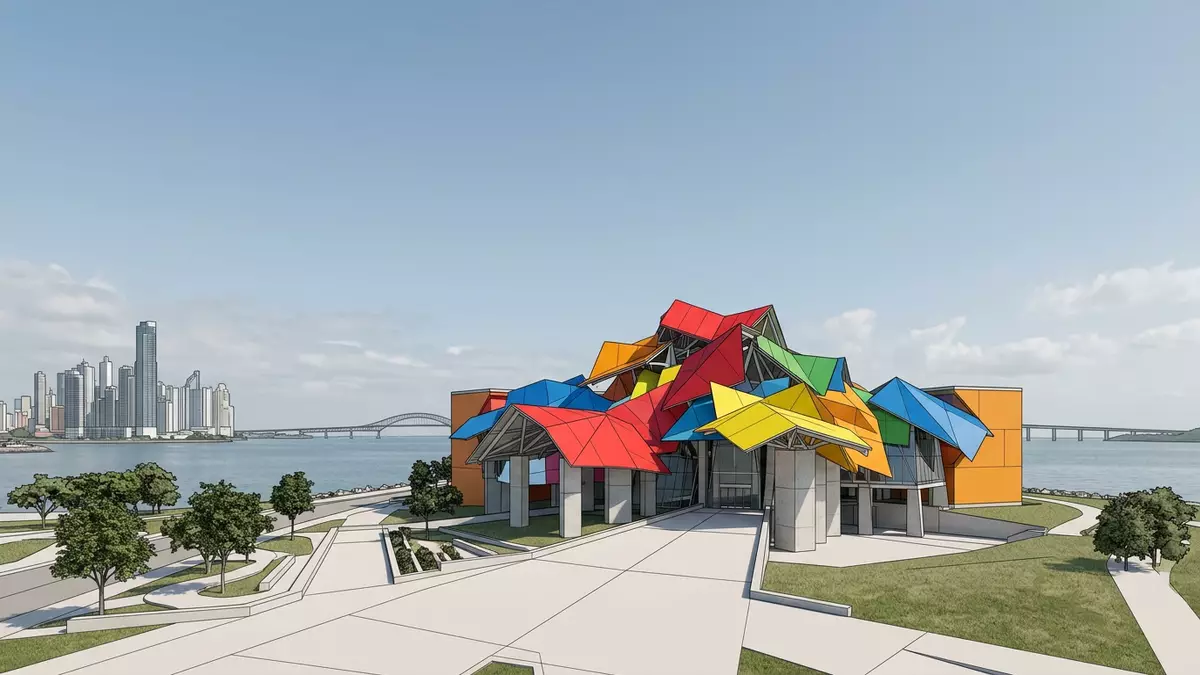
On the Amador Causeway at the Pacific entrance to the Panama Canal, Biomuseo combines Frank Gehry’s vivid architecture with a museum dedicated to Panama’s extraordinary biodiversity.Frank Gehry conceived the project in 1999, and the museum opened to the public in October 2014 as his first built work in Latin America.opened in October 2014
An explosion of colour on the Amador Causeway
Biomuseo stands on Panama-Stadt’s Amador Causeway, a strip of reclaimed land reaching into Panama Bay towards the Pacific entrance of the canal.set on the Amador Causeway Gehry’s building appears as a collage of bold, angular volumes, capped by overlapping metal roofs in strong colours such as blue, red, yellow and green.vibrant multicoloured building From the causeway it reads as a cluster of intersecting forms, with the canopies dropping at different heights so that some frame views of the bay and others shelter walkways and terraces.
At the centre of the complex sits an open public atrium, covered by the coloured canopies and edged by broad stairways and ramps.outdoor public atrium Around it, the museum’s indoor galleries occupy prismatic volumes clad in neutral panels, while open-sided corridors and balcony-like platforms connect the interior with the surrounding botanical park and views towards the canal.
Panama as a “bridge of life”
Biomuseo is a museum of biodiversity, focusing on the rise of the Isthmus of Panama and its impact on life and climate in the Americas.biodiversity museum The permanent exhibition, titled “Panama: Bridge of Life”, is organised into eight galleries that trace the geological formation of the isthmus, the mixing of species between continents and the relationship between biological and human history.Panama: Bridge of Life
Among the named spaces is the Gallery of Biodiversity, which introduces Panama’s natural heritage with a large multicoloured glass wall showing plants and animals from across the country.Biodiversity Gallery Panamarama is a three-level projection room with ten screens, immersing visitors in audiovisual sequences of forests, coasts and wetlands.ten-screen projection room Other galleries such as Building the Bridge and Worlds Collide use rock formations, sculptural groups of animals, aquariums and interactive displays to tell the story of the isthmus rising from the sea and the resulting exchange of species between North and South America.Worlds Collide
Architecture, landscape and exhibits
The museum building forms part of a wider landscape project, with a botanical park laid out around the structure and along the waterfront.botanical park Paths lead through planted areas towards viewpoints over Panama Bay and the entrance to the canal, and outdoor exhibits such as the Human Path gallery extend portions of the storyline into the open air.Human Path Within the indoor galleries, semi-cylindrical aquariums and smaller tanks show how the Pacific Ocean and Caribbean Sea evolved differently after they were separated by the rising land bridge.semi-cylindrical aquariums
A large sculpture around 15 m (49 ft) high combines plants, animals, insects and microorganisms, creating an environment in which species appear at equal scale and importance.15-metre sculpture Interactive elements including touchscreens, motion sensors and projected images invite visitors to explore links between biological and cultural diversity in Panama, while outdoor panels and murals present the routes of migratory birds across the Americas and the country’s role in those journeys.migratory birds across the American continent
Visiting Biomuseo: what travellers from Western Europe should know
- Biomuseo stands on the Amador Causeway, a waterfront roadway extending from central Panama-Stadt towards islands at the Pacific entrance to the canal; taxis and local buses serve the causeway.
- The museum building is arranged over multiple levels, with stairways, ramps and walkways connecting the central atrium, indoor galleries and outdoor terraces.
- Paths in the surrounding botanical park follow gentle gradients but can involve extended walking between the museum, viewpoints over Panama Bay and the canal entrance.
- The official language is Spanish and the currency is the Panamanian balboa, which is pegged to the US dollar and circulates alongside US dollar banknotes.
- Entry requirements depend on your nationality; UK travellers can check the FCDO travel advice at gov.uk/foreign-travel-advice, Irish travellers the Department of Foreign Affairs at ireland.ie.
Searching for Biomuseo on social platforms
These links open searches for Biomuseo on each platform.
Frequently asked questions about Biomuseo
Where is Biomuseo located in Panama-Stadt?
Biomuseo is located on the Amador Causeway, a waterfront road projecting into Panama Bay near the Pacific entrance to the Panama Canal, a short drive from central Panama-Stadt.
What can visitors expect inside Biomuseo?
Visitors encounter galleries combining large-scale installations, aquariums, projections and interactive media that explain how the Isthmus of Panama formed, how species moved between continents and how biodiversity and human history are linked.
What makes Biomuseo distinctive among museums?
The museum stands out through Frank Gehry’s brightly coloured, angular building on the Amador Causeway and its focused storyline about Panama as a bridge of life connecting oceans and continents.


