
Biomuseo: Frank Gehry’s burst of biodiversity on Panama’s Amador Causeway
Published on 09/12/2026 at 13:07 | Editorial responsibility: Rafael Müller, Editor-in-Chief AD HOC NEWS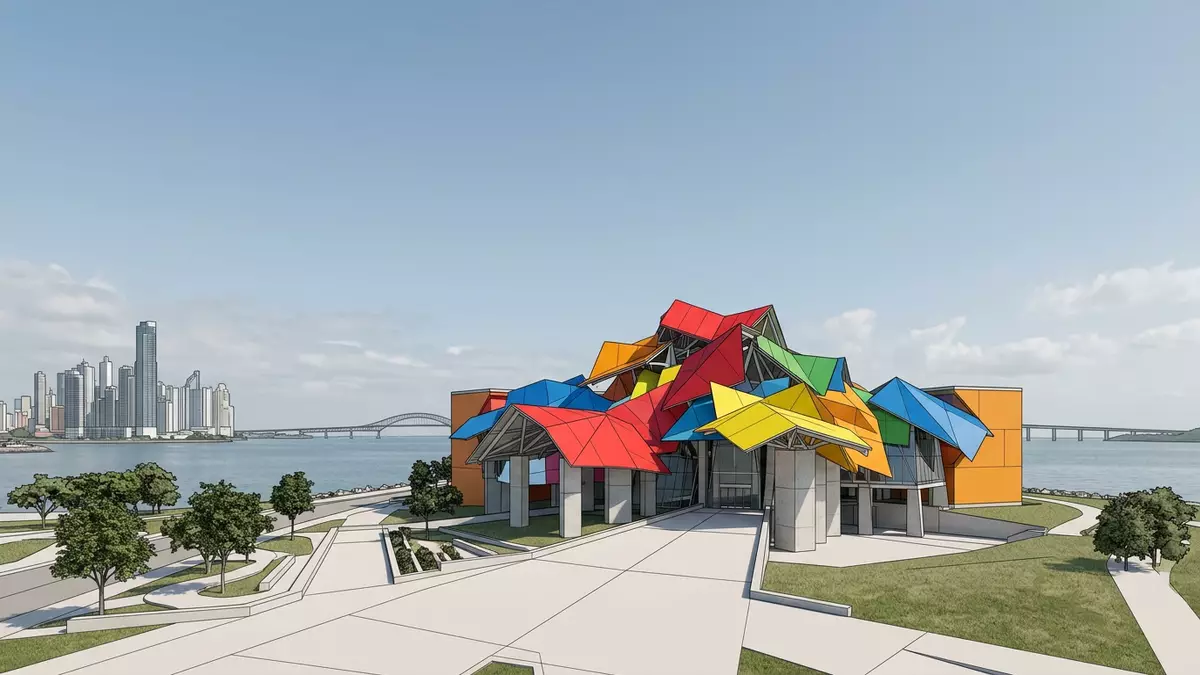
Biomuseo in Panama-Stadt is a museum of natural history and biodiversity where Frank Gehry’s brightly coloured roofscape announces Panama’s role as a crossroads of continents and oceans. Opened in 2014 on the Amador Causeway at the Pacific entrance to the Panama Canal, it brings geology, ecology and human history together under a single, emphatically sculptural structure.
Architecture in vivid colour on the canal’s edge
Biomuseo stands in Amador, the causeway that reaches out into the Bay of Panama towards islands at the Pacific entrance to the canal. The museum occupies a site close to the mainland end of this strip of land, with views to Panama-Stadt’s skyline and the shipping lanes that frame the canal’s ocean gateway.Located on the Amador Causeway
The building was designed by Frank Gehry, the Canadian-born architect whose earlier works include the Guggenheim Museum Bilbao. At Biomuseo he uses interlocking metal canopies in strong colours, layered above box-like gallery volumes, to give the museum a presence that is visible from land and water alike.Designed by world-renowned architect Frank Gehry The museum is described as his first completed building in Latin America, tying an internationally recognised name directly to Panama’s biodiversity story.Frank Gehry's first design in Latin America
Galleries that trace Panama’s geological and ecological story
Inside Biomuseo, the exhibition sequence focuses on how the Isthmus of Panama emerged from the sea and reshaped life on Earth. The museum presents Panama as a bridge between North and South America, and as a divide between the Atlantic and Pacific, explaining how this narrow strip of land altered ocean currents and species migration.
The permanent exhibition is organised into themed galleries that lead visitors through this story. These include a space presenting Panama’s ecosystems in immersive projections, an area on the geological formation of the isthmus, galleries exploring the movement of animals between the continents, sections on human history in the region, an aquarium-style installation on the oceans on either side of the land bridge and a sculptural installation representing interconnected life.There are 8 galleries in the space Exhibition design contributions by Bruce Mau give the interior a contemporary graphic and spatial language that complements Gehry’s exterior forms.The exhibitions designed by Bruce Mau
A museum dedicated to biodiversity and national identity
Biomuseo is formally dedicated to biodiversity, presenting itself as a museum that celebrates Panama’s biological and cultural diversity and explains how the country’s geography has had far-reaching global effects.A museum that celebrates Panama's biological and cultural diversity Its mission statement speaks of motivating Panamanians to recognise biodiversity as part of their identity and of encouraging visitors to value and protect the environment.The mission of the Biomuseo
The museum is operated by the Amador Foundation, a non-profit organisation established in 2000 to oversee the building and its programmes.The Amador Foundation is a non-profit organisation With a floor area of around 4,000 square metres (43,000 sq ft), it combines indoor exhibition halls with outdoor spaces, including terraces and planted areas that extend the biodiversity theme beyond the gallery walls.The 4,000-square-metre biomuseum
Visiting Biomuseo: what travellers from Western Europe should know
- Biomuseo stands on the Amador Causeway at the southern entrance to the Panama Canal, south-west of central Panama-Stadt, and is reached by road, taxi or bus services that run between the city and Amador.
The C850 bus route links the Albrook Line 1 metro station with the causeway. - The museum building rises above a paved forecourt with ramps and stairways leading to the entrance, and the interior includes multi-level galleries linked by corridors and staircases.
- Nearby landmarks include marinas and walkways along the Amador Causeway, with views to the Pacific entrance of the canal and the islands off Panama-Stadt.
- The official language is Spanish and the currency is the Panamanian balboa, which is pegged to the US dollar and circulates alongside it.
- Entry requirements depend on your nationality; UK travellers can check the FCDO travel advice at gov.uk/foreign-travel-advice, Irish travellers the Department of Foreign Affairs at ireland.ie.
Searching for Biomuseo on social platforms
These links open searches for Biomuseo on each platform.
Frequently asked questions about Biomuseo
Where is Biomuseo located in Panama-Stadt?
Biomuseo stands on the Amador Causeway at the Pacific entrance to the Panama Canal, south-west of central Panama-Stadt.
What can visitors expect inside Biomuseo?
Visitors encounter a series of themed galleries, projection spaces, an aquarium installation and sculptural exhibits explaining Panama’s geological formation, biodiversity and human history.
What makes Biomuseo distinctive among museums?
The combination of Frank Gehry’s colourful, angular architecture with a dedicated focus on Panama’s role in global biodiversity gives Biomuseo a character closely tied to its location and subject.


