
Biltmore Estate and its grand house in the Blue Ridge Hills
Published on 09/17/2026 at 21:42 | Editorial responsibility: Rafael Müller, Editor-in-Chief AD HOC NEWS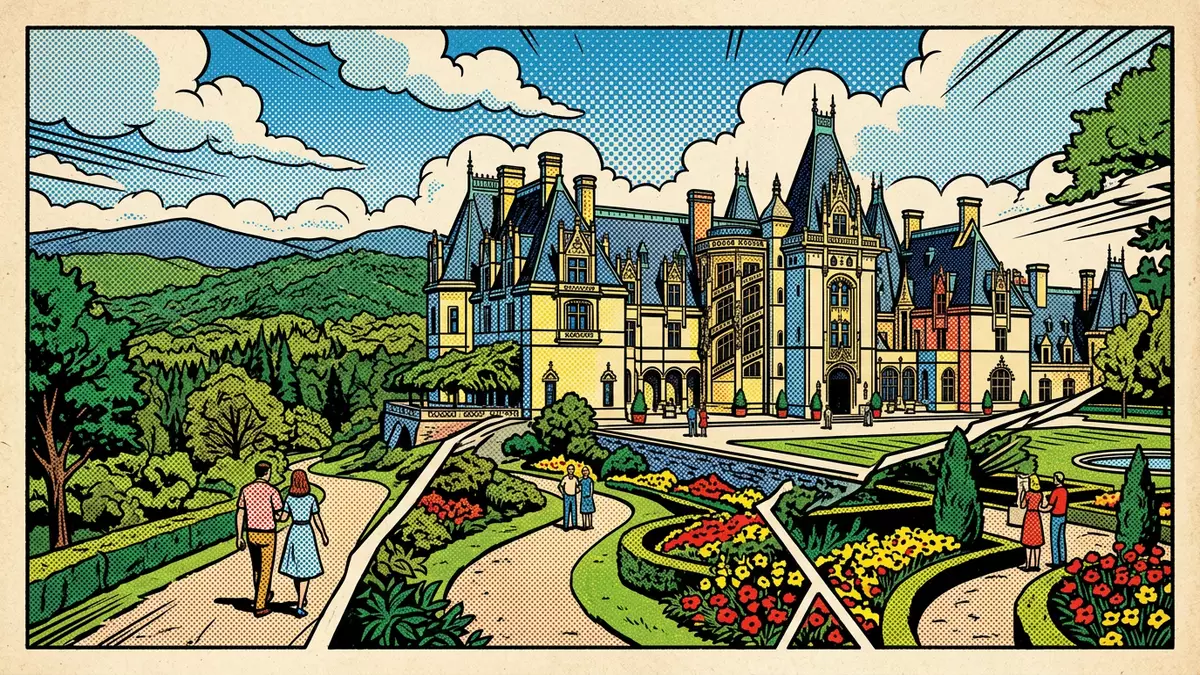
The vast country estate outside Asheville in North Carolina centres on an enormous French Renaissance house set in landscaped grounds and forested hills. Built for George Washington Vanderbilt II in the late nineteenth century, the ensemble links architecture, gardens and working land in one continuous landscape.
A French Renaissance mansion in the Blue Ridge Mountains
The great house at the heart of the estate is a French Renaissance château designed for George Washington Vanderbilt II, grandson of Cornelius Vanderbilt, by architect Richard Morris Hunt.French Renaissance mansion Construction of the building began in 1889 and it was completed in 1895, giving it a clear place in the architectural history of the late nineteenth century.completed in 1895
The house contains around 250 rooms arranged across several storeys, including reception halls, bedrooms, service spaces and recreational areas.250-room residence Its plan draws on the tradition of large European country houses, with a sequence of formal rooms and long corridors opening towards terraces and gardens. The exterior combines towers, sculpted stonework and steeply pitched roofs, while the interior includes a wide staircase, an indoor pool and an array of fireplaces set into carved surrounds.
From private retreat to historic estate
George Vanderbilt began acquiring land near Asheville in the 1880s, eventually assembling an estate of around 125,000 acres that rose above the French Broad River and extended into the surrounding hills.125,000 acres Work on the house started in 1889, and he welcomed his family and guests there for the first time at Christmas in 1895.welcomed his friends and family
In 1914, after George Vanderbilt’s death, his wife Edith sold tens of thousands of acres to the federal government, land that contributed to the formation of Pisgah National Forest to the south of Asheville.sold land to the U.S. Forest Service The family opened the estate to visitors in 1930, turning the house into a historic museum while keeping the wider property under family management.opened to the public in 1930 The Biltmore Estate was designated a National Historic Landmark in 1963 and added to the U.S. National Register of Historic Places in 1966, confirming its status as a major site of American architectural and landscape history.National Historic Landmark designation
Gardens, forestry and wine on the estate
The grounds around the house were laid out by Frederick Law Olmsted, the landscape architect known for Central Park in New York and many other American parks.formal gardens planned by Olmsted He planned a sequence of formal gardens near the house and more naturalistic planting beyond, running into woodland and agricultural land. Vanderbilt worked with Olmsted and forester Gifford Pinchot on the management of the surrounding forest, creating one of the first large scale managed forests in the United States on the slopes and ridges around the estate.first large scale managed forest
Vineyards and a winery add a further layer to the estate’s working landscape. A vineyard was established on the property in 1971, and the Biltmore Estate Wine Company began operating in the 1980s in buildings that had previously housed the estate dairy.Biltmore Estate Wine Company Alongside wine production, the wider property now includes accommodation, restaurants and shops grouped in a small village area, with farm fields, forest and trails extending across around 8,000 acres of remaining estate land.estate size reduced to approximately 8,000 acres
Visiting Biltmore Estate: what travellers from Western Europe should know
- The estate lies south of central Asheville in western North Carolina, reached by road routes that follow the French Broad River towards the Blue Ridge Mountains.
- The grounds include formal gardens, forest trails and farm areas, so a visit can involve walking over uneven paths and gentle slopes between the house and the outlying facilities.
- The official language is English and the currency is the United States dollar.
- Entry requirements depend on your nationality; UK travellers can check the FCDO travel advice at gov.uk/foreign-travel-advice, Irish travellers the Department of Foreign Affairs at ireland.ie.
Searching for Biltmore Estate on social platforms
These links open searches for Biltmore Estate on each platform.
Frequently asked questions about Biltmore Estate
Where is Biltmore Estate located?
The estate lies just outside Asheville in western North Carolina, in the United States, with its grounds extending across hills above the French Broad River.
What can visitors expect on a visit?
A visit combines the large French Renaissance house with formal gardens, woodland, farm areas and a working winery, set within extensive managed estate land.
What makes Biltmore Estate distinctive?
The site is distinctive for its combination of a Châteauesque house by Richard Morris Hunt, landscaped grounds by Frederick Law Olmsted and large-scale forest and vineyard management on one property.


