
Biltmore Estate, a grand American château in the Blue Ridge
Published on 09/16/2026 at 10:24 | Editorial responsibility: Rafael Müller, Editor-in-Chief AD HOC NEWS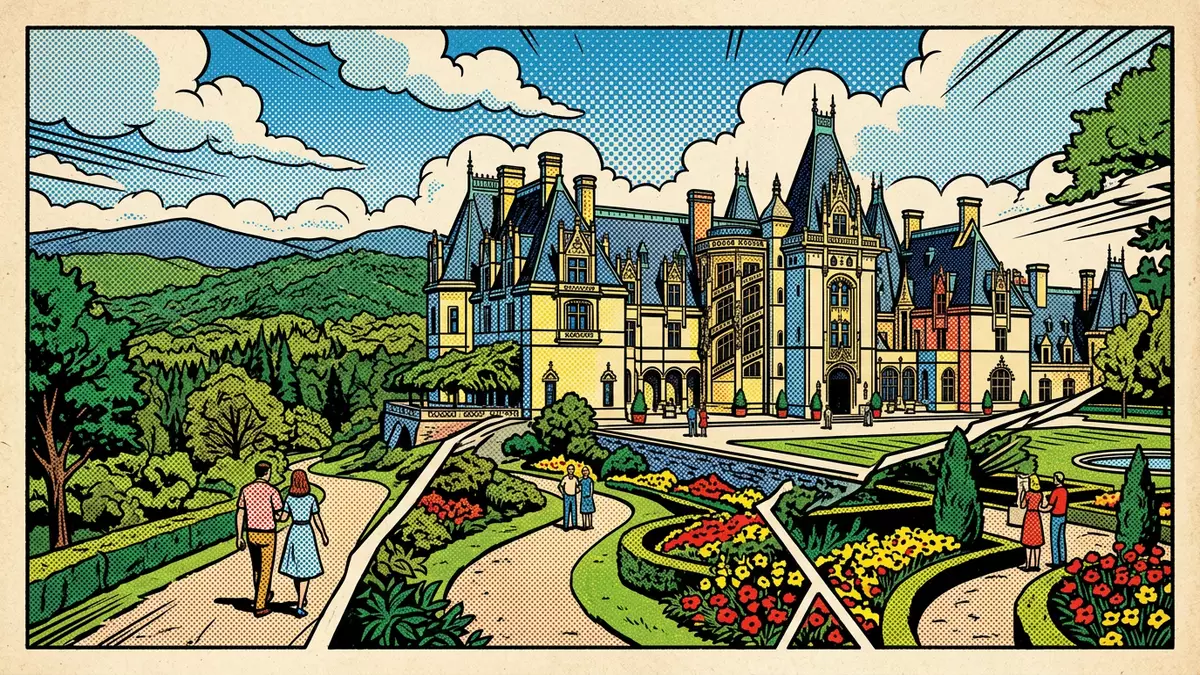
South of Asheville in North Carolina, Biltmore Estate stretches across rolling hills with a vast stone mansion rising above formal gardens and forested slopes. Conceived in the late nineteenth century by George Washington Vanderbilt II, the house was built between 1889 and 1895 as an American interpretation of a French Renaissance château, and the surrounding estate once covered tens of thousands of acres of managed woodland.
A palatial house inspired by Europe
The centrepiece of Biltmore Estate is Biltmore House, a French Renaissance style residence designed by architect Richard Morris Hunt for George Washington Vanderbilt II. Construction began in 1889 and the house was completed in 1895, creating a country home with some 250 rooms arranged around grand corridors and staircases.Construction began in 1889 Inside, the interiors combine carved stone, panelled wood and decorative plaster with imported tapestries, paintings and furniture that reflect Vanderbilt’s interest in European art.250-room residence
Biltmore House incorporates technological features that were advanced for the late nineteenth century, including central heating, plumbing and lift systems built into the fabric of the building.central heating and elevator The house occupies roughly four acres of floor space and has numerous fireplaces and bathrooms, expressing the scale of Gilded Age domestic architecture in the United States.four acres of floor area
Landscaped grounds and working estate
When George Vanderbilt began acquiring land near Asheville in the 1880s, the estate eventually expanded to around 125,000 acres, extending over mountains, forests and farmland in western North Carolina.125,000 acres of land The surrounding grounds were laid out by Frederick Law Olmsted, whose design included formal gardens near the house, a long approach drive and extensive managed woodland beyond.grounds designed by Frederick Law Olmsted
Olmsted’s landscape work at Biltmore encompassed gardens planted with seasonal flowers, arbours and pergolas, and wider parkland that blended planted areas with existing topography. A long lane leads through varied plantings towards the house, giving views of hills and forest that frame the mansion in its wider setting.Olmsted designed estate grounds Beyond the immediate gardens, the estate included productive forestry, farmland and later a vineyard, reflecting efforts to manage the land as a working property as well as a private residence.managed forest and vineyard
From private retreat to historic landmark
George Washington Vanderbilt II, grandson of Cornelius Vanderbilt, used Biltmore as a country estate until his death in 1914, after which the property remained with his family.George Vanderbilt died in 1914 In the same year, large areas of land were sold to the United States government, forming a substantial part of what became Pisgah National Forest and reducing the size of the estate.sale to U.S. Forest Service
The house opened to paying visitors in 1930 and Biltmore Estate was designated a National Historic Landmark in 1963, recognising both the architectural significance of Biltmore House and the importance of the landscape design.National Historic Landmark designation Today the estate covers around 8,000 acres and includes the historic house, gardens, woodland and later additions such as accommodation and a winery, with Biltmore House functioning as a museum-style attraction within this wider managed landscape.estate reduced to about 8,000 acres
Visiting Biltmore Estate: what travellers from Western Europe should know
- Biltmore Estate lies to the south of Asheville in western North Carolina and is reached by road from the city and nearby interstate highways.
- Within the house, visitors move through staircases and corridors, and some areas involve walking on polished floors and using indoor steps.
- The gardens extend over sloping ground with paths that can involve moderate gradients and longer walks between planted sections and woodland edges.
- The official language is English and the currency is the United States dollar.
- Entry requirements depend on your nationality; UK travellers can check the FCDO travel advice at gov.uk/foreign-travel-advice, Irish travellers the Department of Foreign Affairs at ireland.ie.
Searching for Biltmore Estate on social platforms
These links open searches for Biltmore Estate on each platform.
Frequently asked questions about Biltmore Estate
Where is Biltmore Estate located?
Biltmore Estate is in western North Carolina, near Asheville, with the house and gardens situated on an extensive property south of the city.
What can visitors expect during a visit?
Visitors move through historic interiors in Biltmore House and explore landscaped gardens and woodland paths that show the scale of the estate and its design.
What makes Biltmore Estate distinctive?
The estate combines a large French Renaissance style mansion by Richard Morris Hunt with grounds shaped by Frederick Law Olmsted, on land that once formed part of a managed forest.


