
Biltmore Estate, a Gilded Age château in the Blue Ridge Mountains
Published on 09/19/2026 at 11:53 | Editorial responsibility: Rafael Müller, Editor-in-Chief AD HOC NEWS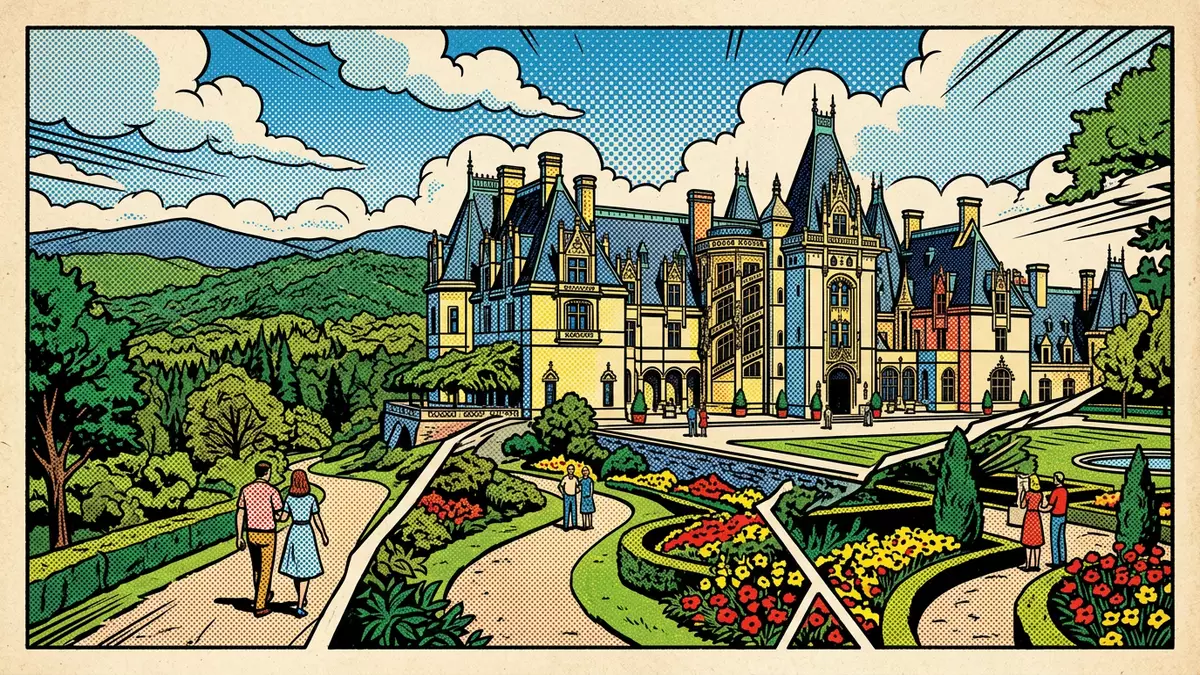
Biltmore Estate near Asheville in North Carolina is a vast French Renaissance country house set against the wooded slopes of the Blue Ridge Mountains, created in the late nineteenth century as a private retreat for George Washington Vanderbilt II.
A French Renaissance château in the Appalachian foothills
The centrepiece of Biltmore Estate is Biltmore House, a Châteauesque mansion built for George Washington Vanderbilt II between 1889 and 1895, during the period known as the Gilded Age in the United States.built for George Washington Vanderbilt II between 1889 and 1895 The building was designed by New York architect Richard Morris Hunt, who drew on French Renaissance châteaux for its asymmetrical outline, towers and elaborate stonework in Indiana limestone.designed by New York architect Richard Morris Hunt Construction began in 1889 and the house opened to Vanderbilt’s family and guests on 24 December 1895, marking the completion of one of the largest domestic building projects of the era.Construction began in 1889 and the house opened
The façade of Biltmore House stretches for hundreds of feet, with projecting wings flanking a central entrance tower and an arcade leading to an internal Winter Garden on one side.an arcade leading to an internal Winter Garden Behind this limestone shell lies an interior planned on a grand scale, with numerous rooms including drawing rooms, bedrooms and a vast banquet hall arranged around staircases and corridors that reflect European country house traditions interpreted for the American South.European country house traditions interpreted
Gardens by Frederick Law Olmsted and a managed forest landscape
Beyond the house, Biltmore Estate is defined by its landscaped grounds, planned by Frederick Law Olmsted, the landscape architect known for New York’s Central Park.planned by Frederick Law Olmsted Olmsted created formal gardens close to the house, including a walled garden and planting schemes that highlight colour and texture, and set them against more informal lawns and woodland that roll away towards the French Broad River.formal gardens close to the house The grounds include extensive shrub and azalea gardens, as well as an arboretum laid out along a broad loop between the house and the river.
The wider estate once covered around 125,000 acres of Appalachian forest, some of which later became part of Pisgah National Forest when land was sold to the federal government.around 125,000 acres of Appalachian forest Under the guidance of Olmsted and forester Gifford Pinchot, the woodland was organised as a large-scale managed forest that contributed to the development of forestry practice in the United States.organised as a large-scale managed forest The landscape today combines formal gardens, open meadows and forested slopes, with long drives and paths that reveal views of the house and the surrounding Blue Ridge Mountains.
From private retreat to historic house and grounds
George Washington Vanderbilt II conceived Biltmore Estate in the 1880s after visiting Asheville with his mother, Maria Louisa Kissam Vanderbilt, and gradually assembled a large tract of land for his country house.visiting Asheville with his mother The estate developed as a working property with gardens, woodland and associated buildings, and over time the house and grounds became a historic house museum open to visitors.historic house museum open to visitors The core of the house, with its historic interiors and art collections, remains a focus, complemented by the outdoor areas and subsidiary structures such as farm buildings and village-style facilities near the entrance.
Biltmore House and the surrounding estate form part of a broader cultural landscape in western North Carolina, linking Gilded Age architecture with the rural scenery of the Blue Ridge region.broader cultural landscape in western North Carolina The site is recognised as a National Historic Landmark, reflecting both the architectural significance of the house and the contribution of the estate to landscape design and forestry.recognised as a National Historic Landmark
Visiting Biltmore Estate: what travellers from Western Europe should know
- Biltmore Estate lies just south of downtown Asheville in western North Carolina, reached by road from the city and from routes crossing the Blue Ridge Mountains.
- The grounds include formal gardens, lawns and forest paths, and visiting the estate involves walking on varied terrain and using stairs within the house.
- The estate sits in the Appalachian foothills near the French Broad River, with views towards the wooded slopes that form part of the Blue Ridge Mountains.
- The official language is English and the currency is the United States dollar.
- Entry requirements depend on your nationality; UK travellers can check the FCDO travel advice at gov.uk/foreign-travel-advice, Irish travellers the Department of Foreign Affairs at ireland.ie.
Searching for Biltmore Estate on social platforms
These links open searches for Biltmore Estate on each platform.
Frequently asked questions about Biltmore Estate
Where is Biltmore Estate located?
Biltmore Estate is situated near Asheville in Buncombe County, in the western part of North Carolina in the United States.
What can visitors expect when exploring Biltmore Estate?
Visitors encounter a large French Renaissance house with historic interiors, formal and informal gardens, and surrounding woodland that forms part of the estate landscape.
What makes Biltmore Estate distinctive among country houses?
The combination of a Châteauesque mansion by Richard Morris Hunt, gardens by Frederick Law Olmsted and a managed forest across the Blue Ridge foothills gives the estate its distinctive character.


