
Biltmore Estate, a French Renaissance mansion in the Blue Ridge
Published on 08/31/2026 at 09:54 | Editorial responsibility: Rafael Müller, Editor-in-Chief AD HOC NEWS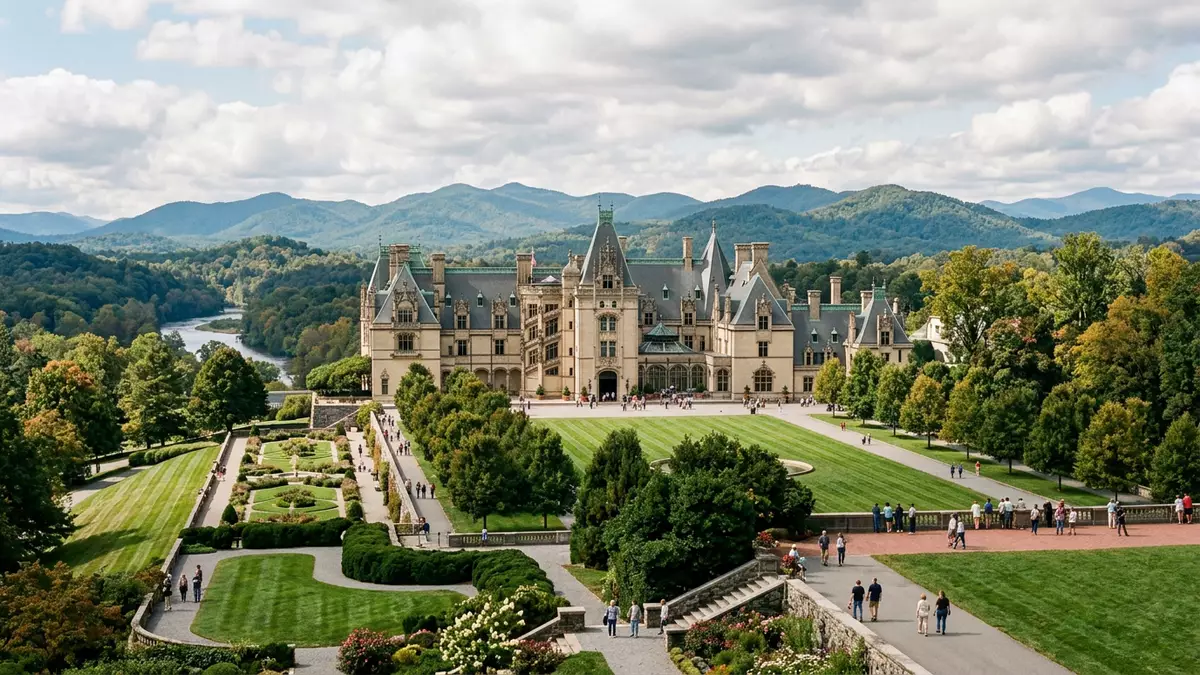
Biltmore Estate near Asheville in North Carolina is centred on a vast French Renaissance mansion set against the wooded slopes of the Blue Ridge Mountains. Built for George Washington Vanderbilt II in the late nineteenth century, the house and its surrounding landscape form one of the most extensive country estates created in the United States.
A French Renaissance mansion in the American South
The main residence at Biltmore Estate is a Châteauesque mansion designed for George Washington Vanderbilt II by architect Richard Morris Hunt in the late 1880s and early 1890s. Construction of the house began in 1889 and was completed in 1895, creating a residence that is widely recorded as the largest privately owned home in the United States.largest privately owned residence The architecture draws heavily on French Renaissance châteaux, with rich external ornament and a prominent stair tower that recall well-known buildings in the Loire Valley such as Blois, Chenonceau and Chambord.Loire Valley châteaux
Inside, the mansion extends over a floor area of about 4 acres (around 1.8 hectares), with around 250 rooms arranged around public halls and private suites.250-room residence The recorded figures include dozens of bedrooms, bathrooms and fireplaces, as well as an indoor swimming pool and a large library housing thousands of volumes. These numbers give a sense of the domestic scale George Vanderbilt commissioned, turning the house into a complete self-contained environment surrounded by countryside.
George Vanderbilt’s estate in the Blue Ridge Mountains
George Washington Vanderbilt II, grandson of industrialist Cornelius Vanderbilt, began acquiring land around Asheville in the 1880s after visiting the region and its mountain scenery. The estate assembled during his lifetime eventually reached around 125,000 acres of land in the Blue Ridge Mountains, with the house set on a ridge above the French Broad River.125,000 acres of land The combination of a grand house and extensive grounds reflects the late nineteenth-century pattern of country retreats created by wealthy families, adapted here to the forested landscape of western North Carolina.
Over the twentieth century, the size of the estate changed as large tracts were sold, including tens of thousands of acres that went to the U.S. Forest Service and contributed to the formation of Pisgah National Forest. By the early twenty-first century, the property covered around 8,000 acres, still spreading across hills and river valleys around the mansion.approximately 8,000-acre estate Within this reduced but still substantial area, visitors encounter formal gardens, managed woodland and views across the Blue Ridge, all connected by estate roads and approaches laid out when the house was built.
Gardens, forestry and landscape design
The grounds surrounding the house were designed by landscape architect Frederick Law Olmsted, whose work also includes major urban parks such as Central Park in New York. At Biltmore Estate, Olmsted combined formal gardens close to the house with more informal planting and pastoral scenery further away, using the slopes and valleys of the site to frame the approach to the mansion.formal and informal gardens A long approach drive leads through varied planting before reaching the main residence, reinforcing the sense of entering a large rural domain.
Beyond the ornamental gardens, Biltmore Estate is associated with early experiments in professional forestry in the United States. George Vanderbilt engaged foresters including Gifford Pinchot and Carl Alwin Schenck to manage the wooded parts of the estate, and in 1898 Schenck established a forestry school on the property that is recognised as the first such institution in the country.forestry school in 1898 This combination of ornamental gardening near the house and managed forest in the wider estate makes Biltmore a significant landscape as well as an architectural landmark.
Visiting Biltmore Estate: what travellers from Western Europe should know
- Biltmore Estate stands south of central Asheville in western North Carolina, with the entrance reached by road routes leading from the city towards the French Broad River.
- The visit involves movement across extensive grounds, including walking between car parks, the mansion and the gardens, with steps and changes in gradient near the house and in the landscaped areas.
- The wider estate includes hills and river valleys characteristic of the Blue Ridge Mountains, so outdoor areas combine paved paths with sections of grass and woodland tracks.
- The official language is English and the currency is the United States dollar.
- Entry requirements depend on your nationality; UK travellers can check the FCDO travel advice at gov.uk/foreign-travel-advice, Irish travellers the Department of Foreign Affairs at ireland.ie.
Searching for Biltmore Estate on social platforms
These links open searches for Biltmore Estate on each platform.
Frequently asked questions about Biltmore Estate
Where is Biltmore Estate located?
Biltmore Estate lies near Asheville in western North Carolina, with the house positioned above the French Broad River in the Blue Ridge Mountains.
What can visitors expect during a visit?
A visit combines time inside a large French Renaissance mansion with walks through formal gardens and wider grounds laid out across hills, valleys and woodland.
What makes Biltmore Estate distinctive?
The estate brings together a late nineteenth-century Châteauesque house by Richard Morris Hunt, extensive grounds shaped by Frederick Law Olmsted and early experiments in American forestry.


