
Big Ben and the Gothic clock tower that frames London’s skyline
Published on 08/16/2026 at 13:36 | Editorial responsibility: Rafael Müller, Editor-in-Chief AD HOC NEWS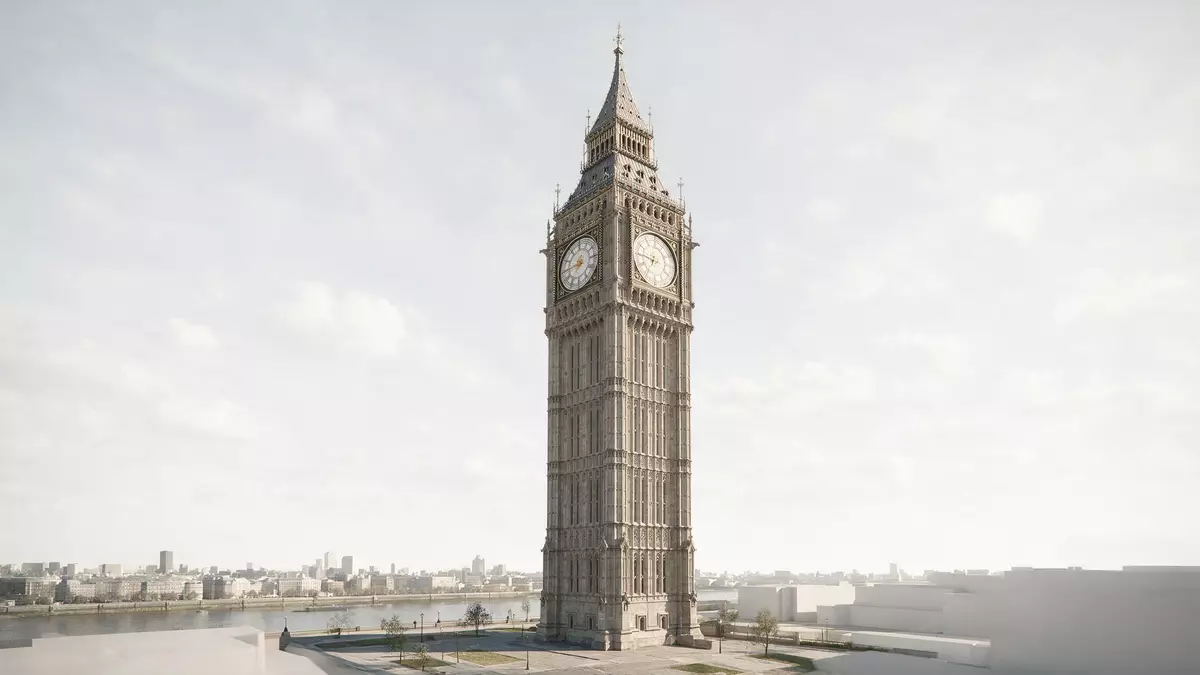
Big Ben is the name given to the Great Bell that hangs high in the clock tower at the north end of the Palace of Westminster in London, yet the nickname has come to stand for the entire tower itself. Rising in Gothic Revival stonework beside the River Thames, the tower has been officially known as the Elizabeth Tower since 2012, linking its profile to the reign of Queen Elizabeth II while the bell inside continues to define the sound of Westminster.
Stone, height and the four clock faces
The Elizabeth Tower stands about 96 m (315 ft) high above the riverside, its height emphasised by narrow vertical lines of stone and pinnacles that draw the eye upwards from the palace roof. Behind the ornament, the tower is built as a robust masonry structure with internal floors stacked above one another, housing the clock mechanism, service spaces and the belfry where Big Ben hangs.the clock tower rises about 320 feet
Near the top, four large clock faces project on each side of the tower, set in decorative frames and backed by translucent glass so that the dials can be lit from behind after dark. Each dial measures several metres across, with minute hands that extend to the outer ring of numerals and shorter hour hands nearer the centre, allowing the time to be read from across Westminster and over the Thames embankment.each dial is seven metres in diameter
The Great Bell and the Gothic Revival partnership
Strictly speaking, Big Ben refers only to the Great Bell, a large bronze bell that weighs about 13.7 tonnes and hangs within the belfry above the clock faces.the bell weighs 13.7 metric tons When struck, the bell sounds the hour, while four smaller bells around it mark the quarter hours, giving the tower a layered sound that carries across central London. Big Ben and its companion bells are mounted on a robust frame inside the upper stage of the tower, with access for maintenance via internal staircases.
The clock tower forms part of the nineteenth-century rebuilding of the Palace of Westminster, led by architect Sir Charles Barry in a Gothic Revival style after the fire of 1834. Barry developed the overall plan of the palace, but the detailed Gothic design of the tower and much of the ornament was created by Augustus Welby Northmore Pugin, whose tracery, panelling and pinnacles give the building its medieval character.Pugin's Perpendicular Gothic detail within Charles Barry's palace plan The clock itself uses a gravity escapement mechanism devised in the mid-nineteenth century, reflecting contemporary interest in precise timekeeping as well as architectural display.a double three-legged gravity escapement designed by Edmund Beckett Denison
Names, dates and the palace setting
The tower was completed and the clock brought into service in 1859, giving the Palace of Westminster a new vertical landmark at its northern end and providing a public clock for the city. The structure was originally known as the Clock Tower and has also been referred to as St Stephen’s Tower, labels that reflected its role within the parliamentary complex. In 2012, to mark the Diamond Jubilee of Queen Elizabeth II, it was officially renamed Elizabeth Tower, a change that underlined its association with the modern monarchy as well as with the Houses of Parliament.Elizabeth Tower is 96 metres talla brief history of Big Ben and Elizabeth Tower
Big Ben stands at the northern end of the Palace of Westminster, above the riverside road and close to Westminster Bridge, so that the tower forms part of a group of landmarks that includes the river, the bridge and the broader parliamentary complex. From the south bank of the Thames the clock faces are seen directly above the palace façade, while from Parliament Square the tower rises behind civic statues and neighbouring government buildings, tying the visual identity of Westminster, London and the United Kingdom to a single piece of nineteenth-century architecture.
Visiting Big Ben: what travellers from Western Europe should know
- Big Ben stands at the north end of the Palace of Westminster in central London, beside the River Thames and close to Westminster Bridge and Westminster Underground station.
- The tower forms part of a working parliamentary complex, so movement around it on foot follows pavements and crossings along the riverside and around Parliament Square.
- Views of the clock faces and the Elizabeth Tower are clear from the pavements on Westminster Bridge, from the South Bank of the Thames opposite the palace, and from the open space of Parliament Square.
- The official language is English and the currency is the pound sterling.
Searching for Big Ben on social platforms
These links open searches for Big Ben on each platform.
Frequently asked questions about Big Ben
Where is Big Ben located in London?
Big Ben stands in the Elizabeth Tower at the northern end of the Palace of Westminster in the borough of Westminster, beside the River Thames and close to Westminster Bridge.
What can visitors expect when seeing Big Ben?
Visitors see a tall Gothic Revival clock tower with four large clock faces above the riverside, forming part of the wider parliamentary complex and clearly visible from nearby streets, bridges and riverbank walks.
What makes Big Ben distinctive among London landmarks?
Big Ben is distinctive because it combines a nineteenth-century Gothic Revival tower by Charles Barry and Augustus Pugin with a precise public clock and a Great Bell whose hourly chimes have become closely associated with Westminster.


