
Bibi-Xonim masjidi and the vast courtyard of Timurid Samarkand
Published on 08/29/2026 at 06:52 | Editorial responsibility: Rafael Müller, Editor-in-Chief AD HOC NEWS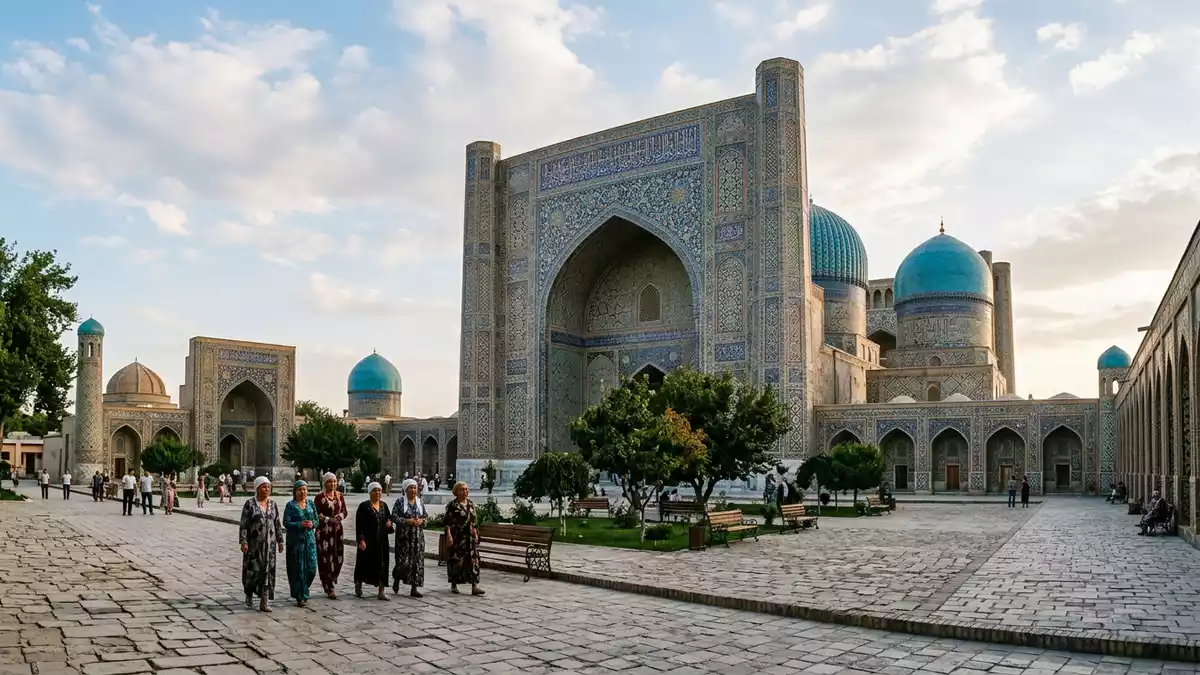
Bibi-Xonim masjidi, better known internationally as the Bibi-Khanym Mosque, rises over the old quarters of Samarkand as a vast Timurid congregational complex dating from the early fifteenth century.Bibi-Xonim masjidi in Samarkand stands within the historic centre that forms part of the UNESCO World Heritage listing for Samarkand. The mosque complex was begun under Amir Timur, also known as Tamerlane, around 1399 and completed in the first years of the fifteenth century.
A courtyard framed by domes and towering portals
The defining experience of Bibi-Xonim masjidi is the transition from the street into an immense enclosed courtyard, framed by monumental entrance arches and flanked by domed halls to north and south.The mosque complex in Samarkand follows a four-iwan plan, with large vaulted halls aligned to the cardinal directions around the open central space. The main sanctuary lies to the west, where a vast domed hall anchors the axis and faces the courtyard through a high arched opening.
Architecturally, the complex belongs to the Timurid period and combines baked brick structure with extensive glazed tile decoration in shades of turquoise and deep blue.Timurid architectural treatment is evident in the tall entrance portal on the eastern side, which rises above the surrounding roofs and signals the mosque from far across the city. Inside the courtyard, the scale of the space and the height of the surrounding walls make the human figure feel small against the architecture.
Timur, Saray Mulk Khanum and the Timurid era
Bibi-Xonim masjidi is closely tied to the reign of Amir Timur, who ruled from Samarkand between 1370 and 1405 and turned the city into a capital for his empire.Construction of the mosque between about 1399 and 1404 placed it among the most ambitious building projects of his rule. The name Bibi-Khanym refers to Saray Mulk Khanum, a principal wife of Timur, whose status in courtly life is reflected in the dedication.
The mosque belongs to the wider flowering of Timurid architecture across Central Asia and Iran in the late fourteenth and early fifteenth centuries.The complex as a congregational mosque between 1398 and 1405 demonstrates how imperial resources were concentrated into a single monumental project. Later restorations in the twentieth century rebuilt damaged sections, but the plan and overall massing still convey the original Timurid conception.
Decoration, restoration and the surrounding ensemble
Much of the visual richness of Bibi-Xonim masjidi lies in its surface decoration, where geometric patterns and calligraphy cover the brickwork in glazed ceramic tiles.The mosque as a restored monument shows how twentieth-century reconstruction campaigns reintroduced tile cladding and reinstated missing elements of the domes and portals. The combination of patterned facades and pale stone floors sets up a contrast between solid structure and intricate ornament.
Bibi-Xonim masjidi stands just north-east of Registan Square, close to Samarkand’s Siyob Bazaar, so the mosque forms part of a wider ensemble of madrasas, mausoleums and markets in the historic core.The mosque’s relationship to Registan and Siyob Bazaar makes it easy to understand how religious, commercial and civic life once interlocked in this Silk Road city. From the courtyard, the skyline of Samarkand appears framed by domes and minarets, with the mosque acting as one of the key reference points.
Visiting Bibi-Xonim masjidi: what travellers from Western Europe should know
- Bibi-Xonim masjidi stands in the historic centre of Samarkand in eastern Uzbekistan, north-east of Registan Square and close to the Siyob Bazaar.
- The mosque complex is reached on foot from the surrounding streets of the old city, and the main entrance portal faces a paved forecourt.
- Within the complex, visitors move across stone paving and shallow steps, and the scale of the courtyard means a fair amount of walking in open air.
- The official language is Uzbek and the currency is the Uzbek som. Entry requirements depend on your nationality; UK travellers can check the FCDO travel advice at gov.uk/foreign-travel-advice, Irish travellers the Department of Foreign Affairs at ireland.ie.
Searching for Bibi-Xonim masjidi on social platforms
These links open searches for Bibi-Xonim masjidi on each platform.
Frequently asked questions about Bibi-Xonim masjidi
Where is Bibi-Xonim masjidi?
Bibi-Xonim masjidi stands in Samarkand in eastern Uzbekistan, north-east of Registan Square and close to the Siyob Bazaar in the historic city centre.
What should a visitor expect at Bibi-Xonim masjidi?
Visitors encounter a large courtyard mosque with monumental entrance portals, domed halls, extensive glazed tile decoration and restored structures dating from the Timurid period.
What makes Bibi-Xonim masjidi distinctive among Samarkand’s monuments?
The mosque’s vast courtyard, Timurid four-iwan layout and association with Amir Timur and Saray Mulk Khanum give it a prominent place within the ensemble of historic Samarkand.


