
Bhaktapur Durbar Square, the Malla kings’ palace city
Published on 09/16/2026 at 11:32 | Editorial responsibility: Rafael Müller, Editor-in-Chief AD HOC NEWS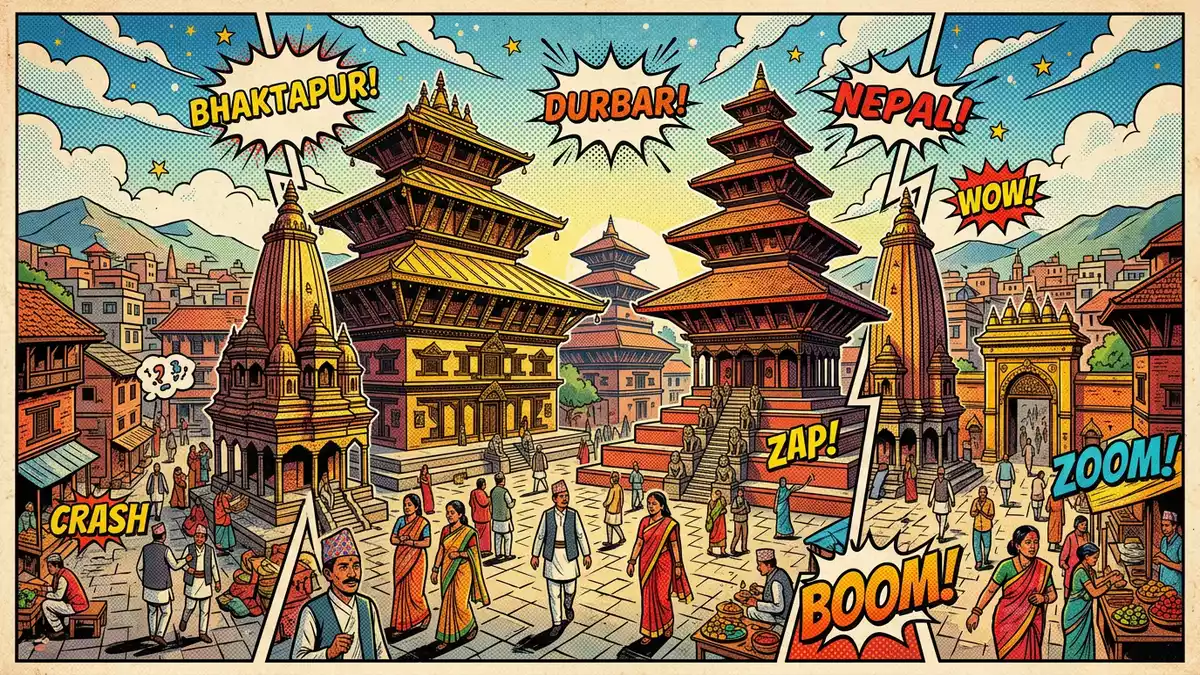
Bhaktapur Durbar Square in Bhaktapur, Nepal is the former royal palace complex of the Malla kings, a dense ensemble of courtyards, temples and gateways that gives the city its historic centre.
A royal square shaped by the Malla dynasty
Bhaktapur Durbar Square is one of three royal palace squares in the Kathmandu Valley, alongside the Durbar Squares of Kathmandu and Patan, and it acted as the political and ceremonial heart of Bhaktapur for centuries.one of three royal squares The square developed under the Hindu Malla dynasty, which held power in Bhaktapur and the wider valley from the thirteenth century until its defeat by Gorkhali forces in 1769.defeat by Gorkhali forces
Construction of the palace area is associated with rulers such as King Jayasthiti Malla, who is credited with founding the first palace complex on the site in the thirteenth century, and with later Malla kings who expanded and embellished the square.King Jayasthiti Malla Over the fourteenth to eighteenth centuries the square grew into a tightly woven royal environment, with palaces framed by Hindu temples, shrines, public platforms and processional routes linked to Bhaktapur’s major festivals.expanded between the 14th and 18th centuries
Palaces, temples and carved gateways
At the core of Bhaktapur Durbar Square stands the former Royal Palace complex, which once comprised many courtyards and residential wings and survives today in a reduced but still prominent form.former Royal Palace complex Its most recognisable component is the Palace of Fifty-Five Windows, a long, timber-fronted elevation whose rhythmic balcony openings and intricate Newar woodcarving are often taken as a symbol of Bhaktapur’s craftsmanship.Palace of Fifty-Five Windows
Close to the palace stands the Golden Gate, a highly decorated entrance commissioned by the Malla king Ranajit Malla in the mid?eighteenth century and known for its dense relief work and mythological imagery in metal and stone.Golden Gate commissioned by Ranajit Malla Around the square rise stone and brick temples such as Vatsala Devi and Siddhi Lakshmi, together with further shrines and statues, giving the former court a strongly religious character alongside its political history.stone temples of Vatsala Devi and Siddhi Lakshmi
World Heritage status and a living urban setting
Bhaktapur Durbar Square forms part of the Kathmandu Valley World Heritage Property, inscribed by UNESCO in 1979 as one of seven Protected Monument Zones recognised for their archaeological, historic, cultural and religious value.Kathmandu Valley World Heritage Property The inscription covers the palace square together with Bhaktapur’s surrounding old city, where narrow streets, brick houses and roadside shrines extend the historic fabric beyond the formal courtyards.
Major earthquakes in 1934 and 2015 damaged parts of the square, reducing the number of original monuments but leaving key structures such as the Palace of Fifty-Five Windows, the Golden Gate and principal temples in place.damage from earthquakes Restoration campaigns led by Nepal’s Department of Archaeology and international partners have focused on stabilising historic buildings and rebuilding selected shrines, so that the square remains a functioning civic and ritual space as well as a protected heritage site.World Heritage documentation
Visiting Bhaktapur Durbar Square: what travellers from Western Europe should know
- Bhaktapur Durbar Square lies in the historic centre of Bhaktapur, east of Kathmandu, and is approached along the main streets of the old city from surrounding roads and bus routes.
- The palace square and its adjoining courtyards are paved and largely level, though temple platforms and palace interiors are reached by stone stairways that require steady footing.
- Several other historic squares of Bhaktapur, including Taumadhi and Dattatreya, are within walking distance, making it possible to explore more temples and traditional houses in one continuous circuit through the old town.
- The official language is Nepali and the currency is the Nepalese rupee.
- Entry requirements depend on your nationality; UK travellers can check the FCDO travel advice at gov.uk/foreign-travel-advice, Irish travellers the Department of Foreign Affairs at ireland.ie.
Searching for Bhaktapur Durbar Square on social platforms
These links open searches for Bhaktapur Durbar Square on each platform.
Frequently asked questions about Bhaktapur Durbar Square
Where is Bhaktapur Durbar Square located?
Bhaktapur Durbar Square is in the city of Bhaktapur in central Nepal, forming the historic core of one of the Kathmandu Valley’s three former royal capitals.
What can visitors expect when they enter the square?
Visitors encounter a compact palace courtyard surrounded by carved brick palaces, stone and brick temples, historic gateways and statues, with further traditional streets and shrines extending into the adjoining neighbourhoods.
What makes Bhaktapur Durbar Square distinctive among Nepal’s palace squares?
Bhaktapur Durbar Square is distinctive for the concentration of Malla?period palaces and temples such as the Palace of Fifty-Five Windows and the Golden Gate, combined with its status as part of the Kathmandu Valley World Heritage Property.


