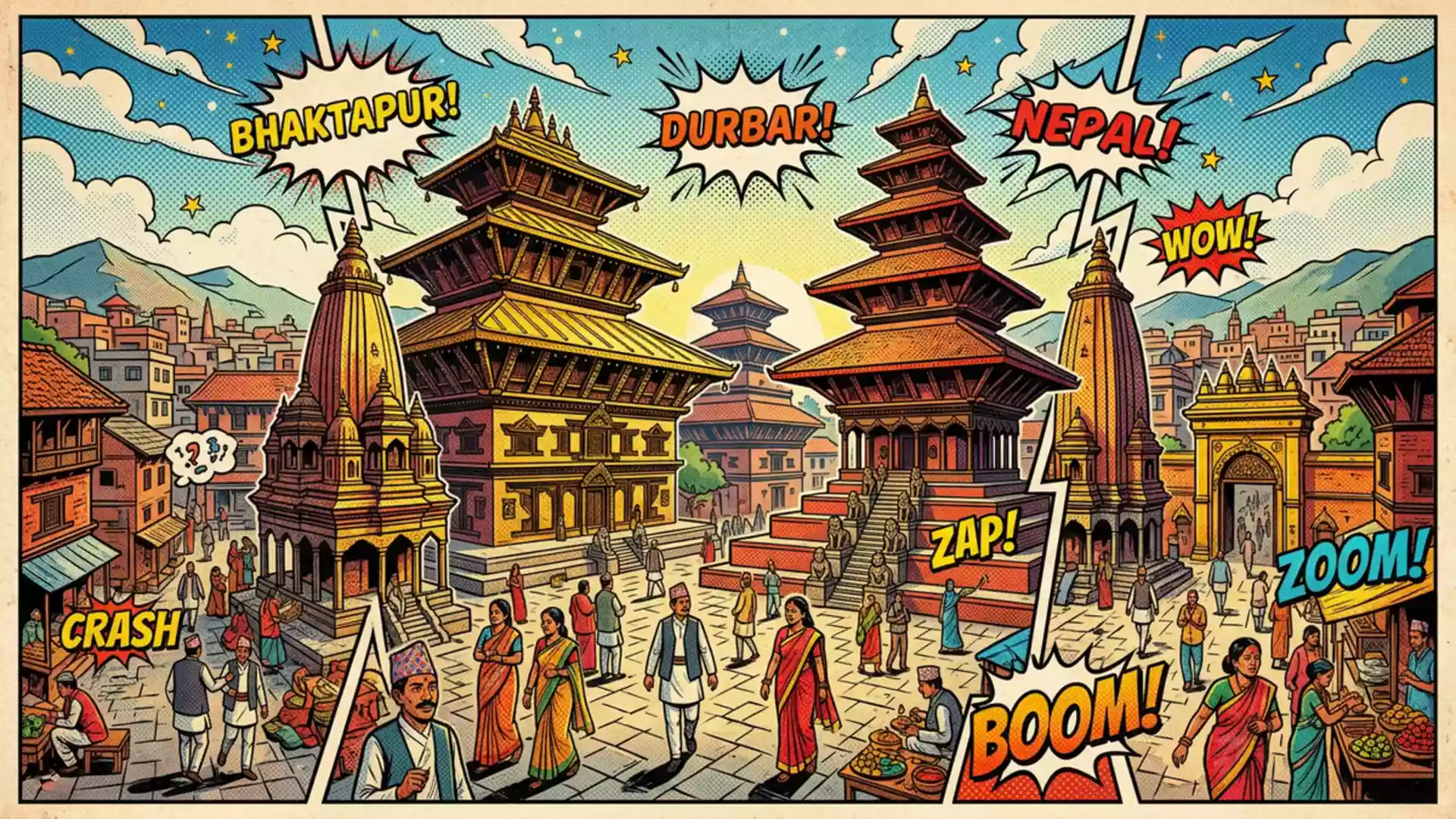
Bhaktapur Durbar Square: Newar palaces, temples and courtyards
Published on 09/14/2026 at 19:30 | Editorial responsibility: Rafael Müller, Editor-in-Chief AD HOC NEWS
Bhaktapur Durbar Square in Bhaktapur is the former royal heart of a Newar city, a dense ensemble of palaces, temples and brick courtyards that still frames daily life in the old town. Built up from the medieval period under rulers of the Thakuri and Malla dynasties, the palace complex and surrounding urban fabric form part of the Kathmandu Valley UNESCO World Heritage Site, recognised in 1979 for their outstanding Newar architecture and townscape.
Royal palaces and the Malla period
The palace complex at Bhaktapur Durbar Square grew over centuries as Bhaktapur developed into a royal centre in the Kathmandu Valley. Historical accounts describe the city as an important urban settlement by at least the twelfth century under King Ananda Deva of the Thakuri dynasty, with later expansions under Malla kings between the fourteenth and eighteenth centuries.Thakuri and Malla rulers Bhaktapur served as a capital for Malla kings during the fifteenth century and remained an independent city-state until the late eighteenth century, when the kingdom was conquered.
The square’s palace buildings reflect this layered royal history. Structures associated with the Malla period, including the long brick palace with multiple carved windows and the Golden Gate leading into an inner courtyard, show how royal patronage turned the square into a seat of power and ritual. The palace complex formed one of several royal capitals in the Kathmandu Valley, alongside those at Kathmandu and Patan, and together these urban centres are listed within the “Kathmandu Valley” World Heritage inscription.Kathmandu Valley inscription
Newar architecture in brick, wood and stone
Bhaktapur Durbar Square is widely recognised for its concentration of Newar architecture: brick structures with timber frameworks, elaborately carved wooden windows and doorways, and stone sculptures set around stepped plinths. Royal palace buildings stand beside multi-tiered pagoda temples and taller shikhara-style shrines, creating a varied skyline above the paved square.Newar palace and temple ensemble The mix of brick walls and dark wooden elements gives many façades a reddish-brown tone punctuated by deep relief carvings.
Among the palace elements, the façade known as the 55-Window Palace is noted for its long row of intricately carved windows, each framed with ornamental latticework and devotional motifs. Nearby, the Golden Gate acts as a richly worked entrance to an inner courtyard, combining gilt metalwork with stone surrounds. The square also contains key temples such as Vatsala Durga, built in stone and traditionally associated with a sandstone exterior and tiered roof, alongside other shrines that stand on raised platforms with guardian sculptures at their stairways.55-Window Palace, Golden Gate and Vatsala Durga Temple
A living square within the Kathmandu Valley World Heritage Site
Bhaktapur Durbar Square is one of several monument zones that collectively form the Kathmandu Valley World Heritage Site, alongside palace squares in Kathmandu and Patan and major religious ensembles such as Swayambhu and Changu Narayan.Monument zones in the valley This status reflects both the architectural quality of the square and the way its palaces, temples and courtyards remain embedded in a wider historic city, with narrow streets radiating out from the complex and traditional Newar houses lining nearby lanes.
The square has experienced earthquake damage, including major events in 1934 and 2015, but many of its key monuments have been repaired or reconstructed on their historic foundations.Earthquake damage and restoration Conservation programmes led by Nepal’s Department of Archaeology and local authorities concentrate on retaining original materials and forms wherever possible, so the ensemble of brick surfaces, timber balconies, stone lions and ritual structures continues to present a largely coherent medieval townscape.
Visiting Bhaktapur Durbar Square: what travellers from Western Europe should know
- Bhaktapur Durbar Square lies in the historic centre of Bhaktapur, a Newar city east of Kathmandu in Nepal. It is reached by road from Kathmandu and local buses and taxis run along the main highway into Bhaktapur.
- The square itself is paved, with palace courtyards and temples connected by stone steps and raised platforms. Moving between levels involves stairways that can be steep and irregular in places.
- Bhaktapur is part of Bagmati Province, where Nepali is the official language and the currency is the Nepalese rupee (NPR).
- Entry requirements depend on your nationality; UK travellers can check the FCDO travel advice at gov.uk/foreign-travel-advice, Irish travellers the Department of Foreign Affairs at ireland.ie.
Searching for Bhaktapur Durbar Square on social platforms
These links open searches for Bhaktapur Durbar Square on each platform.
Frequently asked questions about Bhaktapur Durbar Square
Where is Bhaktapur Durbar Square located?
Bhaktapur Durbar Square sits at the centre of Bhaktapur, a historic Newar city in Nepal’s Kathmandu Valley, east of Kathmandu.
What can visitors expect on a visit to the square?
Visitors encounter palace façades, temples, shrines and brick courtyards arranged around a paved square, with carved wood and stone sculptures prominent throughout.
What makes Bhaktapur Durbar Square distinctive among Nepal’s historic sites?
Bhaktapur Durbar Square is part of the Kathmandu Valley World Heritage Site and stands out for its dense concentration of Newar palaces, temples and courtyards within an intact old city grid.