
Bhaktapur Durbar Square, Nepal’s royal heart of Newar artistry
Published on 09/18/2026 at 12:12 | Editorial responsibility: Rafael Müller, Editor-in-Chief AD HOC NEWS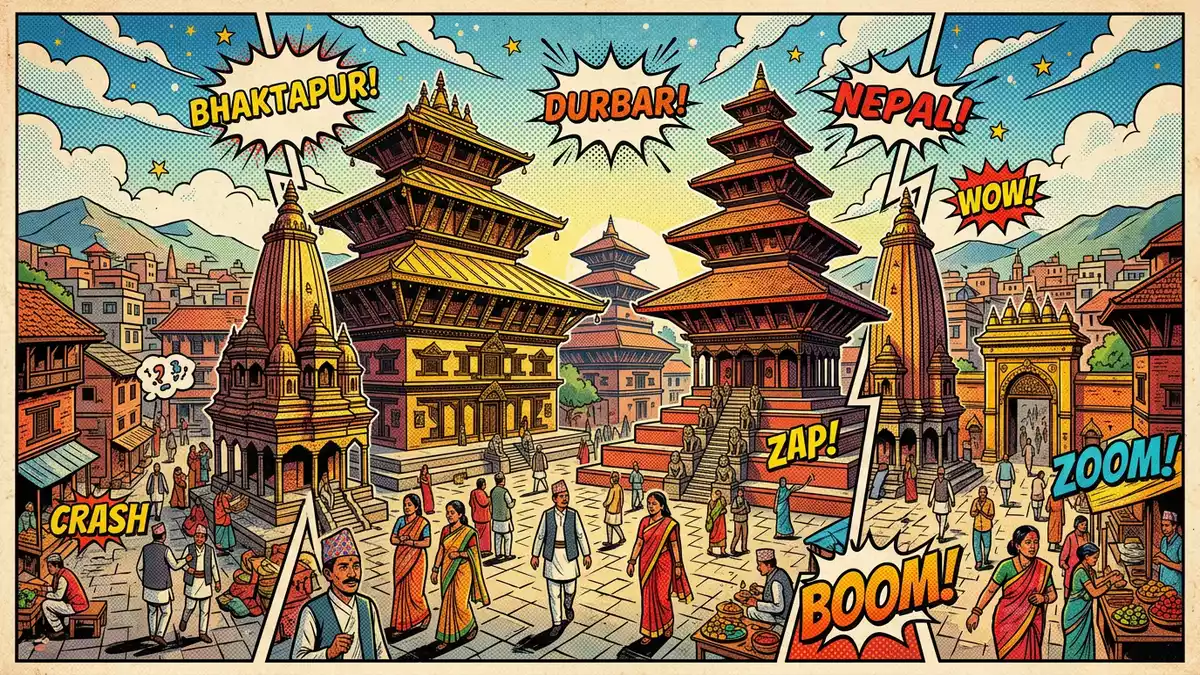
Bhaktapur Durbar Square is the former royal palace complex of Bhaktapur, a historic city-state in Nepal’s Kathmandu Valley where brick, carved wood and stone temples crowd into a single dense square. The complex took shape across the Malla period between the thirteenth and eighteenth centuries, when Bhaktapur served as a royal centre and kings expanded their palaces and courtyards into an urban ensemble that still defines the city’s historic core.
A royal square shaped over the Malla centuries
Bhaktapur Durbar Square forms one of three major palace squares in the Kathmandu Valley, alongside those of Kathmandu and Patan, each built as the political and ceremonial focus of an independent court.three royal squares located in Nepal’s Kathmandu Valley In Bhaktapur the square developed as the seat of the Malla dynasty, whose rulers extended the palace and filled the surrounding space with temples, shrines and administrative buildings from the fourteenth century onwards.Malla kings who ruled Bhaktapur until the late eighteenth century
The palace complex is closely tied to named rulers whose building campaigns left enduring landmarks. King Yaksha Malla expanded the square in the fifteenth century, including the Palace of Fifty-Five Windows that stretches along one side as a principal façade.Yaksha Malla constructs the 55-Window Palace In the seventeenth century king Bhupatindra Malla remodelled structures and commissioned further temples, a phase often associated with a peak of architectural refinement in the square.peak during the reign of King Bhupatindra Malla The overall ensemble reflects this layered history, where successive Malla rulers added new courtyards and shrines rather than replacing the earlier ones.
Brick palaces, pagoda temples and carved wood
The architecture of Bhaktapur Durbar Square is grounded in the Newar building tradition of the Kathmandu Valley, marked by red brick walls, dark timber and stone sculpture integrated into a cohesive urban fabric.traditional Newari architecture distinguished by red brick structures Palace ranges with rows of timber windows stand beside multi-tiered pagoda-roofed temples and vertically emphasised shikhara-style shrines, creating a varied roofline above the relatively compact ground plan.pagoda-style temples and shikhara-style shrines
Several individual structures within the square have become reference points for Newar craftsmanship. The Palace of Fifty-Five Windows, dating to the fifteenth century, presents a long elevation of closely spaced timber windows with carved frames that illustrate the detailed woodwork associated with Bhaktapur.Palace of 55 Carved Windows called Pachpanna Jhyale Durbar Nearby the Golden Gate, executed in repoussé metalwork, forms an ornate entrance to an inner courtyard and is frequently cited as a masterpiece of metal carving in Nepal.the palace entrance, the Golden Gate - a masterpiece in repoussé art Stone temples such as those dedicated to Vatsala Devi and Siddhi Lakshmi introduce finely worked stone bases and sculptural programmes beside the brick and timber structures, further enriching the material mix inside the square.stone temples of Vatsala Devi and Siddhi Lakshmi
A UNESCO-listed urban ensemble and living city
Bhaktapur Durbar Square forms part of the Kathmandu Valley ensemble inscribed on the UNESCO World Heritage List in 1979, recognised as an outstanding example of urban Newar architecture with a high concentration of historic buildings.UNESCO World Heritage site (1979 A.D) Unlike isolated monuments, the square sits within a wider historic fabric of lanes, houses and subsidiary squares that continue the brick-and-wood idiom beyond the palace precincts.palace complex and surrounding historic fabric represent one of the most complete and original examples of urban Newar architecture
Although earthquakes in 1934 and 2015 damaged a number of buildings in Bhaktapur Durbar Square, the main layout and several key monuments remain in place, with reconstructions following established forms to retain the historic appearance.received heavy damage from both the 1934 and 2015 earthquake, while many of the fallen monuments have been reconstructed The square continues to serve as a setting for religious observances, processions and everyday passage through the city, so visitors encounter palace façades and temples that share space with markets, local residents and urban movement rather than standing as isolated museum pieces.
Visiting Bhaktapur Durbar Square: what travellers from Western Europe should know
- Bhaktapur Durbar Square lies within the historic centre of Bhaktapur in Nepal’s Kathmandu Valley, east of Kathmandu, and is reached by road connections from the wider valley.
- The square itself is paved and largely level, but approaches pass through streets with steps, uneven brick surfaces and occasional narrow passageways that demand sure footing.
- Bhaktapur sits at an elevation typical for the Kathmandu Valley, so walking around the square involves modest altitude but no mountain terrain.
- Bhaktapur is in Nepal, where the official language is Nepali and the currency is the Nepalese rupee.
- Entry requirements depend on your nationality; UK travellers can check the FCDO travel advice at gov.uk/foreign-travel-advice, Irish travellers the Department of Foreign Affairs at ireland.ie.
Searching for Bhaktapur Durbar Square on social platforms
These links open searches for Bhaktapur Durbar Square on each platform.
Frequently asked questions about Bhaktapur Durbar Square
Where is Bhaktapur Durbar Square located?
Bhaktapur Durbar Square is in the historic centre of Bhaktapur, one of the Kathmandu Valley cities in Nepal, east of the capital Kathmandu.
What can visitors expect when exploring the square?
Visitors encounter a compact area of palaces, temples, shrines and courtyards built in brick, carved wood and stone, with historic façades lining a paved plaza and surrounding lanes.
What makes Bhaktapur Durbar Square distinctive among Nepal’s historic sites?
Bhaktapur Durbar Square is distinctive for its dense concentration of Newar palace and temple architecture from the Malla period and its inclusion in the Kathmandu Valley UNESCO World Heritage ensemble.


