
Bhaktapur Durbar Square and the brick palaces of the Malla kings
Published on 09/01/2026 at 21:37 | Editorial responsibility: Rafael Müller, Editor-in-Chief AD HOC NEWS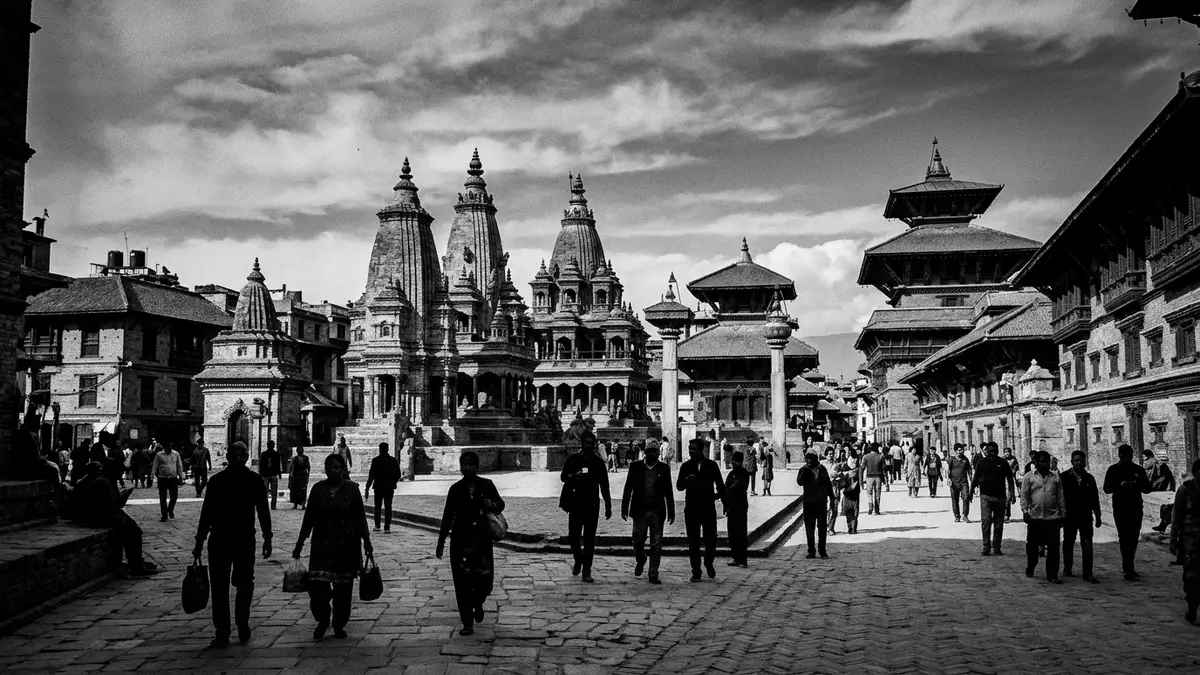
Bhaktapur Durbar Square in Bhaktapur, Nepal is a former royal palace complex where brick courtyards, pagoda temples and carved timber facades form a continuous urban ensemble shaped under the Malla kings in the Kathmandu Valley. Construction of the palace core began in the fourteenth century and the square later gained World Heritage recognition in 1979, firmly tying this compact area of courts and shrines to the wider story of Newar art and power.
A royal square of the Malla dynasty
Bhaktapur Durbar Square is one of three historic royal squares in the Kathmandu Valley, alongside the palace complexes of Kathmandu and Patan, and was the seat of the Hindu Malla dynasty that ruled the valley between 1201 and 1769.royal squares in the Kathmandu Valley The earliest palace on the site is attributed to King Jayasthiti Malla in the thirteenth century, when Bhaktapur was rising as a capital within the valley’s confederation of city-states.first palace in the Durbar area Over later centuries the square’s courtyards, shrines and palace wings were extended and rebuilt by successive rulers including Yaksha Malla, Bhupatindra Malla and Ranjit Malla, whose reigns are associated with Bhaktapur’s golden age of architecture.Yaksha Malla and Bhupatindra Malla
The Durbar Square formed the political and ceremonial centre of the Kingdom of Bhaktapur, housing the palace where the Malla kings of Bhaktapur ruled until the late eighteenth century, when the kingdom was conquered and integrated into a wider state under Prithvi Narayan Shah.former royal palace complex At its historical height the palace precinct contained many courtyards; while only a fraction survive in recognisable form, the remaining open spaces still show how domestic, ritual and administrative life were concentrated within one brick-walled compound facing an urban square.
Brick, timber and pagoda temples
The visual character of Bhaktapur Durbar Square rests on traditional Newar architecture, which combines red brick structures with multi-tiered pagoda roofs and finely carved wooden elements.traditional Newari architecture The palace complex is entered through the Golden Gate, a richly worked repoussé metal portal that forms the principal entrance to the palace of fifty-five windows, a long brick elevation whose rhythm of timber-framed openings has become one of Bhaktapur’s most recognisable facades.Palace of 55 Carved Windows and Golden Gate In front of the palace, stone lions flank gateways and a statue of King Bhupatindra Malla stands on a high pillar, facing towards the temples that line the southern edge of the square.
Within and around the square stand several temples and structures that show the breadth of Newar craftsmanship. Nearby Taumadhi Square is dominated by the multi-storey Nyatapola Temple, while Bhairavnath Temple and the Vatsala Devi stone temple contribute further shrines to the ensemble.Nyatapola and Bhairavnath temples The broader area informally described as Bhaktapur Durbar Square includes Taumadhi, Dattatreya and Pottery Squares, where brick townhouses, workshops and open spaces extend the historic fabric beyond the immediate palace frontage and keep the traditional street patterns legible.Durbar, Taumadhi, Dattatreya and Pottery Squares
World Heritage status and a living city
Bhaktapur Durbar Square is part of the Kathmandu Valley World Heritage property recognised by UNESCO in 1979, a listing that covers the Durbar squares of Kathmandu, Patan and Bhaktapur alongside major religious ensembles such as Swayambhu and Pashupati.Kathmandu Valley World Heritage property The designation acknowledges the outstanding cultural value of the square’s monuments and their role in expressing the artistic and religious traditions of the Newar community, whose craftsmen created the wood carving, metalwork and stone sculpture that still line the palace walls and temple plinths.UNESCO inscription recognising art and history
Beyond its monuments, the Durbar Square sits within the old city of Bhaktapur, a settlement historically known as Khwopa, whose medieval layout of narrow lanes, brick houses and neighbourhood shrines remains visible.medieval city of Bhaktapur The palace complex itself rises at around 1,400 m (4,593 ft) above sea level on the eastern side of the valley, giving the courtyards views across the rooftops and surrounding hills that frame the historic town.royal residence of the Kingdom of Bhaktapur Visitors walking through the linked squares encounter both religious structures and everyday activity, as pottery yards, small workshops and domestic buildings sit within sight of palace gateways and stone plinths.
Visiting Bhaktapur Durbar Square: what travellers from Western Europe should know
- Bhaktapur Durbar Square lies in the city of Bhaktapur in the Kathmandu Valley, east of Kathmandu, and is reached by road from the Nepali capital through the valley’s main highway corridors.
- The palace complex and surrounding squares are paved with brick and stone; approaches involve walking across uneven surfaces and moving between several levels linked by outdoor staircases.
- The square sits at an elevation of around 1,400 m (4,593 ft), which gives cooler air than many lowland cities but does not involve high-altitude conditions associated with Himalayan trekking routes.
- Bhaktapur is part of Nepal, where the official language is Nepali and the currency is the Nepalese rupee.
- Entry requirements depend on your nationality; UK travellers can check the FCDO travel advice at gov.uk/foreign-travel-advice, Irish travellers the Department of Foreign Affairs at ireland.ie.
Searching for Bhaktapur Durbar Square on social platforms
These links open searches for Bhaktapur Durbar Square on each platform.Frequently asked questions about Bhaktapur Durbar Square
Where is Bhaktapur Durbar Square located?
Bhaktapur Durbar Square is in the city of Bhaktapur in Nepal’s Kathmandu Valley, east of Kathmandu, forming part of the historic urban core.
What can visitors expect on a visit?
Visitors encounter a former royal palace complex with brick courtyards, the Golden Gate, the palace of fifty-five windows and a concentration of temples, statues and traditional townhouses.
What makes Bhaktapur Durbar Square distinctive?
The square is distinctive for its Newar brick and timber architecture shaped under the Malla dynasty and for its inclusion in the Kathmandu Valley UNESCO World Heritage property alongside other royal squares.


