
Bhaktapur Durbar Square and its carved brick temples
Published on 09/22/2026 at 10:19 | Editorial responsibility: Rafael Müller, Editor-in-Chief AD HOC NEWS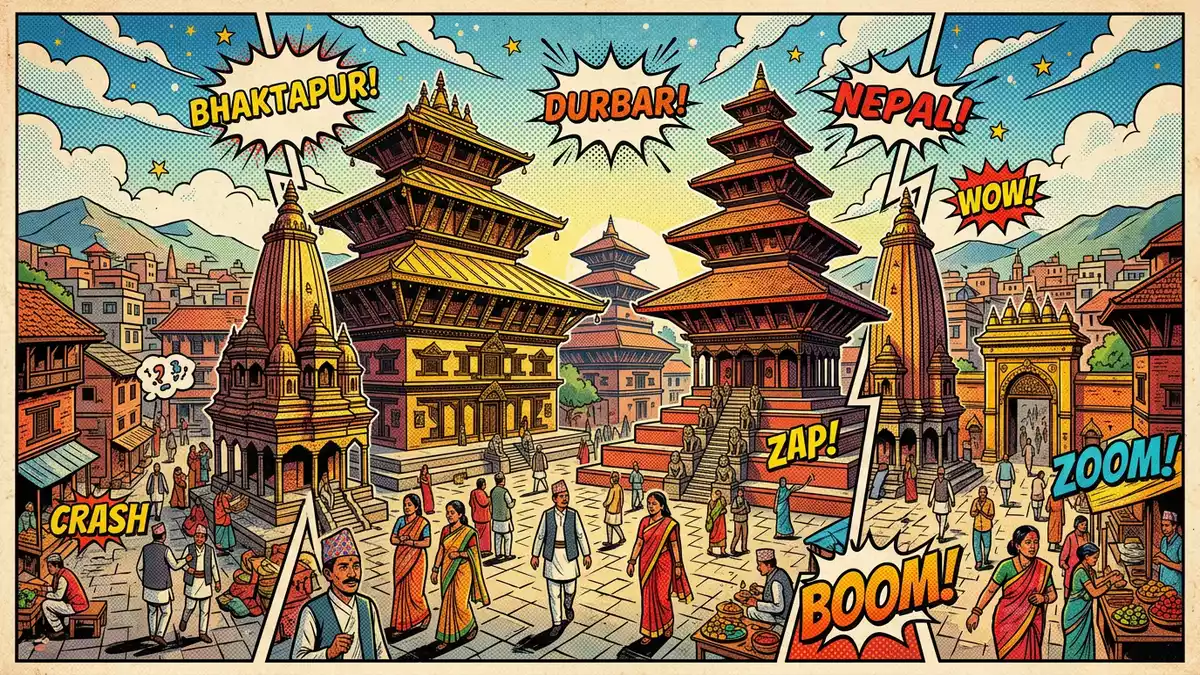
Bhaktapur Durbar Square is a historic urban ensemble in Bhaktapur, Nepal, where brick temples, timber details and palace courtyards occupy the same public space. The square belongs to the Kathmandu Valley’s monumental heritage and remains closely associated with the Newar architectural tradition.
Bhaktapur Durbar Square: a square shaped by brick and timber
Red brick gives the square its dominant colour, while carved timber appears in windows, doorways, struts and roof supports. These materials form a dense architectural language across temples, palace buildings and smaller shrines. The result is not a single monument but a connected group of structures arranged around open urban space.
Pagoda roofs rise above the square in stacked tiers, with finials marking the upper edges of the buildings. The temples stand beside palace walls and courtyards, creating a sequence of façades rather than an isolated view. Stone images, metal fittings and carved surfaces add different textures to the brick setting.
Royal courtyards and Newar architectural detail
Bhaktapur Durbar Square developed as the ceremonial centre of the former Bhaktapur kingdom. The Malla dynasty shaped the city’s palace architecture and religious monuments, with much of the visible ensemble dating from the medieval and early modern periods.
The Golden Gate leads into the palace area and carries elaborate metalwork. Behind it lies the palace complex associated with Bhaktapur’s royal history, including courtyards, shrines and carved architectural elements. The National Art Gallery occupies part of the palace precinct and presents works connected with Nepalese art.
Among the square’s best-known monuments is Nyatapola Temple, a five-storey pagoda dedicated to Siddha Lakshmi. Its broad stairway rises through a sequence of guardian figures, including elephants, lions, griffins and deities. The temple’s vertical form is one of the clearest examples of Bhaktapur’s layered pagoda architecture.
From palace precinct to living historic city
The square is part of the Kathmandu Valley World Heritage property, inscribed in 1979. Its buildings belong to a wider historic cityscape that includes religious courtyards, narrow streets, water conduits and traditional houses.
Bhaktapur’s cultural identity is closely linked with the Newar communities of the valley. Hindu and Buddhist traditions appear together in the city’s temples, shrines, festivals and artistic practices. Religious images and ritual spaces remain part of the urban fabric, rather than being confined to a single museum setting.
Earthquakes have damaged buildings in the Kathmandu Valley, including monuments in Bhaktapur. Repairs and conservation have shaped the appearance of parts of the square, while surviving carvings, inscriptions and structural forms preserve links with the city’s royal past. The visible ensemble therefore contains both historic fabric and evidence of continued care.
Visiting Bhaktapur Durbar Square: what travellers from Western Europe should know
- Bhaktapur lies east of Kathmandu in the Kathmandu Valley. Road transport from Kathmandu reaches the city through the valley’s urban corridor.
- The square is an open historic precinct with paved surfaces, steps, courtyards and uneven thresholds around temples and palace buildings.
- Nyatapola Temple stands on a raised platform reached by a long flight of steps. The upper parts of the monument are viewed from the square below.
- The official language is Nepali and the currency is the Nepalese rupee.
- Entry requirements depend on your nationality; UK travellers can check the FCDO travel advice at gov.uk/foreign-travel-advice, Irish travellers the Department of Foreign Affairs at ireland.ie.
Searching for Bhaktapur Durbar Square on social platforms
These links open searches for Bhaktapur Durbar Square on each platform.
Frequently asked questions about Bhaktapur Durbar Square
Where is Bhaktapur Durbar Square?
Bhaktapur Durbar Square is in the historic centre of Bhaktapur, an urban settlement east of Kathmandu in Nepal’s Kathmandu Valley.
What can visitors see there?
The square contains palace buildings, courtyards, pagoda temples, carved timber details, stone images and the Golden Gate. Nyatapola Temple stands nearby within the same historic city.
What makes the square distinctive?
Its distinctive character comes from the close grouping of red-brick architecture, carved timber, royal courtyards and active Hindu and Buddhist sacred spaces.


