
Bayon and its stone faces at the heart of Angkor Thom
Published on 09/16/2026 at 22:13 | Editorial responsibility: Rafael Müller, Editor-in-Chief AD HOC NEWS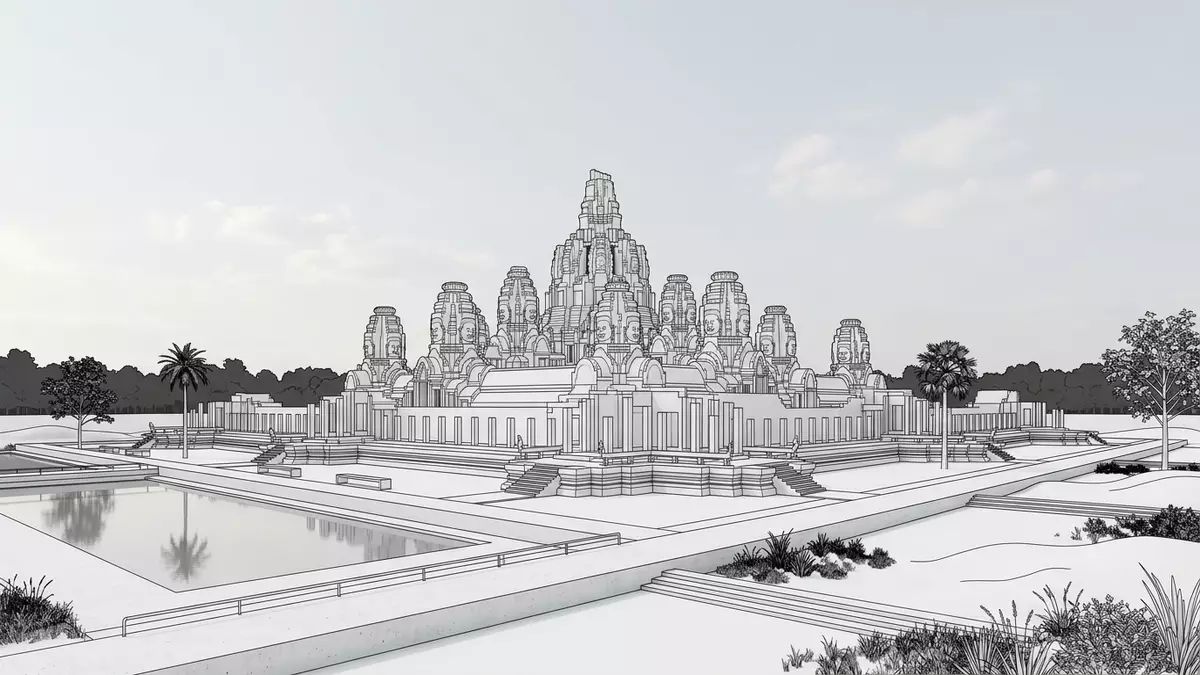
At the centre of Angkor Thom near Siem Reap, Bayon rises as a compact stone mountain whose towers carry enormous carved faces looking out in all directions. Built in the late twelfth and early thirteenth centuries as the state temple of King Jayavarman VII, it marks the moment when Mahayana Buddhism became the official religion of the Khmer Empire and gives that shift a striking architectural form.
A state temple at the centre of Angkor Thom
Bayon stands at the geographical and symbolic centre of Angkor Thom, the walled city that Jayavarman VII established as his new capital during his reign from 1181 to the early thirteenth century.state temple of King Jayavarman VII The temple forms a multi-storey pyramid built principally from sandstone, rising above a series of galleries that ring the inner sanctuaries.Cambodian Buddhist pyramid temple This “temple mountain” layout echoes other Angkor monuments, but here it carries a different religious content: instead of a Hindu shrine at the summit, Bayon embodies Jayavarman VII’s adoption of Mahayana Buddhism as a royal cult.only Buddhist state temple at Angkor
The temple’s main mass dates to around 1200, with construction traditionally dated to the late twelfth and early thirteenth centuries rather than a single year.constructed c.1200 at the behest of Jayavarman VII It was the last state temple built in the Angkor complex and served both as the spiritual focus of the new capital and as a monument closely linked to the king’s own person.last state temple to be built at Angkor Later, under rulers such as Jayavarman VIII in the thirteenth century, elements of its Buddhist imagery were reworked and additions were made for Brahmanical deities, but the underlying structure remained a dense cluster of towers rising from a stepped base.converted back to Hinduism under Jayavarman VIII
The face towers and the “Bayon smile”
What distinguishes Bayon among the temples of Angkor is the extraordinary system of towers whose upper blocks are carved into vast human faces. Roughly thirty-seven towers survive, many of them carrying four faces each, oriented to the cardinal directions, which together produce around two hundred individual visages rising above the galleries.37 remaining face towers Each face has downcast eyes, full lips and a gentle, controlled smile that has become known as the “Bayon smile”, an expression repeated across Khmer Buddhist art of this period.Bayon smile expression
The faces are cut into the masonry of the towers rather than added as separate sculptures, so the structure and the image are inseparable.sculpture is the structure Scholars generally link them to the bodhisattva Avalokiteshvara, also known as Lokeshvara, a figure of compassion central to Mahayana Buddhism, while also noting their resemblance to iconographic portraits of Jayavarman VII.faces as Avalokiteshvara and Jayavarman VII On the upper terrace, visitors move through a maze of these towers, passing narrow passages and small courts where the carved faces appear at different heights and angles above the stone paving.circular upper terrace with face towers
Galleries, bas-reliefs and later history
Below the tower cluster, Bayon’s outer gallery carries extensive bas-reliefs that run along its walls. These carved panels depict battles involving the Khmer forces as well as scenes from everyday life, including markets, river activities and domestic routines, giving a detailed picture of society during Jayavarman VII’s era.outer gallery bas-reliefs Inside the inner galleries, the layout becomes more intricate, with successive enclosures and smaller shrines arranged around the temple’s vertical core.
Bayon forms part of the wider Angkor archaeological complex, which is recognised on the World Heritage List, and the temple itself has been the focus of long-running conservation efforts.safeguarding Bayon Temple Angkor Thom project Work led with international support, including projects guided by Waseda University and the APSARA National Authority, has stabilised major structures and documented the condition of stones and carvings. As part of Angkor Thom, Bayon sits within a landscape of other gates and temples, yet its dense mass of towers and the concentration of stone faces give it a character distinct from the long axial galleries of nearby Angkor Wat.contrast with Hindu tradition of Angkor Wat
Visiting Bayon: what travellers from Western Europe should know
- Bayon stands at the centre of Angkor Thom, north of Angkor Wat, reached from Siem Reap by road into the Angkor archaeological park and through the monumental city gates.
- The temple is built as a stepped stone pyramid with multiple levels; the upper terrace is reached by staircases and involves climbing over uneven sandstone blocks and negotiating narrow passages between towers.
- The official language is Khmer and the currency is the Cambodian riel.
- Entry requirements depend on your nationality; UK travellers can check the FCDO travel advice at gov.uk/foreign-travel-advice, Irish travellers the Department of Foreign Affairs at ireland.ie.
Searching for Bayon on social platforms
These links open searches for Bayon on each platform.
Frequently asked questions about Bayon
Where is Bayon located?
Bayon stands at the centre of Angkor Thom, within the Angkor archaeological complex near Siem Reap in north-western Cambodia.
What should visitors expect at Bayon?
Visitors encounter a stepped stone temple with galleries of bas-reliefs and an upper terrace crowded with towers, many of them carved into large serene faces.
What makes Bayon distinctive among Angkor temples?
Bayon is distinctive for its face towers carrying around two hundred carved images and for its role as Jayavarman VII’s Buddhist state temple at the heart of Angkor Thom.


