
Batu Caves and the rainbow climb into Malaysia’s limestone heart
Published on 09/04/2026 at 06:47 | Editorial responsibility: Rafael Müller, Editor-in-Chief AD HOC NEWS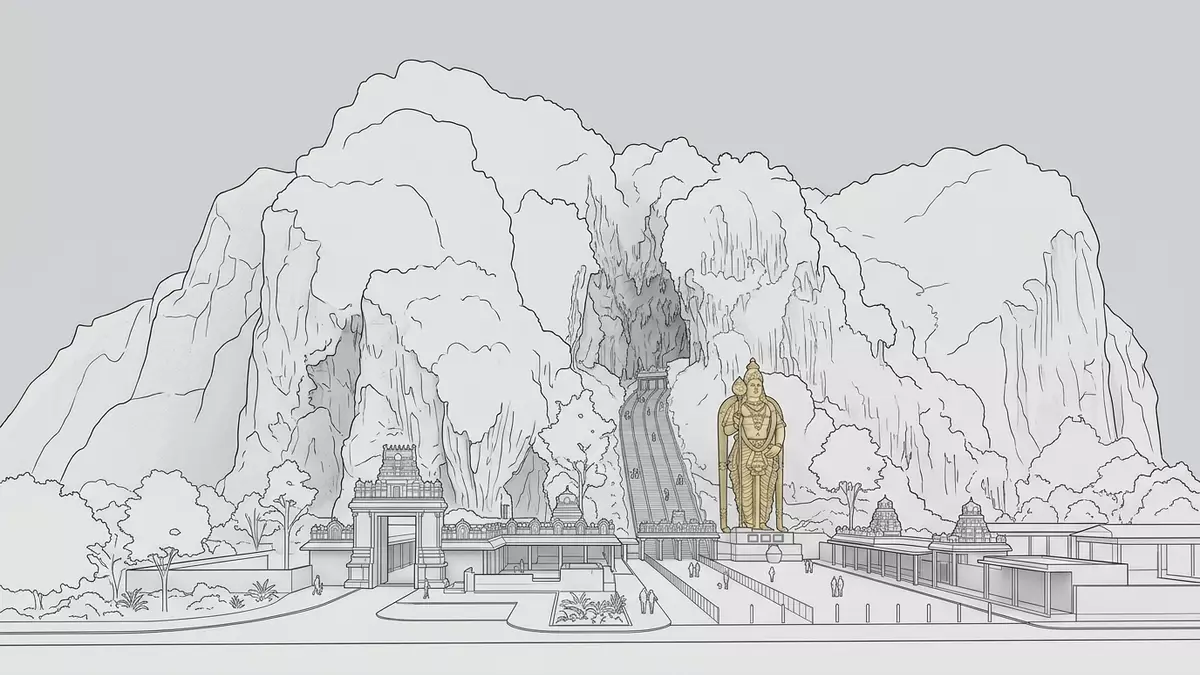
Batu Caves near Gombak in Malaysia is a limestone hill where Tamil Hindu devotion and ancient rock share the same steep climb. The caves entered the historical record in 1878 through the account of American naturalist William Temple Hornaday, and by 1891 K. Thamboosamy Pillai had established a temple to Lord Murugan in the main chamber, turning the hill into a major pilgrimage centre.Batu Caves
Limestone hill, ancient caves and a temple in the rock
The hill known as Batu Caves rises north of central Kuala Lumpur, its flanks made of limestone that formed over hundreds of millions of years. The rock has weathered into cliffs and gullies, with several cave mouths opening in the face of the hill above the surrounding urban landscape, giving the site its mixture of natural geology and built devotion.limestone hills in the area The limestone itself has long attracted human use: indigenous Temuan people used some cave entrances as shelters, and Chinese settlers were later recorded mining bat guano in the caves to fertilise vegetable plots.Temuan people and Chinese settlers
The modern religious character of the hill is closely linked to the late nineteenth century. In accounts of Batu Caves, William Temple Hornaday’s description in 1878 is cited as the moment the caves became known beyond local communities, while Tamil businessman K. Thamboosamy Pillai is credited with recognising the cave as a suitable site for a shrine to Murugan and installing a consecrated image of the deity in 1891.installed the murti of Subramania Swamy The limestone hill therefore carries two histories at once: an ancient geological past and a more recent story of colonial exploration and Tamil Hindu settlement.
Temple Cave, Lord Murugan and the rainbow stairway
The main focus for visitors is Temple Cave, a large chamber reached by a flight of concrete steps climbing the face of the hill. At the foot of the hill stands a towering statue of Lord Murugan, described in several sources as one of the tallest Murugan sculptures in the world and recorded at around 42.7 m (140 ft) high, its golden surface and upright spear marking the entrance to the sacred complex.42.7m golden sculpture The staircase itself has become widely recognised for its brightly painted steps, rising in bands of colour that echo the shrines and statues set along the route.
At the top of the climb, the temple complex occupies the cavern now known as Temple Cave or Cathedral Cave, a name linked to Hornaday’s comparison of its volume to a vast hall in his nineteenth-century travel writing.Cathedral Cave still used for the temple cave Inside, the Sri Subramaniar Swamy Temple is dedicated to Murugan (also known as Subramaniar or Karttikeya), and stands among stalactites and other limestone formations that descend from the roof and walls. Altars, gopuram-like decorative elements and smaller shrines share the space with patches of daylight that reach the interior from higher openings in the rock. The combination of Hindu temple architecture and limestone surfaces gives Temple Cave a character distinct from purpose-built urban temples.
Thaipusam and Batu Caves as a pilgrimage centre
Batu Caves is closely associated with the annual Thaipusam festival, a Tamil Hindu observance devoted to Lord Murugan and dated to the full moon in the Tamil month of Thai, which falls between mid-January and mid-February.Thaipusam in the Tamil month of Thai Thaipusam commemorates the gift of the divine spear, or vel, from Parvati to Murugan and his victory over the demon Soorapadman, a mythic narrative that informs the symbolism at the site. Batu Caves has hosted Thaipusam observances since 1892, and in sources on the region it is described as a major centre of Tamil Hindu pilgrimage in Southeast Asia.Thaipusam first celebrated in 1892
During Thaipusam, processions move from central Kuala Lumpur towards Batu Caves, with devotees carrying kavadi structures and containers of milk as an offering to Murugan, converging on the Sri Subramaniar Swamy Temple at the top of the stairway.Sri Subramaniar Swamy Temple at Batu Caves On other days the same stairway carries temple visitors from the Kuala Lumpur region, and the hill functions both as a religious site and as a place where travellers encounter Tamil Hindu ritual embedded in a Malaysian landscape. The enduring link between the caves and Thaipusam means that the site’s identity is shaped as much by annual cycles of worship as by its geology.
Visiting Batu Caves: what travellers from Western Europe should know
- Batu Caves stands in the district of Gombak, just north of Kuala Lumpur, and is reached by road or rail links from the city, including services on the KTM Komuter network to Batu Caves station.Batu Caves in Malaysia Travel Guide
- The climb to Temple Cave runs up a long flight of concrete steps on the limestone face, a sustained ascent that can be demanding in humid conditions and requires steady footing.
- The terrain around the hill combines paved temple courtyards with exposed limestone and vegetation, and macaques are commonly seen near the stairway and shrines.
- Malaysia’s official language is Malay and the currency is the Malaysian ringgit.
- Entry requirements depend on your nationality; UK travellers can check the FCDO travel advice at gov.uk/foreign-travel-advice, Irish travellers the Department of Foreign Affairs at ireland.ie.
Searching for Batu Caves on social platforms
These links open searches for Batu Caves on each platform.
Frequently asked questions about Batu Caves
Where is Batu Caves and what kind of place is it?
Batu Caves is a limestone hill with several caves and Hindu shrines in the Gombak district of Selangor, just north of Kuala Lumpur in Malaysia.
What should a visitor expect on a first visit?
Visitors encounter temple courtyards, the large golden statue of Lord Murugan, a long painted stairway up the limestone face and the cavern of Temple Cave with shrines inside.
What makes Batu Caves distinctive among temple sites?
The combination of an ancient limestone hill, a significant Tamil Hindu temple to Murugan founded in 1891 and the Thaipusam pilgrimage gives Batu Caves a character rooted in both geology and faith.


