
Batu Caves, a limestone temple hill above Gombak
Published on 09/10/2026 at 14:49 | Editorial responsibility: Rafael Müller, Editor-in-Chief AD HOC NEWS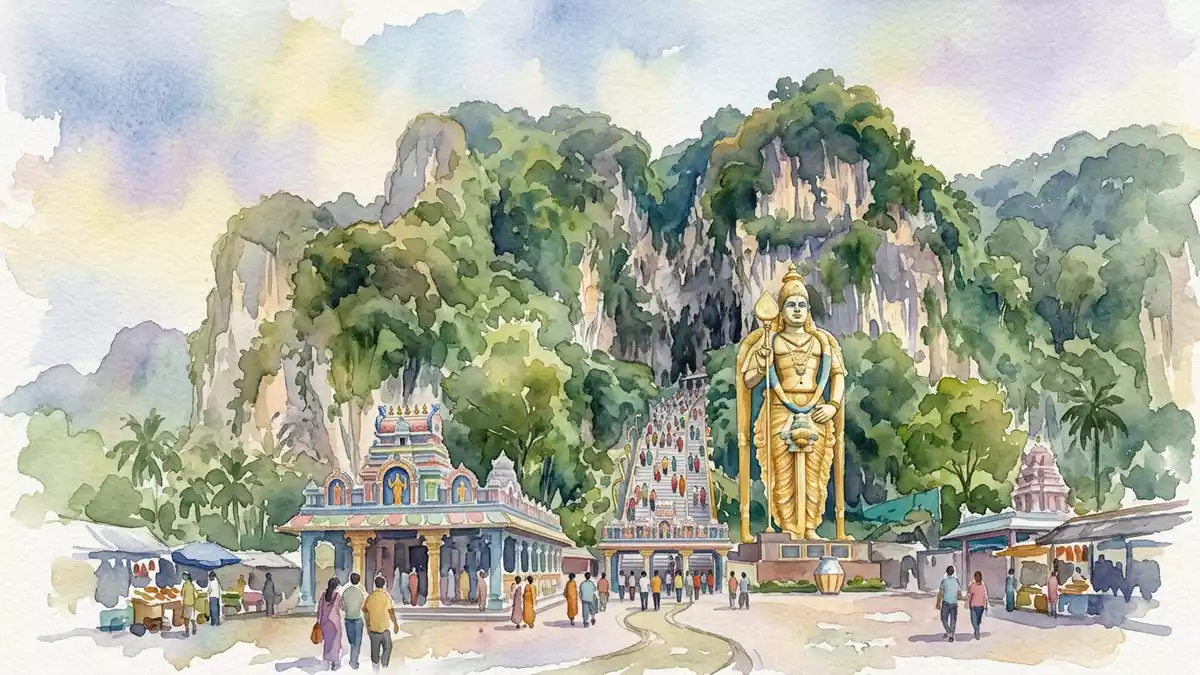
North of Kuala Lumpur in Malaysia, Batu Caves rises above Gombak as a limestone hill whose caverns hold one of the country’s most prominent Hindu temple complexes. The hill’s limestone has been dated to ancient geological periods, while the modern temple focus took shape in the late nineteenth century under Tamil Hindu patron K. Thamboosamy Pillai.
A limestone hill turned into a Hindu temple complex
Batu Caves is a limestone outcrop with multiple caves and cave temples set in the Gombak district of Selangor in peninsular Malaysia, around 13 km (8.1 mi) north of central Kuala Lumpur.complex of limestone grottoes The hill stands around 325 m (1,066 ft) high, its steep cliffs rising from the urban edge and forested land to form a conspicuous natural landmark.325 m tall mogote The caves take their name from the nearby Batu River, and over time the largest caverns have been adapted as spaces for worship, shrines and processions while smaller caves remain more natural.
The main religious focus is the Temple Cave, also known as Cathedral Cave, a high chamber within the hill that functions as an active shrine to Lord Murugan, a major deity in Tamil Hindu tradition.shrine established here to Lord Murugan Devotional activity there took shape in the 1890s, when K. Thamboosamy Pillai and other Tamil merchants consecrated the cavern as a temple site during the British colonial era.consecrated the largest cavern in the 1890s Since then the cave complex has developed into a significant place of pilgrimage for Tamil Hindus in Malaysia and beyond, while also drawing tourists who come to see the combination of geology and religious architecture.
The golden Murugan statue and the rainbow staircase
At the foot of Batu Caves, the base of the hill is fronted by a towering gold-painted statue of Lord Murugan beside the long staircase that leads up to the Temple Cave. The statue stands 42.7 m (140 ft) high, and when it was unveiled on 29 January 2006 it became the tallest statue in Malaysia.42.7-metre gold Lord Murugan statue unveiled in 2006 Its figure, facing the approach, sets a strong visual axis for the entire site, with the limestone cliffs rising behind it.
Beside the statue, a straight flight of 272 concrete steps climbs from the forecourt up into the entrance of the Temple Cave. Concrete stairs replaced earlier wooden steps in 1940, and the current staircase gained international attention when its steps were painted in bright rainbow colours in 2018, turning the ascent itself into a vivid visual element.272 concrete steps painted in rainbow colours in 2018 From the base, visitors see the coloured bands rising directly towards the limestone opening, the temple buildings clustered at the top and the cliffs framing the whole composition.
Cave chambers from natural grotto to temple space
The Batu Caves complex consists of several named cave chambers, each with its own character. The Temple Cave at the top of the main stairs forms a large vaulted interior with shrines and small temple structures set on the cave floor, and daylight entering through openings overhead onto the rock surfaces.large cave converted into a temple Lower on the hill and around its base are other caves adapted as themed attractions and shrines, including the Ramayana Cave, where sculptures and painted scenes narrate episodes from the Ramayana epic, centred on figures such as Rama and Hanuman.Ramayana Cave attraction
Another part of the hill is known as the Dark Cave, a conservation-oriented cave system left in a relatively natural state, with limestone formations and a specialised ecosystem that has attracted scientific interest.natural state Dark Cave ecosystem Around the base, the Cave Villa provides further cave interiors adapted with artworks and displays. Across the complex, the caves share the same underlying limestone geology thought to date from hundreds of millions of years ago, while their uses range from temple halls to protected habitats.
Visiting Batu Caves: what travellers from Western Europe should know
- Batu Caves stands on the northern edge of the Kuala Lumpur urban area in the Gombak district of Selangor; it is reached by suburban rail services and roads from the city.
- The climb to the main Temple Cave involves ascending a long, steep staircase with 272 steps, which can be demanding, especially in hot and humid weather.
- Around the hill and on the staircase, long-tailed macaques are common; they move freely through the complex and are accustomed to people.
- The terrain combines hard concrete steps, uneven cave floors and exposed rock, so sturdy footwear is helpful for exploring more than the forecourt.
- The official language is Malay and the currency is the Malaysian ringgit.
Searching for Batu Caves on social platforms
These links open searches for Batu Caves on each platform.
Frequently asked questions about Batu Caves
Where is Batu Caves and what kind of place is it?
Batu Caves is a limestone hill with a complex of caves and Hindu temple spaces in the Gombak district of Selangor, around 13 km (8.1 mi) north of Kuala Lumpur.
What should visitors expect on a visit to Batu Caves?
Visitors encounter a large gold-painted statue of Lord Murugan, a long rainbow-coloured staircase, active Hindu shrines and cave interiors combining temple structures with exposed limestone rock.
What makes Batu Caves distinctive among temple sites?
The combination of ancient limestone cliffs, the height of the hill, the 42.7 m Murugan statue and the 272-step rainbow staircase into a high temple cavern makes Batu Caves distinctive.


