
Basilique Notre-Dame de Montreal and its Gothic Revival form
Published on 09/12/2026 at 15:03 | Editorial responsibility: Rafael Müller, Editor-in-Chief AD HOC NEWS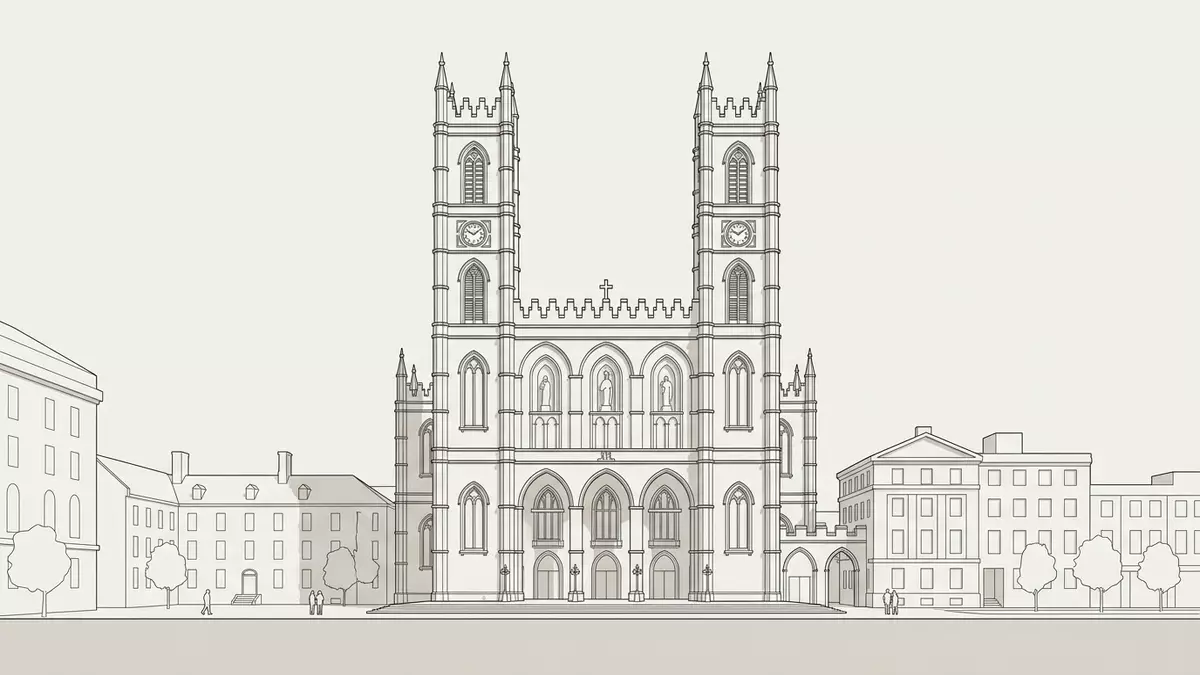
Basilique Notre-Dame de Montreal rises above Old Montreal as a Gothic Revival church of grey stone, twin towers and a richly layered interior. It was built between 1824 and 1829, with James O'Donnell named to the project, and it remains the city’s mother church.
James O'Donnell’s Gothic Revival basilica
The basilica is a nineteenth-century stone church linked with James O'Donnell and the period between 1824 and 1829. Its first major identity is architectural rather than monumental: a parish church raised in the Gothic Revival style, with a symmetrical front and two towers.
That combination gives the building a disciplined exterior and a highly worked interior. The basilica is also recognised as a national historic site, and the national designation places it among the country’s formally protected religious landmarks.
Stone outside, colour inside
The exterior keeps to Montreal grey stone and pointed openings, while the interior turns to colour, gilt and painted surfaces. The contrast is reinforced by later decoration associated with Victor Bourgeau, who worked on the interior in the nineteenth century.
Blue vaulting with gold stars is one of the basilica’s most recognisable interior features, and the nave reads more ornate than the outside suggests. The building’s formal status as Montréal’s mother church sits naturally beside that visual contrast, because the place has both parish gravity and decorative ambition.
Montreal parish history in one building
The basilica stands within a long parish history that predates the present church and is tied to the Sulpicians. Its place in the city is not only architectural, but also institutional: it served the Catholic heart of Montreal and later received the rank of minor basilica in 1982.
The same building therefore carries several layers at once: O'Donnell’s design, Bourgeau’s interior work and the nineteenth-century Gothic Revival frame. It is also a landmark of Canadian Gothic Revival, a phrase that fits its role in church architecture without reducing it to a single decorative effect.
Visiting Basilique Notre-Dame de Montreal: what travellers from Western Europe should know
- The basilica stands at 110 Notre-Dame Street West in Old Montreal, near Place d’Armes and the Saint-Sulpice area. It is reached on foot through the historic centre and by Montreal’s metro network via nearby stations.
- The building presents a stone exterior and a tall interior volume. The nave, towers and richly decorated surfaces make the scale legible from several angles.
- The official language is French and the currency is the Canadian dollar.
- Entry requirements depend on your nationality; UK travellers can check the FCDO travel advice at gov.uk/foreign-travel-advice, Irish travellers the Department of Foreign Affairs at ireland.ie.
Searching for Basilique Notre-Dame de Montreal on social platforms
These links open searches for Basilique Notre-Dame de Montreal on each platform.
Frequently asked questions about Basilique Notre-Dame de Montreal
Where is Basilique Notre-Dame de Montreal?
It stands in Old Montreal on Notre-Dame Street West, close to Place d’Armes. The surrounding district gives the basilica a dense urban setting of historic streets and stone façades.
What should a visit there involve?
The main impression comes from the exterior towers and the richly decorated nave. The interior mixes dark wood, colour and gilded ornament with a strong vertical profile.
What makes the basilica distinctive?
James O'Donnell’s Gothic Revival design and Victor Bourgeau’s interior work create a sharp contrast between outside and inside. Its status as Montreal’s mother church and as a National Historic Site adds historical weight to that visual split.


