
Basilique Notre-Dame de Montreal and its Gothic Revival drama
Published on 08/29/2026 at 22:37 | Editorial responsibility: Rafael Müller, Editor-in-Chief AD HOC NEWS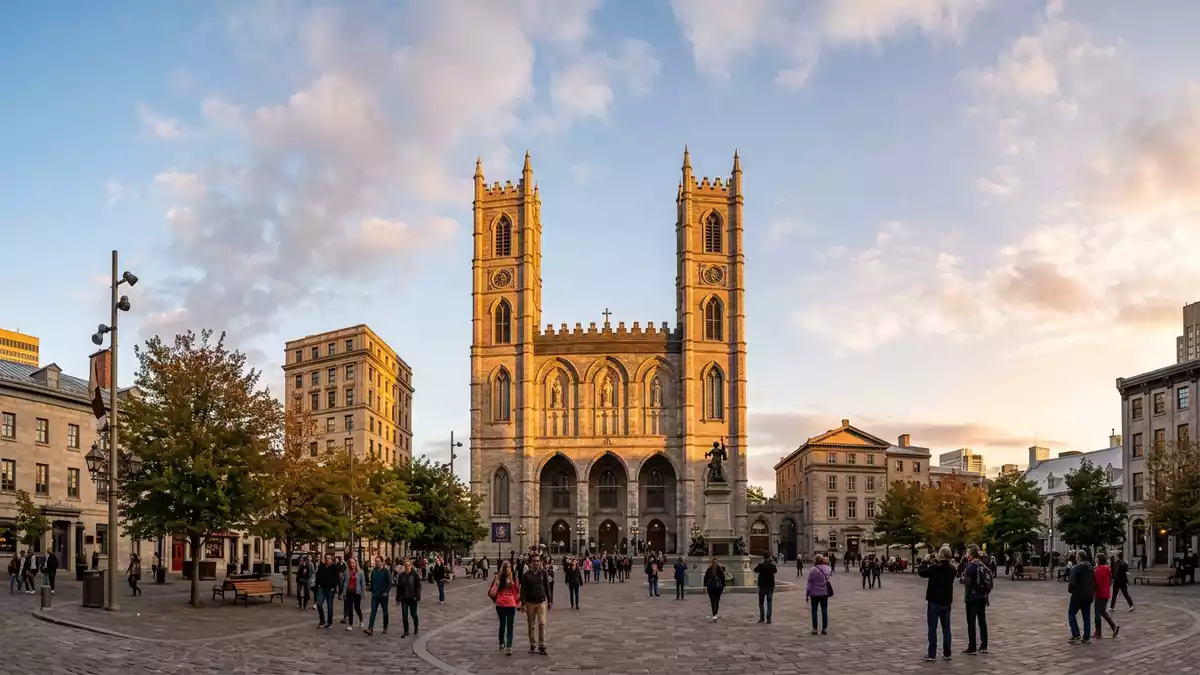
Basilique Notre-Dame de Montreal in Montreal is a Gothic Revival church where architecture and colour turn a historic Catholic basilica into an enveloping interior spectacle. Built in the 1820s under Irish-born architect James O’Donnell, its vast stone nave and twin towers frame an interior that later gained richly coloured decoration by Victor Bourgeau in the nineteenth century.
A nineteenth-century Gothic Revival landmark in Old Montreal
The basilica stands on Notre-Dame Street West in the historic Old Montreal district, facing Place d’Armes and neighbouring the Saint-Sulpice Seminary, so its façade forms part of a dense urban ensemble of stone architecture.Old Montreal district The present church was constructed between 1824 and 1829, replacing an earlier parish church that had become too small for a growing city in the early nineteenth century.constructed between 1824 and 1829
James O’Donnell, a New York-based, Irish-born architect, designed the building in the Gothic Revival style, drawing on medieval forms for a large North American Catholic church.Irish architect James O’Donnell The exterior, built of stone with a symmetrical front and two towers, became the first major example of Gothic Revival church architecture in Canada and later gained recognition as a National Historic Site of Canada.first significant example of the Gothic Revival style in Canada
From sober walls to a saturated interior
Inside, Basilique Notre-Dame de Montreal tells a second story of nineteenth-century design through its decor. O’Donnell’s initial interior was relatively plain and followed English Gothic traditions, which left the wall behind the altar flat and dominated by a large window. Later in the nineteenth century, parish leaders invited Montreal architect Victor Bourgeau to redesign the interior, and he worked from the 1870s onwards on a decorative scheme inspired by Sainte-Chapelle in Paris.inspired by Sainte-Chapelle in Paris
Bourgeau’s work introduced deep colour, gold-leaf motifs on the vaults and highly detailed carved elements along the columns and choir, creating a strong contrast with the relatively sober stone exterior. The nave now rises under dark blue vaults patterned with golden stars, while the high altar and reredos form a dense vertical composition of sculpted figures and tracery against a backdrop of saturated colour.gold-leaf motifs on the vault ceiling Stained-glass windows add another layer of narrative detail, presenting episodes from Montreal’s religious history rather than the more common biblical scenes and tying the decor directly to the city’s development from the seventeenth century.Montreal’s religious history
Mother church and minor basilica
Basilique Notre-Dame de Montreal serves as Montreal’s mother church, reflecting the central role it has played in the city’s Catholic life since the parish origins in the seventeenth century. The first parish church on Notre-Dame Street was built in the 1670s, and the basilica’s present structure continues that long line of worship on the same urban axis.Montréal's mother church In 1982, the church was elevated to the rank of minor basilica, and later it was formally recognised as a National Historic Site of Canada, underlining its importance within both religious and architectural heritage.
The basilica’s twin towers rise above Place d’Armes, and the building’s stone mass, Gothic-arched portico and large nave are characteristic of nineteenth-century Romantic Gothic Revival church design.massive twin towers Within that structure, later decorative campaigns have layered colour and carving onto the original framework, so a visit reveals an interplay between the early nineteenth-century architecture and the later nineteenth-century interior programme, all within a single, coherent sacred space.
Visiting Basilique Notre-Dame de Montreal: what travellers from Western Europe should know
- Basilique Notre-Dame de Montreal stands on Notre-Dame Street West in Old Montreal, facing Place d’Armes and close to the historic Saint-Sulpice Seminary.
- The interior is arranged around a long nave with seating and side aisles, leading towards a raised sanctuary framed by elaborate carved and painted decoration.
- The official language in Montreal is French and the currency is the Canadian dollar.
- Entry requirements depend on your nationality; UK travellers can check the FCDO travel advice at gov.uk/foreign-travel-advice, Irish travellers the Department of Foreign Affairs at ireland.ie.
Searching for Basilique Notre-Dame de Montreal on social platforms
These links open searches for Basilique Notre-Dame de Montreal on each platform.
Frequently asked questions about Basilique Notre-Dame de Montreal
Where is Basilique Notre-Dame de Montreal located?
Basilique Notre-Dame de Montreal is in the Old Montreal district on Notre-Dame Street West, facing Place d’Armes and next to the historic Saint-Sulpice Seminary.
What can visitors expect inside the basilica?
Visitors encounter a long Gothic Revival nave leading to a richly decorated sanctuary, with deep colours, gold-leaf patterns, carved woodwork and stained glass depicting episodes from Montreal’s religious history.
What makes Basilique Notre-Dame de Montreal distinctive among churches in Canada?
The basilica is Montreal’s mother church and Canada’s first major Gothic Revival church, combining a nineteenth-century stone structure by James O’Donnell with a later, highly coloured interior scheme by Victor Bourgeau.


