
Basilica of Our Lady of Peace and its vast dome in Yamoussoukro
Published on 09/14/2026 at 11:53 | Editorial responsibility: Rafael Müller, Editor-in-Chief AD HOC NEWS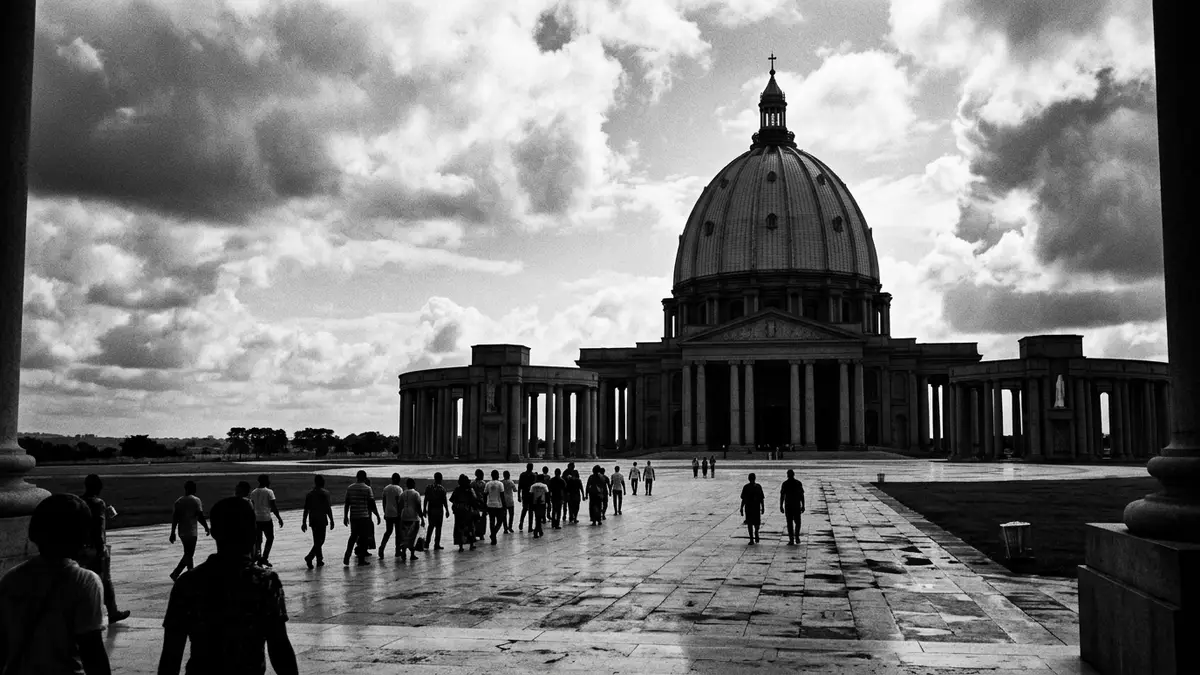
In Yamoussoukro, the political capital of Ivory Coast, the Basilica of Our Lady of Peace dominates the surrounding savannah with a vast dome and sweeping marble colonnades. Conceived in the 1980s under President Félix Houphouët?Boigny and consecrated in 1990, this Roman Catholic minor basilica has become one of the most striking Christian buildings of the late twentieth century, echoing the proportions and layout of St Peter’s Basilica in Rome while standing alone on the plains of West Africa.
A late twentieth-century mega-basilica on the savannah
The Basilica of Our Lady of Peace stands on the outskirts of Yamoussoukro, in the central region of Ivory Coast, set amid flat terrain and low-rise urban districts. Its official French name, Basilique Notre-Dame de la Paix de Yamoussoukro, reflects its dedication to Our Lady of Peace and its status as a minor basilica within the Roman Catholic Church.Basilique Notre-Dame-de-la-Paix de Yamoussoukro The project was launched in 1986 under the patronage of President Félix Houphouët?Boigny, whose political career was closely tied to Yamoussoukro, and the main construction phase ran until 1989, followed by its consecration by Pope John Paul II in 1990.consecration in 1990 by Pope John Paul II
The basilica was designed by Franco?Lebanese architect Pierre Fakhoury, who combined a modern structural approach with forms drawn from Renaissance and Baroque church architecture.architect Pierre Fakhoury A large dome rises above the central crossing, flanked by tall colonnades and extensive paved esplanades that spread out from the main body of the church into the surrounding landscape. The building has become closely associated with Ivory Coast’s late twentieth-century ambition to project a modern national identity through monumental architecture, while retaining classical church forms that remain legible to visitors from Europe and elsewhere.
Scale, dome and colonnades inspired by St Peter’s
From ground level, the most immediate aspect of the Basilica of Our Lady of Peace is its sheer scale. The main dome reaches a height that surpasses St Peter’s Basilica in Rome, and the overall footprint of the complex, including its esplanades and colonnaded wings, gives it a place among the largest Christian churches in the world.largest Christian church in the world The interior capacity is reported around 18,000 worshippers in the nave and galleries, while the adjoining exterior plaza can accommodate several times that number for outdoor liturgies.capacity of 18,000 worshippers
The plan and elevation closely echo the Vatican’s basilica, with a central dome, a long nave, radiating chapels and a broad frontal square framed by colonnades.architecture inspired by St Peter’s in Rome Marble, glass and bronze are used extensively, giving the building and its arcades a pale, reflective surface that stands out against the reddish soil and dry grassland beyond. Seen from a distance on the approach roads to Yamoussoukro, the dome appears above the horizon with the straight lines of the esplanade and the vertical rhythm of columns forming a complete ensemble that merges European church typology with an African setting.
Interior space, stained glass and liturgical function
Inside, the Basilica of Our Lady of Peace is arranged around a vast central volume beneath the dome, with rows of columns supporting the upper galleries and clerestory. The altar stands near the centre of this space, aligned with the main axis that runs from the entrance through the nave to the sanctuary, similar to the alignment in major European basilicas.Roman Catholic minor basilica in Yamoussoukro Around the perimeter, chapels and side aisles provide quieter areas for prayer, while the upper levels contain galleries and additional seating, all organised within the geometry set by the dome and supporting structures.
Stained glass is a prominent feature of the interior, with large windows depicting biblical figures and scenes associated with peace and fraternity, filtered through coloured glass into the monumental volume of the nave.Ivory Coast's mega-basilica The basilica is attached to the Diocese of Yamoussoukro and serves both as a local parish church and as a destination for pilgrims from Ivory Coast and neighbouring West African countries, with liturgies, processions and religious festivals taking place within the main hall and across the esplanades that extend from its façade.
Visiting Basilica of Our Lady of Peace: what travellers from Western Europe should know
- The Basilica of Our Lady of Peace stands on the outskirts of Yamoussoukro in central Ivory Coast, reached primarily by road from coastal cities such as Abidjan and served by Yamoussoukro’s regional airport.
- The immediate surroundings consist of broad paved esplanades, landscaped areas and open savannah, so visiting the basilica involves walking across extensive hard surfaces with little shade.
- The official language of Ivory Coast is French and the currency is the West African CFA franc.
- Entry requirements depend on your nationality; UK travellers can check the FCDO travel advice at gov.uk/foreign-travel-advice, Irish travellers the Department of Foreign Affairs at ireland.ie.
Searching for Basilica of Our Lady of Peace on social platforms
These links open searches for Basilica of Our Lady of Peace on each platform.
Frequently asked questions about Basilica of Our Lady of Peace
Where is the Basilica of Our Lady of Peace located?
The Basilica of Our Lady of Peace is in Yamoussoukro, the political capital of Ivory Coast in West Africa, in the country’s central region.location in Yamoussoukro, Ivory Coast
What can visitors expect on a visit to the basilica?
Visitors encounter a vast domed church with marble interiors, stained glass windows, chapels and extensive colonnades and esplanades set in the open savannah around Yamoussoukro.
What makes the Basilica of Our Lady of Peace distinctive among churches?
Its combination of late twentieth-century construction, a dome and plan inspired by St Peter’s in Rome, and its scale as one of the largest Christian churches built in Africa make it distinctive.largest Christian church


