
Basilica of Our Lady of Peace, a marble dome on the savannah
Published on 08/26/2026 at 21:20 | Editorial responsibility: Rafael Müller, Editor-in-Chief AD HOC NEWS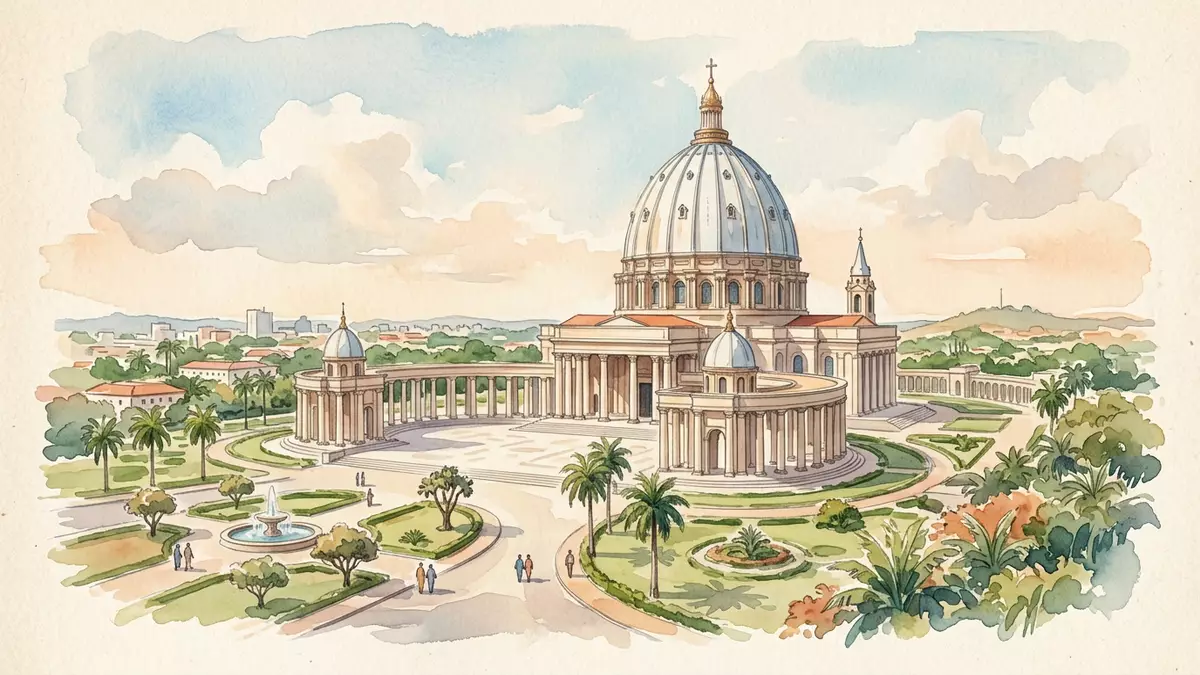
The Basilica of Our Lady of Peace in Yamoussoukro is a vast Roman Catholic church whose marble dome and colonnades rise above the flat savannah of central Ivory Coast. Conceived and built in the late 1980s and consecrated in 1990, it adapts the outline of St Peter’s Basilica in Rome to an African setting, using pale stone, stained glass and an immense footprint to create one of the largest Christian churches in the world.
A neo-Renaissance basilica on the Ivorian savannah
The Basilica of Our Lady of Peace stands in Yamoussoukro, the political and administrative capital of Ivory Coast in the centre of the country. It is a Roman Catholic minor basilica dedicated to Our Lady of Peace and is laid out as a Latin-cross church with a dominant dome rising above a long nave and flanking colonnades, recalling the form of St Peter’s in Vatican City.Latin-cross church The architectural language is described as neo-Renaissance and neo-Baroque, with classical orders, symmetry and a strong axis leading from the entrance across the plaza into the main interior.neo-Renaissance and neo-Baroque
The church was designed by architect Pierre Fakhoury, a Lebanese-Ivorian architect who was briefed to create a monumental basilica in Yamoussoukro.designed by Pierre Fakhoury Construction began in 1986 and was completed in 1989, with the basilica consecrated on 10 September 1990 by Pope John Paul II, anchoring it in the period of post-independence monumental building in Ivory Coast.construction 1986–1989 The building is clad externally in pale Italian marble, giving its surfaces a smooth, reflective finish that contrasts with the deep colours of the stained glass set into the facades and dome.
Scale, structure and marble detail
The basilica occupies an interior floor area in the region of 30,000 m², making it among the largest churches built in terms of covered space.floor area of 30,000 m² Its dome and cross reach a height of about 158 m (518 ft), a figure that places the building among the tallest Christian structures, and the main dome itself has a diameter recorded at about 90 m (295 ft).height and dome diameter The colonnades surrounding the church and framing the plaza are carried on hundreds of Doric-style columns in reinforced concrete, some rising over 30 m (98 ft), creating long covered arcades that guide visitors towards the entrances.
The interior continues the monumental treatment with marble paving, polished columns and extensive stained-glass glazing. Contemporary stained glass manufactured in France covers several thousand square metres, bringing coloured light into the nave, transepts and chapels and depicting Christian and African themes across the windows.contemporary stained glass Seating is provided for several thousand worshippers, with further space for congregants in the nave and under the great dome, and the large marble-clad esplanade outside can host substantial crowds for outdoor liturgies and civic ceremonies.capacity figures
A post-independence monument and Marian shrine
The Basilica of Our Lady of Peace is closely linked to the history of post-independence Ivory Coast and to the presidency of Félix Houphouët-Boigny. Houphouët-Boigny, the country’s first president, chose his birthplace Yamoussoukro as the site for the new administrative capital and for this monumental church during the 1980s.choice of Yamoussoukro The basilica forms part of a wider ensemble of state buildings in the city, but its religious dedication to Our Lady of Peace gives it a distinct identity as a Marian shrine as well as a national symbol.Marian shrine
The church has been described in records such as Guinness World Records as the largest church in the world when measured by internal surface area, exceeding St Peter’s Basilica by certain metrics.largest church by area It functions both as a parish church serving local Catholics in Yamoussoukro and as a destination for pilgrims and visitors interested in monumental twentieth-century church architecture in Africa. Its vast dome, sweeping colonnades and marble finishes present a striking encounter between European-influenced classical forms and the open landscape of central Ivory Coast.
Visiting Basilica of Our Lady of Peace: what travellers from Western Europe should know
- The basilica stands in Yamoussoukro in central Ivory Coast; the closest major city on the Atlantic coast is Abidjan, and the site is reached overland by road from there.
- The approach to the church crosses an expansive plaza and broad paved terraces, so a visit involves walking across open ground with little shade between the outer parking areas and the main entrances.
- The basilica lies within the political capital of Ivory Coast, where French is the official language and the national currency is the West African CFA franc (XOF).
- Entry requirements depend on your nationality; UK travellers can check the FCDO travel advice at gov.uk/foreign-travel-advice, Irish travellers the Department of Foreign Affairs at ireland.ie.
Searching for Basilica of Our Lady of Peace on social platforms
These links open searches for Basilica of Our Lady of Peace on each platform.Frequently asked questions about Basilica of Our Lady of Peace
Where is the Basilica of Our Lady of Peace located?
The Basilica of Our Lady of Peace stands in Yamoussoukro, the political and administrative capital of Ivory Coast in West Africa, roughly in the centre of the country.
What can visitors expect on a visit?
Visitors encounter a vast marble-clad church with a towering dome, long colonnades, extensive stained glass and an open plaza, all set against the low, flat surrounding landscape.
What makes the basilica distinctive among modern churches?
Its combination of neo-Renaissance and neo-Baroque architecture, immense scale, marble finishes and African setting mark it out as one of the largest and most visually striking Christian churches built in the late twentieth century.


