
Basilica i Temple Expiatori de la Sagrada Familia in Barcelona
Published on 08/31/2026 at 13:30 | Editorial responsibility: Rafael Müller, Editor-in-Chief AD HOC NEWS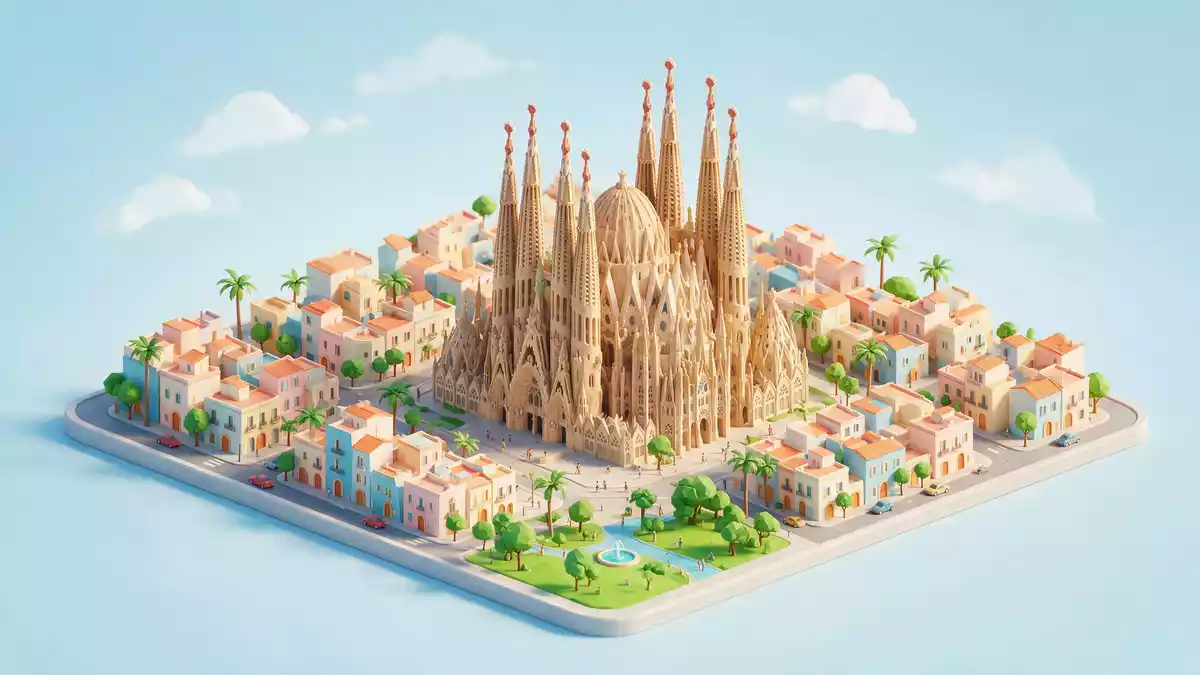
Basilica i Temple Expiatori de la Sagrada Familia in Barcelona is one of Antoni Gaudí’s defining works, and its unfinished silhouette still dominates the city skyline. Begun in 1882, the basilica combines a soaring urban presence with a dense vocabulary of towers, façades and carved stone.
Gaudí’s basilica in Barcelona
The church was taken over by Antoni Gaudí in 1883, after an initial project by Francisco de Paula del Villar. Its identity is tied to that turn, and to Gaudí’s long involvement with a building that remained under construction across generations. Antoni Gaudí in 1883 is the key name attached to the basilica, and the date anchors the story in late nineteenth-century Barcelona.
The exterior presents a forest of towers above the nave, with three major façades giving the building a strong and varied profile. The Nativity façade, the Passion façade and the Glory façade are the most immediate markers of the structure. three façades and the church’s long construction history are central to how it is read at street level.
Stone, towers and façades
Sagrada Familia is built in a highly individual Modernisme idiom, with forms that move between Gothic reference and organic invention. The language of the building is visible in the clustered verticals, the deep sculptural surfaces and the way the mass breaks into a series of distinct parts. basilica in Barcelona and its stone architecture make the building legible from near and far.
The façades carry much of the basilica’s character, each with its own sculptural density and narrative subject. The Nativity façade is associated with the east side, the Passion façade with the west side, and the Glory façade forms the main entrance front. UNESCO World Heritage recognition for parts of the work underlines its place within Gaudí’s wider legacy in Barcelona.
A basilica still under construction
The building remains unfinished, and that open-ended condition is part of its identity. The basilica is associated with a long sequence of works, interruptions and restarts that have left different generations visible in the same structure. begun in 1882 is the most reliable date to hold in mind when reading the site as a whole.
The result is a place where the unfinished and the monumental sit together without contradiction. Visitors see a functioning church, a major work of modern architecture and a structure whose towers, façades and sculptural programme continue to define the skyline of Barcelona. Gaudí’s years on the project are part of the building’s historical weight, but the place itself remains the clearest evidence.
Visiting Basilica i Temple Expiatori de la Sagrada Familia: what travellers from Western Europe should know
- The basilica stands in Barcelona’s Eixample district, close to the city’s grid of broad streets and regular blocks. The nearest Metro stations are Sagrada Família and nearby stops on the Barcelona network.
- The building is large and vertical, with façades that reward a slow circuit around the perimeter. The stone surfaces, carved figures and tower bases are easiest to read from street level and from the surrounding pavements.
- The official language is Catalan and Spanish, and the currency is the euro.
- The church is a working basilica as well as a major architectural monument. That combination shapes the atmosphere of the interior, where the liturgical role and the built form belong to the same place.
- Entry requirements depend on your nationality; UK travellers can check the FCDO travel advice at gov.uk/foreign-travel-advice, Irish travellers the Department of Foreign Affairs at ireland.ie.
Searching for Basilica i Temple Expiatori de la Sagrada Familia on social platforms
These links open searches for Basilica i Temple Expiatori de la Sagrada Familia on each platform.
Frequently asked questions about Basilica i Temple Expiatori de la Sagrada Familia
Where is Basilica i Temple Expiatori de la Sagrada Familia?
It stands in Barcelona, in the Eixample district, where its towers rise above the city grid. The building is one of Antoni Gaudí’s best-known works.
What does a visit involve?
The main experience is architectural: façades, stone carving, towers and the large interior volume. The exterior circuit adds another layer, because the building reads differently from each side.
What makes the basilica distinctive?
Its combination of unfinished status, Gaudí’s authorship and highly sculptural Modernisme forms gives it a rare presence in Barcelona. The three façades and multiple towers make that character visible from several angles.


