
Basilica i Temple Expiatori de la Sagrada Familia and Gaudí's stone forest
Published on 09/14/2026 at 08:21 | Editorial responsibility: Rafael Müller, Editor-in-Chief AD HOC NEWS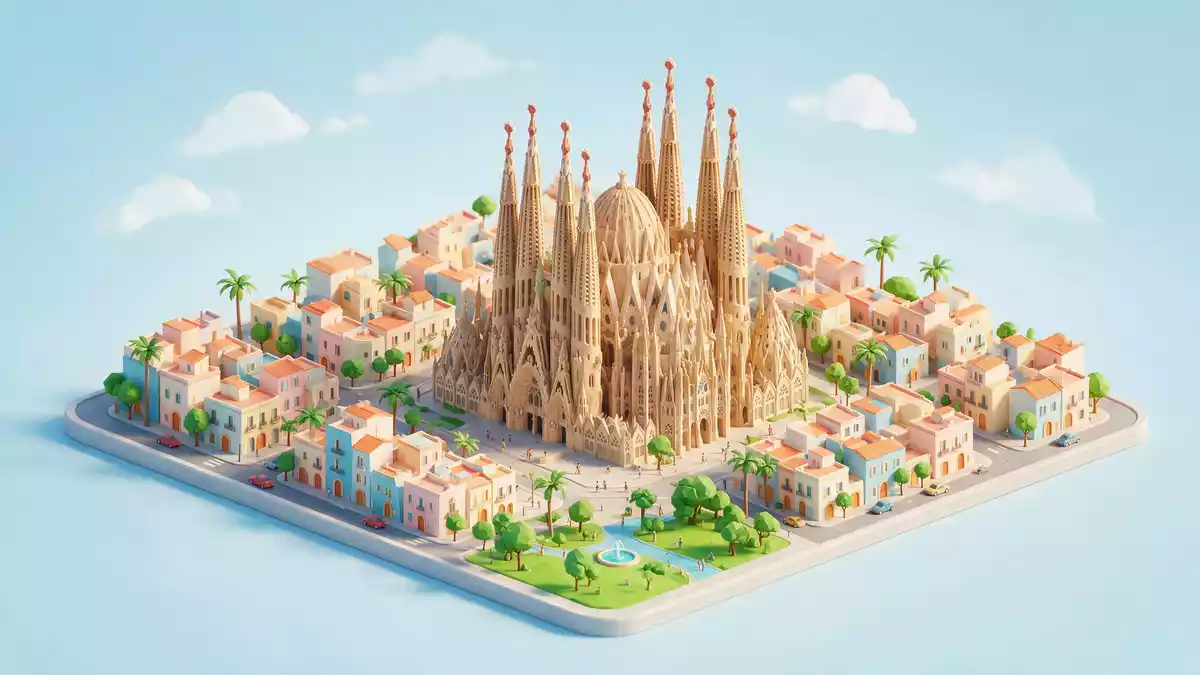
Basilica i Temple Expiatori de la Sagrada Familia is Antoni Gaudí’s great Barcelona church, begun in 1882 and still recognisably his in stone, towers and façades. Its power lies in the contrast between a strict basilica plan and an interior that reads like a forest of carved columns.
Gaudí’s basilica in Barcelona
The church stands in the Eixample district of Barcelona and is closely associated with Antoni Gaudí, who took over the project in 1883. The building is a Roman Catholic basilica, and its long construction history is part of its identity without defining its appearance.
Its formal recognition includes the UNESCO listing for the Works of Antoni Gaudí, which covers the Nativity façade and crypt. The church’s designation as a minor basilica adds another anchor to its religious and architectural status.
A façade sequence in carved stone
The exterior is organised around three façades: Nativity, Passion and Glory. Each one carries a different sculptural character, with the Nativity side dense and ornamental, and the Passion side more severe in outline and figure.
The church’s towers rise above the façades and give the building its unmistakable profile. Their vertical rhythm is a visible counterpoint to the basilica plan below, and the whole mass reads as a layered composition rather than a single block.
The building’s materials matter as much as its silhouette. Stone dominates the surfaces, and the work of carving gives the façades their sharp depth, shadow and texture.
The interior as a stone forest
Inside, the nave opens on to rows of branching columns that spread upward like trunks and limbs. This is the most striking space in the building, and it turns structural support into a visual landscape.
The plan remains legible beneath the ornament. A Latin cross layout, aisles and a tall central volume give the church a clear ecclesiastical order, while Gaudí’s surfaces make that order feel transformed.
The building’s interior also connects to Gaudí’s wider body of work in Barcelona, where Modernista design often mixes structure and decoration. Here the effect is especially strong because the stone, geometry and sculpture belong to one continuous whole.
Visiting Basilica i Temple Expiatori de la Sagrada Familia: what travellers from Western Europe should know
- The basilica stands in the Eixample district of Barcelona, near the city’s grid of broad streets. The Sagrada Família station on the metro places it within the urban core.
- The church is large and vertical, with towers and a high interior volume. The façades and nave reward slow looking because the details shift between distance and close range.
- The interior uses stone, stained glass and branching supports. Those elements create a clear contrast between the exterior mass and the space inside.
- The official language is Catalan and Spanish, and the currency is the euro.
- Entry requirements depend on your nationality; UK travellers can check the FCDO travel advice at gov.uk/foreign-travel-advice, Irish travellers the Department of Foreign Affairs at ireland.ie.
Searching for Basilica i Temple Expiatori de la Sagrada Familia on social platforms
These links open searches for Basilica i Temple Expiatori de la Sagrada Familia on each platform.
Frequently asked questions about Basilica i Temple Expiatori de la Sagrada Familia
Where is Basilica i Temple Expiatori de la Sagrada Familia?
It stands in Barcelona’s Eixample district, among the city’s broad grid streets. The basilica is closely linked with Antoni Gaudí and the architectural identity of the city.
What does a visit reveal?
The visit reveals a large church defined by façades, towers and a vast interior. Stone carving and branching supports are central to what can be seen.
What makes it distinctive?
Its distinction lies in the combination of Gaudí’s design, the unfinished basilica form and the sculptural treatment of the surfaces. The Nativity façade, the Passion façade and the interior all present different aspects of the same building.


