
Basilica i Temple Expiatori de la Sagrada Familia and Gaudí’s forest of stone
Published on 08/27/2026 at 08:33 | Editorial responsibility: Rafael Müller, Editor-in-Chief AD HOC NEWS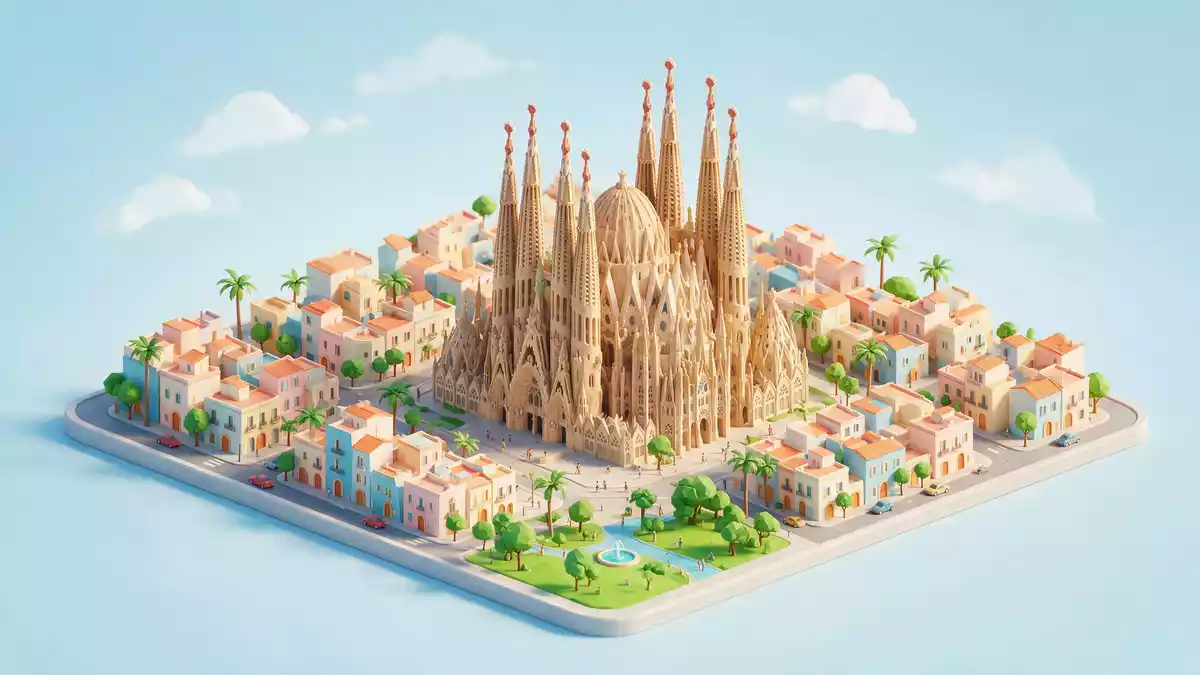
Basilica i Temple Expiatori de la Sagrada Familia rises in Barcelona as a vast stone church associated with Antoni Gaudí and the city’s Eixample grid. Its unfinished profile, clustered towers and dense sculptural detail make it one of the most recognisable buildings in Spain.
Gaudí’s Barcelona basilica in stone and light
The basilica is the principal work of Antoni Gaudí, the Catalan architect whose name is inseparable from Barcelona. Work began in 1882, and the building belongs to the Modernisme tradition that Gaudí transformed into something highly personal.Works of Antoni Gaudí
The building is also part of the UNESCO-listed group known as the Works of Antoni Gaudí, and the protected element here is the Nativity façade and crypt. That designation places the church among the architect’s key surviving works in Barcelona, alongside landmarks such as Casa Vicens, Casa Batlló and Park Güell.Sagrada Família
The façades and towers of a still-growing church
Three façades give the basilica its broad public face: the Nativity, Passion and Glory fronts. Each has its own sculptural language, from crowded ornament to sharper, more restrained surfaces, and the towers rise above them in a serrated outline.
Inside, the nave is carried by branching columns that read like a stone grove. The structure combines Gothic ambition with Modernista form, and the result is a church that looks engineered and carved at once.Antoni Gaudí
Gaudí took over the project in 1883 and remained attached to it until his death in 1926. That long span matters because the basilica is not only a monument to a single architect, but also a record of an evolving design language across generations.1883 until 1914
What the basilica means in Barcelona
The site belongs to Barcelona as much as to Gaudí. It sits in the Eixample district, where the church’s vertical mass stands apart from the regular street plan, and its address on Carrer de Mallorca places it firmly in the city fabric.
The basilica was consecrated in 2010 and given the status of a minor basilica. That ceremony completed one chapter in its history without ending the building itself, which still reads as a living work of architecture rather than a sealed monument.minor basilica
Visiting Basilica i Temple Expiatori de la Sagrada Familia: what travellers from Western Europe should know
- The basilica stands at Carrer de Mallorca, 401 in Barcelona’s Eixample district. Metro services reach the area, and the building sits close to the city’s central street pattern.
- The towers and façades are the clearest exterior features from street level. The interior is defined by tall columns, a long nave and large areas of sculpted stone.
- The church is linked to Antoni Gaudí and to the broader Modernisme movement in Catalonia. That connection is central to how the building is read within Barcelona.
- The basilica belongs to the UNESCO-listed Works of Antoni Gaudí. The listed component is the Nativity façade and crypt, which gives the site an added layer of heritage status.
Searching for Basilica i Temple Expiatori de la Sagrada Familia on social platforms
These links open searches for Basilica i Temple Expiatori de la Sagrada Familia on each platform.
Frequently asked questions about Basilica i Temple Expiatori de la Sagrada Familia
Where is Basilica i Temple Expiatori de la Sagrada Familia?
It stands in Barcelona’s Eixample district, on Carrer de Mallorca. The basilica is one of the city’s defining landmarks.
What should a visit be prepared for?
The building is large, vertical and highly detailed, with façades and towers outside and a columned interior within. It is an active basilica rather than a closed historical shell.
What makes it distinctive?
Its association with Antoni Gaudí, its Modernisme language and its UNESCO-listed Nativity façade and crypt set it apart. The unfinished form is part of its identity.


