
Basilica di Superga and the Baroque crown above Turin
Published on 09/23/2026 at 10:10 | Editorial responsibility: Rafael Müller, Editor-in-Chief AD HOC NEWS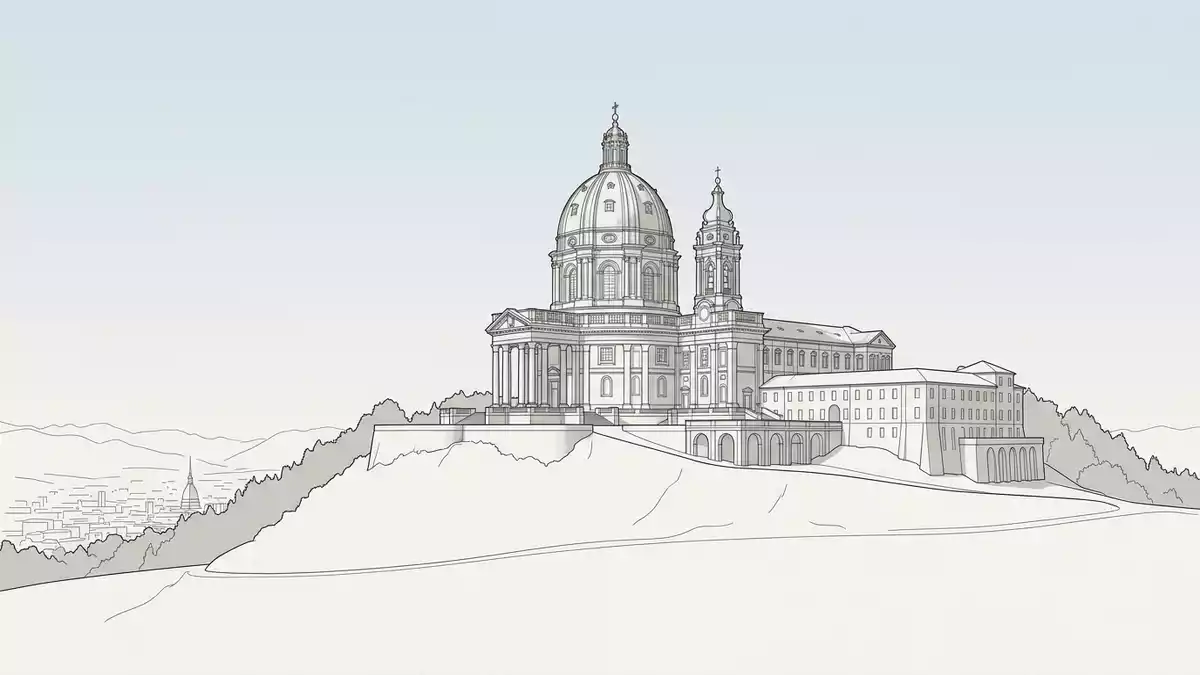
Basilica di Superga rises on a hill east of Turin as a Baroque church crowned by a large dome. Designed by Filippo Juvarra for Victor Amadeus II of Savoy, it was constructed between 1717 and 1731. The building combines a monumental façade, a high drum, paired bell towers and a royal burial place.
Basilica di Superga on the hill above Turin
The basilica stands on Superga Hill, outside Turin’s historic centre. Its position gives the church a distinct relationship with the city below, while the architecture remains visible as a compact composition of pale stone, columns, pilasters and curved forms.
The sanctuary is dedicated to the Nativity of Mary. Its principal exterior is organised around a central entrance framed by columns and crowned by a broad pediment. Bell towers rise on either side, creating a balanced façade beneath the dome. The Baroque church design belongs to the architectural language of eighteenth-century Piedmont.
Filippo Juvarra’s eighteenth-century architecture
Filippo Juvarra directed the project for Victor Amadeus II, Duke of Savoy. The foundation stone was laid in 1717, and the sanctuary was inaugurated in 1731. Juvarra, a Sicilian architect working in Savoy service, gave the building a strong vertical profile and a carefully ordered plan.
The dome dominates the composition from the exterior and continues the church’s sequence of spaces inside. A circular central area is surrounded by chapels, columns and richly worked surfaces. Marble, stucco and painted decoration appear across the interior, with the altar and devotional imagery forming the visual focus of the sanctuary. The 1717 foundation and 1731 inauguration place the basilica firmly within the early eighteenth century.
The Savoy royal burial place
Basilica di Superga is also associated with the House of Savoy through its royal tombs. The underground crypt contains the monumental burial chambers of Savoy princes and kings, linking the church’s religious function with the dynastic history of Piedmont and Sardinia.
The crypt has a different architectural character from the bright central church. Tombs, sculpted monuments and inscriptions occupy a sequence of enclosed spaces below the sanctuary. The royal burials make the basilica more than a hilltop church: it is also a place where the history of the Savoy dynasty is expressed through architecture and memorial sculpture. Its Savoy royal tombs remain part of the site’s identity.
Visiting Basilica di Superga: what travellers from Western Europe should know
- Basilica di Superga stands on Superga Hill east of Turin. The historic rack railway known as the Sassi–Superga tramway connects the city with the hill.
- The approach reaches a hilltop sanctuary, and the visit includes the church’s large interior, the crypt and elevated spaces associated with the dome.
- The official language is Italian and the currency is the euro.
Searching for Basilica di Superga on social platforms
These links open searches for Basilica di Superga on each platform.
Frequently asked questions about Basilica di Superga
Where is Basilica di Superga?
Basilica di Superga stands on Superga Hill east of Turin, in northern Italy. The Sassi–Superga tramway provides a historic route from the city towards the sanctuary.
What can visitors see there?
The complex includes the Baroque church, its dome and chapels, along with the underground crypt containing Savoy royal tombs.
What makes the basilica distinctive?
Its identity rests on the combination of Juvarra’s eighteenth-century Baroque architecture, a hilltop setting above Turin and the royal burial place beneath the church.


