
Basilica di Superga above Turin in Baroque brick and stone
Published on 09/21/2026 at 19:40 | Editorial responsibility: Rafael Müller, Editor-in-Chief AD HOC NEWS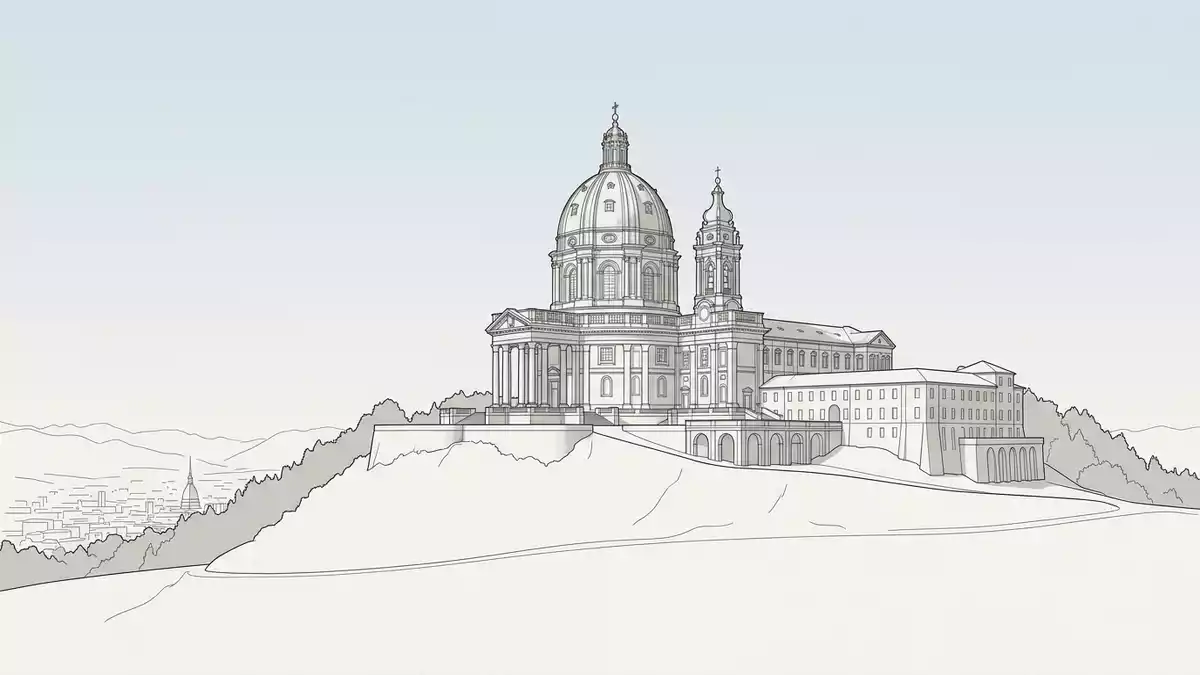
Basilica di Superga rises above Turin as a hilltop Catholic basilica in brick and stone, with an unmistakable dome and twin bell towers. It was built for Victor Amadeus II of Savoy and designed by Filippo Juvarra between 1717 and 1731built between 1717 and 1731.
Juvarra’s hilltop basilica over Turin
The building belongs to the late Baroque and Rococo phase of Juvarra’s work, and its formal profile is easy to read from below. The basilica stands on Superga hill, with the city spread out beneath itlate Baroque and Rococo.
Victor Amadeus II commissioned the church after the siege of Turin in 1706, and the site remained tied to the House of Savoy. The project became one of Juvarra’s major works in Piedmont, and his name remains central to the basilica’s identityVictor Amadeus II.
The dome and the Savoy crypt
The most visible elements are the large dome, the projecting temple front and the two bell towers. Beneath the church lies the royal crypt of the House of Savoy, where members of the dynasty are buriedroyal crypt.
The basilica also carries a second historical layer through its association with the burial place of the Savoy family. That gives the interior a funerary dimension that sits alongside its role as a Catholic churchHouse of Savoy.
A hilltop landmark with a long view
Superga hill gives the church a clear presence in the Turin landscape, and the basilica reads as a designed object rather than a low urban church. Its position, mass and dome make the outline legible from the city and from the approaches to the hillSuperga hill.
The building’s historical layers are visible in the contrast between its religious use and its dynastic memorial role. That combination places it at the meeting point of devotion, court culture and the architectural ambitions of early eighteenth-century Turinearly eighteenth-century Turin.
Visiting Basilica di Superga: what travellers from Western Europe should know
- The basilica stands on Superga hill above Turin. The Sassi–Superga rack tramway connects the lower station with the hill, and the site is also reached by roadSassi–Superga rack tramway.
- The setting is elevated and exposed on the hilltop. The approach brings the basilica’s brick mass, dome and towers into view before the building itself is reached.
- The church contains the royal crypt of the House of Savoy. That means the interior combines parish and dynastic functions in a single monumentdynastic functions.
- The basilica is linked to Victor Amadeus II, Filippo Juvarra and the year 1731. Those names and that date are central to its historical identity.
Searching for Basilica di Superga on social platforms
These links open searches for Basilica di Superga on each platform.
Frequently asked questions about Basilica di Superga
Where is Basilica di Superga?
It stands on Superga hill above Turin in Italy. The basilica is set apart from the city centre by its elevated position.
What should travellers expect to see?
A hilltop Baroque church with a dome, two bell towers and a royal crypt. The building combines religious architecture with the burial place of the House of Savoy.
What makes it distinctive?
The combination of Juvarra’s design, the Savoy connection and the hilltop setting gives the basilica its identity. The building reads as both a church and a dynastic monument.


