
Basilica di San Vitale and the shimmering geometry of Ravenna
Published on 08/28/2026 at 08:04 | Editorial responsibility: Rafael Müller, Editor-in-Chief AD HOC NEWS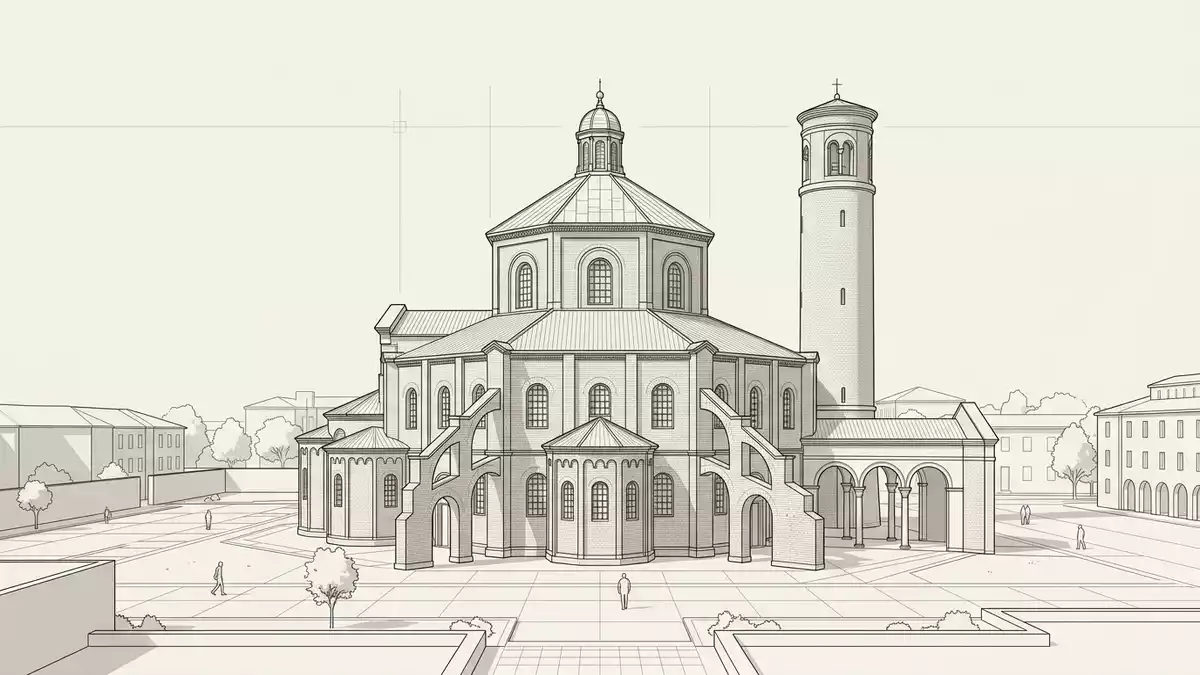
Basilica di San Vitale in Ravenna is an early Christian church where an octagonal plan, plain brick exterior and glittering Byzantine mosaics form a single, memorable space. Built in the sixth century and consecrated in 547, it stands as a meeting point between Roman construction and the Eastern Roman Empire’s visual language.
An octagon of brick, marble and light
Seen from outside, Basilica di San Vitale is a compact mass of reddish brick, its walls stepping out in short projections and narrow towers that give only a hint of the complex shape within.The octagonal structure is made of marble and capped by a dome, yet the approach is along simple paths and low walls that frame the building rather than overshadow it.
Inside, the plan resolves into a central octagon surrounded by an ambulatory and gallery, a double shell of space that wraps around a high, domed core.The church is built on a plan of a double octagonal shell and combines Roman elements such as the dome and stepped towers with features associated with Byzantine architecture, including a polygonal apse and delicate capitals in pale stone.The church has an octagonal plan and combines Roman elements with Byzantine elements The contrast between the plain exterior and the richly articulated interior volumes anchors any visit: what appears modest from the street opens into a layered, vertical space supported by columns and piers.
From Bishop Ecclesius to Justinian’s Ravenna
Basilica di San Vitale belongs firmly to the sixth century, a period when Ravenna served as a key city in the late Roman and Byzantine worlds.Construction began in 526 on the orders of Bishop Ecclesius of Ravenna, during Ostrogothic rule, and the building was financed by the banker Julianus Argentarius, whose 26,000 solidi in gold are recorded in written sources.The construction of the church was sponsored by a Greek banker, Julius Argentarius, and the final cost amounted to 26,000 solidi The church was consecrated in 547 by Archbishop Maximian, who is still visible in mosaic form on the apse wall.
The building’s history spans political shifts without losing its core fabric. San Vitale began as a church dedicated to Saint Vitalis, regarded as Ravenna’s patron martyr, and in later centuries formed part of a Benedictine monastery that occupied the surrounding grounds.It first served as the martyrium of Saint Vitalis and was later part of a Benedictine monastery The basilica is now recognised as part of the UNESCO World Heritage listing for Ravenna’s early Christian monuments, which highlights both its architecture and its mosaic cycles.The basilica is a UNESCO World Heritage monument since 1996 For travellers, that continuity means the core sixth-century structure and decoration remain central to the experience.
Mosaics of emperors, prophets and a green paradise
Step into the presbytery and apse of Basilica di San Vitale and the architecture becomes a framework for mosaics in glass and stone, whose surfaces still catch the light with unusual intensity.San Vitale is one of the most important surviving examples of Eastern Roman architecture and mosaic work The upper walls show Old Testament scenes, including a youthful Christ and figures such as Abraham and Moses, set against backgrounds of deep green and gold. Beneath them, processional panels depict Emperor Justinian and Empress Theodora, each flanked by clergy, courtiers and soldiers, their garments picked out in fine tesserae that still read clearly from floor level.The panels depicting the processions of Emperor Justinian and Empress Theodora are among the most famous mosaics in the world
Higher up, the vault over the presbytery centres on the Lamb of God, surrounded by a ring of foliage, animals and stylised flowers that spread across the curved surfaces.Of particular note are the mosaics on the presbytery’s ceiling, which depict the Lamb of God amid plants and animals The floors include geometric mosaic patterns in stone, while the walls carry bands of marble that rise to carved capitals and arches. Together, these layers give the basilica an interior that rewards slow looking, from the expressive faces in the imperial panels to the small decorative details tucked into the corners of the apse.
Visiting Basilica di San Vitale: what travellers from Western Europe should know
- Basilica di San Vitale stands within Ravenna’s historic centre, north of the modern railway station, and is reached on foot along streets shared with other early Christian sites.
- The basilica’s interior involves a short series of steps between levels, and the gallery above the main space is accessed by a relatively narrow staircase within the thick outer walls.
- Ravenna lies in northern Italy’s Emilia-Romagna region, connected by rail to cities such as Bologna and Ferrara, and Basilica di San Vitale is signposted from the main streets of the old town.
- The official language is Italian and the currency is the euro.
Searching for Basilica di San Vitale on social platforms
These links open searches for Basilica di San Vitale on each platform.
Frequently asked questions about Basilica di San Vitale
Where is Basilica di San Vitale?
Basilica di San Vitale is in Ravenna, a city in the Emilia-Romagna region of northern Italy, within walking distance of the main streets of the historic centre.
What can visitors expect inside the basilica?
Visitors encounter an octagonal interior with a domed central space, galleries around the edges and extensive sixth-century mosaics depicting biblical figures, Emperor Justinian, Empress Theodora and Archbishop Maximian.
What makes Basilica di San Vitale distinctive?
The combination of its double-shell octagonal plan, early Byzantine mosaics and the rare survival of a largely intact sixth-century church in Western Europe gives Basilica di San Vitale a distinctive character.


