
Basilica di San Vitale and the shimmer of Ravenna’s mosaics
Published on 08/21/2026 at 07:54 | Editorial responsibility: Rafael Müller, Editor-in-Chief AD HOC NEWS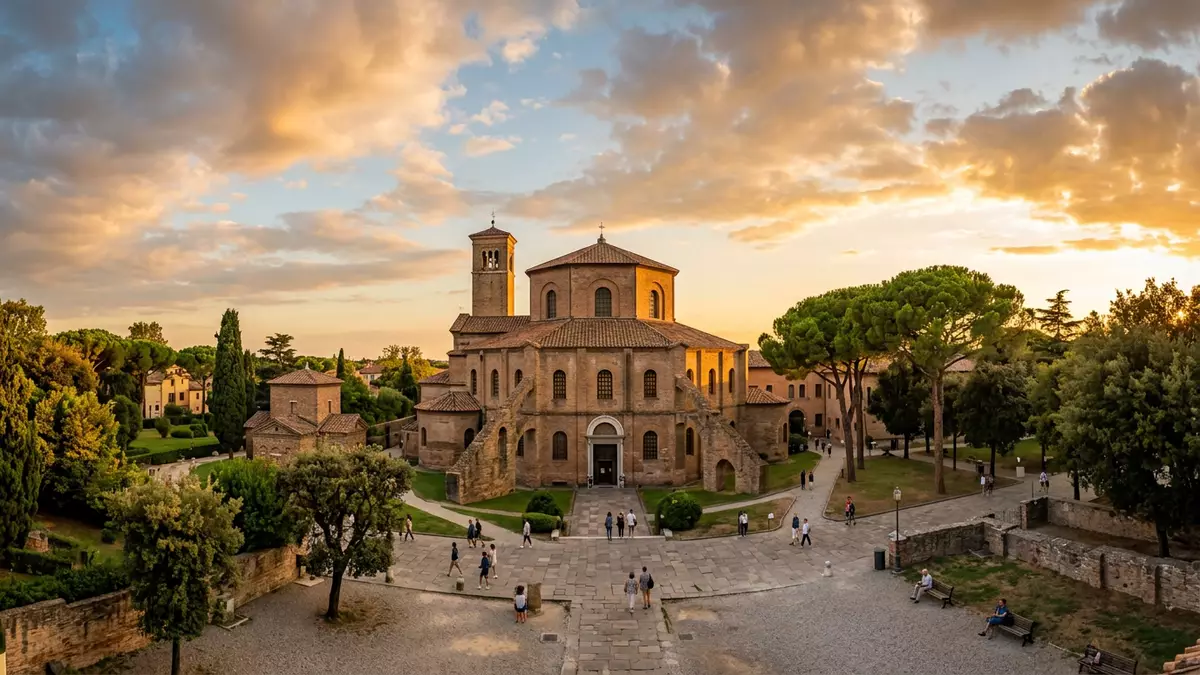
Basilica di San Vitale in Ravenna is a sixth-century church where plain brick walls on the outside give way to a blaze of gold and colour inside. Built under Bishop Ecclesius and consecrated in 547, it stands as a masterpiece of early Byzantine architecture in Italy and anchors Ravenna’s reputation as a city of mosaics.
An octagonal space suspended under a dome
Seen from outside, Basilica di San Vitale reads as a compact brick mass, its main body arranged in an octagon that contrasts with the rectangular streets around it. This centralised plan, capped by a lofty dome in terracotta, reflects the architectural language developed in the Eastern Roman Empire and brought to Ravenna when the city served as its Italian capital.The octagonal structure is made of marble Inside, the geometry becomes more complex, with a ring of ambulatory and gallery spaces wrapping around the central core and drawing the visitor’s eye back to the altar.
The contrast between the restrained exterior and the finely articulated interior is deliberate in effect rather than in explanation. The outer walls use exposed brickwork, while the inner surfaces carry marble revetment and mosaic panels that layer over one another on the curved apse walls.Roman architectural elements such as the dome and towers stand alongside details derived from Constantinople, including slender columns and basket-like capitals that support the arches ringing the central space.
Byzantine mosaics in glass, gold and stone
The interior of Basilica di San Vitale is most closely associated with its mosaics, which were laid in the sixth century and remain a textbook of Byzantine iconography. The apse vault centres on a vision of Christ, flanked by archangels and Saint Vitalis, surrounded by greenery and animals that are rendered in shimmering tesserae. The presbytery and triumphal arch continue the programme with Old and New Testament scenes, while a medallion of the Lamb of God occupies the apex above the altar.The mosaics depict Old and New Testament figures The density of images means that almost every surface above the marble wall panelling carries narrative or symbolic scenes.
On the lower walls of the apse, two facing mosaic panels show the emperor Justinian and his consort Theodora, each framed by attendants and clergy in a carefully ordered procession. Justinian holds a bowl, while Theodora carries a chalice, both set against patterned backgrounds that emphasise their status.San Vitale is one of the most important surviving examples of Eastern Roman architecture and mosaic work The combination of imperial portraits, biblical figures and vegetal ornament turns the choir and apse into a single visual field, where glass, stone and gold leaf combine to catch the light from high windows.
Ravenna, early Christianity and UNESCO recognition
Basilica di San Vitale belongs to a group of early Christian monuments in Ravenna that share a World Heritage listing and trace the city’s role between the Western and Eastern halves of the Roman world.The basilica has been a UNESCO World Heritage monument since 1996 The church itself was begun under the Ostrogothic kingdom and completed under the rule of emperor Justinian, and it was dedicated to Saint Vitalis, a martyr adopted as Ravenna’s patron.Construction began under Bishop Ecclesius and it was consecrated by Bishop Maximianus in 547 That layering of political and ecclesiastical authority is legible in the decoration, which mixes references to imperial ceremony with liturgical themes.
Over the centuries, Basilica di San Vitale formed part of a Benedictine monastic complex and retained its role as a place of worship while the surrounding city changed. The building shows later additions, including painted decoration on the vault above the central space, but the sixth-century mosaics in the apse and presbytery have remained in place and continue to define the experience of the interior.The basilica has been part of Ravenna’s World Heritage ensemble since 1996 Together with the nearby Mausoleum of Galla Placidia, it anchors a compact district where late Roman, Ostrogothic and Byzantine layers stand within a short walk of one another.
Visiting Basilica di San Vitale: what travellers from Western Europe should know
- Basilica di San Vitale stands in central Ravenna, in the Emilia-Romagna region of Italy, a short walk north of the city’s main square and close to the Mausoleum of Galla Placidia.
- The approach streets are level, but inside the church there are changes in floor height, low steps near the apse and a raised gallery level reached by staircases.
- Ravenna lies on the Adriatic side of northern Italy and is linked by rail to other cities in the region, with the nearest larger airports serving Bologna and other Emilia-Romagna hubs.
- The official language is Italian and the currency is the euro.
Searching for Basilica di San Vitale on social platforms
These links open searches for Basilica di San Vitale on each platform.
Frequently asked questions about Basilica di San Vitale
Where is Basilica di San Vitale?
Basilica di San Vitale stands in Ravenna, a historic city in the Emilia-Romagna region of northern Italy, a short distance inland from the Adriatic coast.
What should visitors expect inside the basilica?
Visitors encounter a centralised octagonal space with a dome, surrounded by galleries, whose upper walls and apse are covered with sixth-century mosaics in glass and gold.
What makes Basilica di San Vitale distinctive among early Christian churches?
The basilica combines an Eastern-style central plan with Western construction techniques and preserves one of the richest ensembles of early Byzantine mosaics in Western Europe.


