
Basilica di San Pietro and the vast space of faith
Published on 08/31/2026 at 21:53 | Editorial responsibility: Rafael Müller, Editor-in-Chief AD HOC NEWS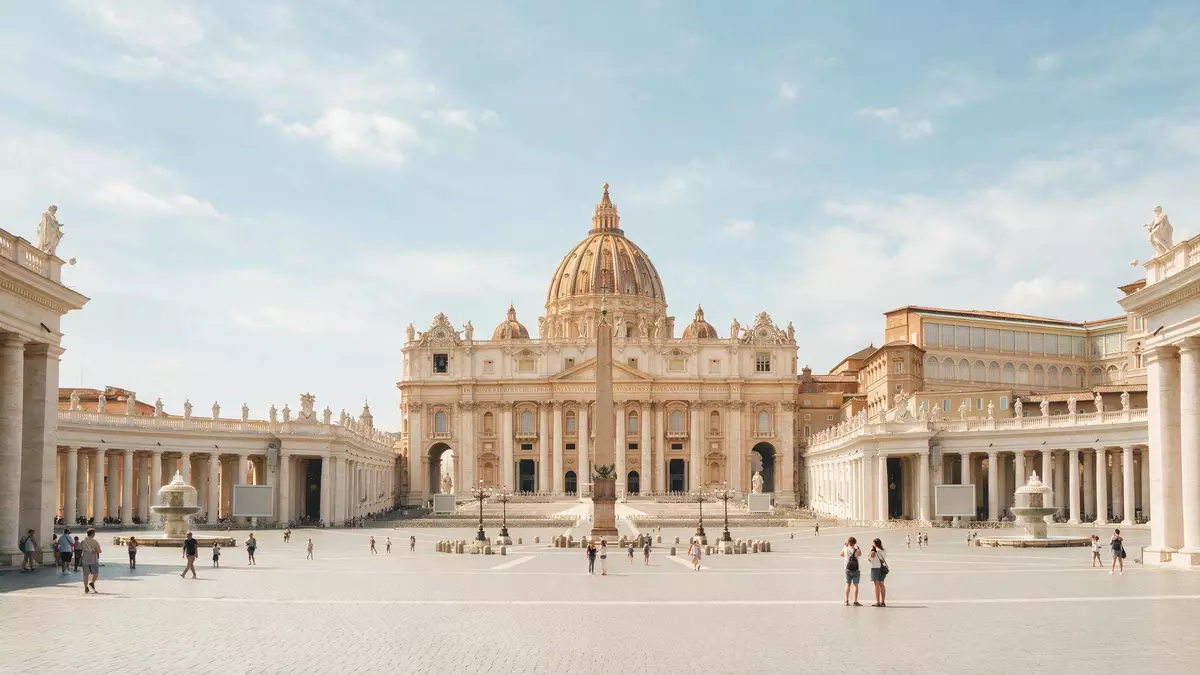
Basilica di San Pietro in Vatikanstadt is both a vast architectural statement and the spiritual heart of the Roman Catholic Church, its great dome rising above an ordered sweep of colonnades. Constructed in the Renaissance and Baroque periods over the traditional burial place of Saint Peter, first Bishop of Rome, it gathers centuries of design by figures such as Donato Bramante, Michelangelo and Gian Lorenzo Bernini into a single monumental interior.
The great church on Vatican Hill
Basilica di San Pietro stands on the Vatican Hill, an enclave within Rome on the western side of the River Tiber, forming the centrepiece of the independent state of Vatikanstadt. The present basilica replaced the earlier Old St Peter’s Basilica, which was begun in the fourth century under Emperor Constantine and stood for more than a millennium before being deemed beyond repair and demolished in the early sixteenth century.Independent country within Rome The new building was constructed above the grave traditionally associated with Saint Peter, making the tomb beneath the high altar the focal point of the church’s layout.Tomb beneath the main altar
The basilica took shape between 1506 and 1626, after Pope Julius II ordered the replacement of Constantine’s ageing structure and commissioned Bramante to design a new church.Construction between 1506 and 1626 Successive architects including Raphael, Michelangelo, Giacomo della Porta, Carlo Maderno and Bernini each left a distinct mark: from the Greek-cross centralised plan to the later extended nave and the vast St Peter’s Square framed by Bernini’s colonnades.Role of Julius II and later architects
Scale, structure and the soaring dome
Stepping inside Basilica di San Pietro, the first impression is of scale: a nave stretching far towards the crossing, flanked by massive piers and side chapels, beneath an intricately coffered ceiling. The building reaches around 137 m (449 ft) in height at the top of Michelangelo’s dome, with an overall length of about 186 m (610 ft), dimensions that place it among the largest churches ever constructed.Dimensions and dome height The main dome itself spans roughly 42 m (138 ft) across, rising over the crossing on a drum pierced by windows and resting on four colossal piers.
Michelangelo’s contribution, taken on in the 1540s, reshaped Bramante’s earlier scheme into a more unified centralised mass crowned by that imposing dome, which Giacomo della Porta later completed to its present form.Michelangelo’s dome and crossing In the early seventeenth century Carlo Maderno extended the eastern end, adding the deep nave and grand façade recognisable from images of the basilica’s front elevation, while Bernini’s work inside includes the bronze Baldacchino rising over the high altar and the sculptural Cathedra Petri at the far end of the apse.Façade, nave and papal functions
Layers of history and artistic detail
The story of Basilica di San Pietro reaches back to the first century, when the area was occupied by the Circus of Nero, an elongated race-track associated with early Christian martyrdoms, and when Peter himself is believed to have been crucified and buried nearby.Circus of Nero and burial tradition In the fourth century Constantine sponsored the construction of the first basilica above that grave, a longitudinal plan church that hosted imperial ceremonies such as the coronation of Charlemagne in the year 800.Constantine’s basilica and Charlemagne
Within the current basilica, visitors encounter an interior dense with altars, tombs and artworks, from papal monuments in marble to mosaics that reproduce paintings in a durable medium suited to the building’s scale. The nave and transepts contain numerous side chapels, each with its own decorative scheme, while beneath the floor lie grottoes and archaeological spaces associated with the earlier structures. Above, the dome’s inner surface is ringed by Latin inscriptions and gilded decoration, a visual counterpart to the colonnaded square outside, where Bernini’s sweeping arms frame the façade and lead the eye towards the central axis of the church.Renaissance and Baroque art and layout
Visiting Basilica di San Pietro: what travellers from Western Europe should know
- Basilica di San Pietro stands within Vatikanstadt on the Vatican Hill, west of the River Tiber, and is reached from Rome by urban transport links serving the area around Piazza San Pietro.
- The interior involves long walks along the nave and around the chapels, and access to the dome includes a staircase with a substantial number of steps and narrow sections.
- English is widely used for information, but the official language of Vatikanstadt is Italian and the currency is the euro.
- St Peter’s Square lies directly in front of the basilica, enclosed by Bernini’s colonnades, and offers clear views of the façade and dome from ground level.
- Entry requirements depend on your nationality; UK travellers can check the FCDO travel advice at gov.uk/foreign-travel-advice, Irish travellers the Department of Foreign Affairs at ireland.ie.
Searching for Basilica di San Pietro on social platforms
These links open searches for Basilica di San Pietro on each platform.
Frequently asked questions about Basilica di San Pietro
Where is Basilica di San Pietro located?
Basilica di San Pietro stands on the Vatican Hill within Vatikanstadt, an independent state enclaved in Rome on the western side of the River Tiber.
What should visitors expect inside the basilica?
Visitors encounter a vast nave, numerous side chapels, richly decorated altars and tombs, and, above the crossing, Michelangelo’s monumental dome rising on four great piers.
What makes Basilica di San Pietro distinctive among churches?
Its combination of immense scale, the traditional association with Saint Peter’s burial place and the layered contributions of architects from Bramante to Bernini give it a distinctive presence.


