
Basilica di San Pietro and the sweep of Renaissance Rome
Published on 09/07/2026 at 22:58 | Editorial responsibility: Rafael Müller, Editor-in-Chief AD HOC NEWS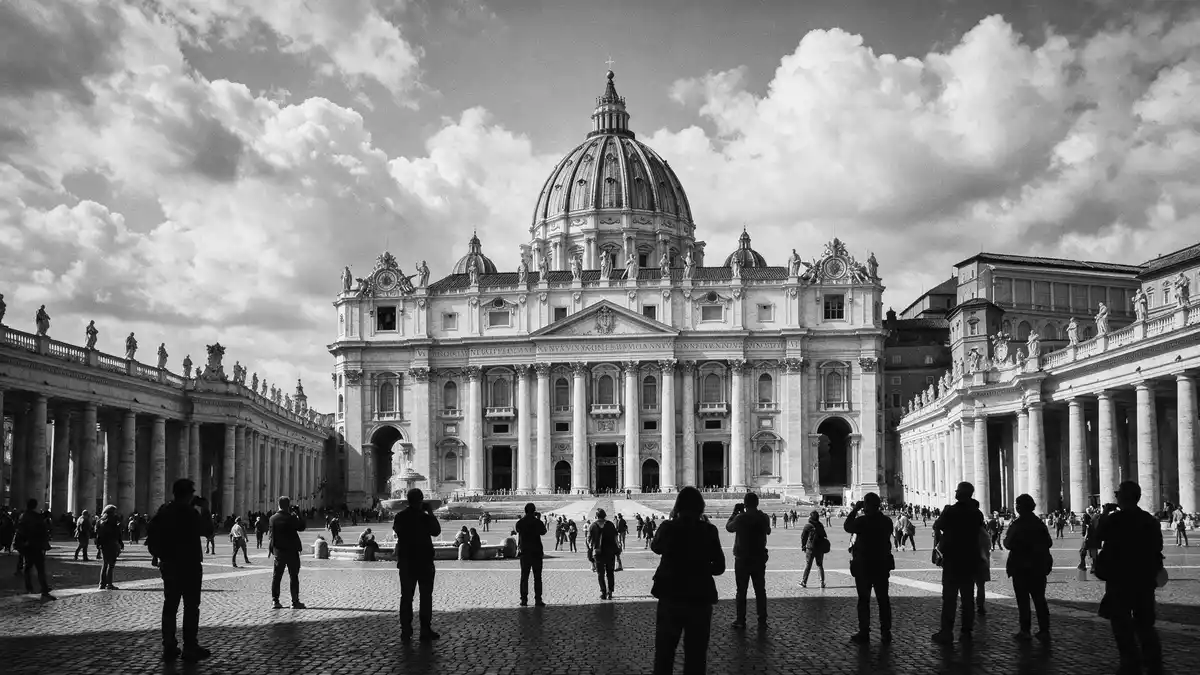
Basilica di San Pietro in Vatikanstadt is defined by scale and by the meeting of several great hands: construction began in 1506, and the present church took shape through the work of Donato Bramante, Michelangelo, Carlo Maderno and Gian Lorenzo Bernini. The result is a basilica whose dome, façade and piazza form a sequence of monumental spaces rather than a single front.
The church stands on the Vatican side of Rome and belongs to the Catholic heart of Vatikanstadt, where stone, marble and vast interior volumes carry the history of papal patronage. Its present form reflects the Renaissance and Baroque traditions that shaped the building across the sixteenth and seventeenth centuries.
Michelangelo’s dome above a long nave
The dome is the most legible part of the skyline, rising above a structure that extends into a long nave and broad crossing. Michelangelo gave the building much of its architectural force, while Carlo Maderno extended the plan and completed the façade.
Bernini’s contribution is visible outside as well as inside. The piazza in front of the basilica and the great colonnades give the church its ceremonial approach, and the whole complex reads as an ordered ensemble of architecture and urban space.
From Renaissance ambition to Baroque finish
The rebuilding of Basilica di San Pietro began under Pope Julius II and continued across successive papacies, a process that brought together different artistic languages. Bramante, Michelangelo and Bernini each left a clear mark, and the building preserves those shifts in style rather than hiding them.
That layered history is part of the basilica’s character. The core of the structure belongs to the Renaissance, while the completed church and its surrounding square carry the confidence of the Baroque age.
The Vatican basilica as a working monument
Basilica di San Pietro remains a church as well as a major work of architecture. The building’s interior scale, the dome overhead and the piazza outside create a sequence that mixes liturgical use with public presence.
The basilica is also linked to the long history of papal Rome and to the burial place traditionally associated with Saint Peter. That connection gives the monument its strongest historical frame and helps explain why the site matters beyond architecture alone.
Visiting Basilica di San Pietro: what travellers from Western Europe should know
- It stands in Vatikanstadt, near Rome, and is reached through the urban streets and squares around St Peter’s Square.
- The main approach is across the open piazza, where the basilica’s façade and colonnades come into view as a single composition.
- The dome and upper structure dominate the skyline, and the scale of the nave is apparent once inside the church.
- The official language is Italian and the currency is the euro.
Searching for Basilica di San Pietro on social platforms
These links open searches for Basilica di San Pietro on each platform.
Frequently asked questions about Basilica di San Pietro
Where is Basilica di San Pietro?
It stands in Vatikanstadt, beside the main papal square in the centre of the Vatican. The building forms part of the monumental core of the city-state.
What should a visit include?
The façade, the dome and the vast interior are the central elements. The piazza outside is part of the experience of the place as a whole.
What makes it distinctive?
The basilica brings together Bramante, Michelangelo, Maderno and Bernini in one building. Its Renaissance structure and Baroque finish make it one of the defining monuments of papal Rome.


