
Basilica di San Pietro and its vast Renaissance interior
Published on 09/05/2026 at 07:05 | Editorial responsibility: Rafael Müller, Editor-in-Chief AD HOC NEWS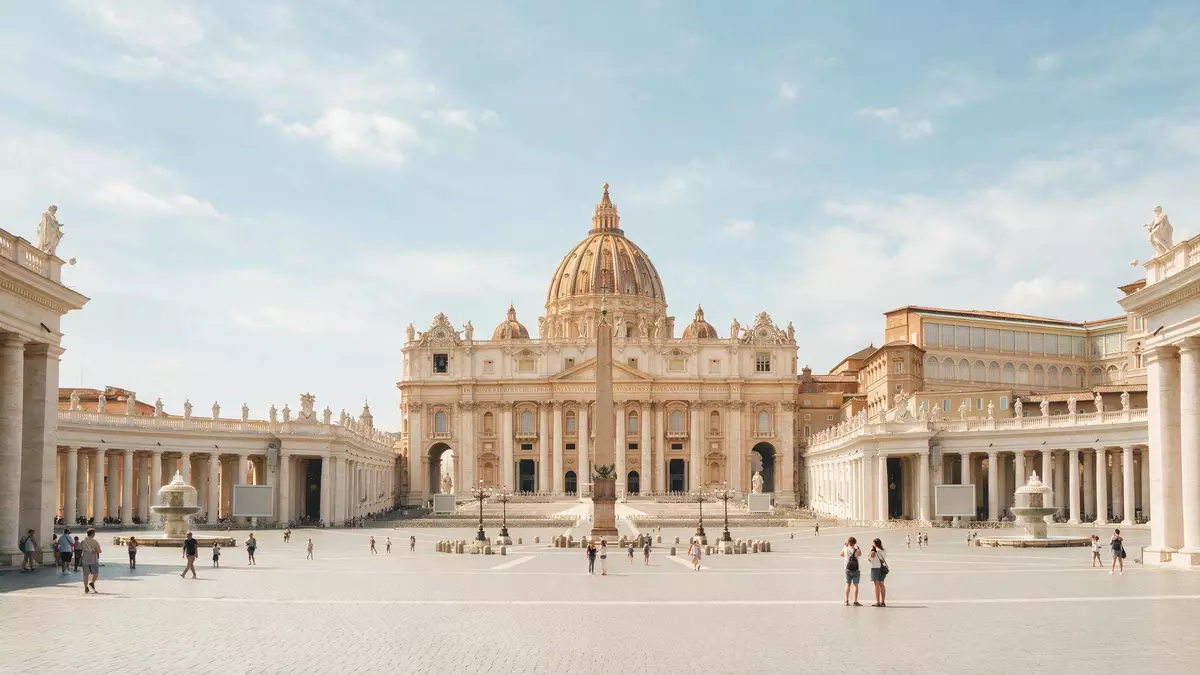
Basilica di San Pietro in Vatikanstadt is the great Renaissance church of the Catholic world, raised above the traditional tomb of Saint Peter and crowned by a monumental dome that dominates the skyline around the Tiber. Standing at the centre of Vatican City, it brings together long papal patronage, the work of architects such as Donato Bramante and Michelangelo and the ceremonial life of the Roman Church from the sixteenth and seventeenth centuries.
A basilica built over Saint Peter’s tomb
The site on Vatican Hill has been associated with the grave of the apostle Peter since the early centuries of Christianity, and the Constantinian basilica of the fourth century was laid out to focus directly on that burial place.The history of the basilica That first church stood for more than a millennium as a major pilgrimage destination before the decision in the late fifteenth and early sixteenth century to replace it with a new, larger building in line with Renaissance ideas of geometry and proportion.Construction between 1506 and 1626
Pope Julius II initiated the current Basilica di San Pietro, with the first stone laid in 1506 and consecration following in 1626 under Pope Urban VIII, after more than a century of design revisions and construction campaigns.The construction span from 1506 to 1626 The basilica forms part of a wider complex that includes Saint Peter’s Square and the Vatican Palace, but within the church the focus remains the confessed tomb of the apostle beneath the main altar.
Renaissance architecture and an immense dome
Basilica di San Pietro is a vast masonry structure in the Renaissance style, with a Latin cross plan that combines a long nave, side aisles and a prominent central crossing beneath its dome.The basilica’s plan and style Donato Bramante developed an early centralised scheme, followed by architects including Raphael and Antonio da Sangallo the Younger, each modifying the design before Michelangelo Buonarroti took over in 1546 and imposed a stronger, more unified composition around the crossing piers.Successive Renaissance architects
The dome that rises above Basilica di San Pietro is one of the most recognisable elements of the church, built to Michelangelo’s design and completed after his death by Giacomo della Porta and Domenico Fontana.The dome and lantern specifications From the floor of the basilica to the summit of the cross above the lantern, the structure reaches about 136 m (446 ft), while the internal diameter is a little over 41 m (135 ft), measurements that make it one of the tallest and broadest masonry domes in Europe.Recorded dome dimensions
Interior spaces, artworks and liturgical focus
Inside Basilica di San Pietro, the visitor encounters a long nave lined with colossal pilasters and chapels, leading towards the high altar and Baldacchino under the dome. The scale of the interior has been carefully recorded, with the overall length exceeding 180 m (590 ft), and the height of the main space sufficient for large liturgical processions and papal ceremonies.Overall dimensions and layout Sculptures, altarpieces and mosaics by artists of the late Renaissance and Baroque periods occupy the chapels and walls, including Michelangelo’s “Pietà” in a side chapel near the entrance, carved at the turn of the sixteenth century.The presence of the Pietà
Beneath the main altar lies the confession of Saint Peter, marked by a descending space that aligns the liturgical heart of the church with the apostle’s grave recognised since the Constantinian era.Location of Saint Peter’s tomb Around this vertical axis, Gian Lorenzo Bernini and other seventeenth-century artists shaped the interior decorations that accompany major papal rites, giving Basilica di San Pietro a layered artistic character that reflects its prolonged construction period from the early sixteenth to the early seventeenth century.Seventeenth-century completion and decoration
Visiting Basilica di San Pietro: what travellers from Western Europe should know
- Basilica di San Pietro stands within Vatican City immediately north-west of central Rome, with access on foot from the surrounding Italian streets and by urban public transport to the area around Saint Peter’s Square.
- The approach to the basilica involves crossing the large paved expanse of the square and then ascending a shallow flight of steps to reach the main entrance; the interior floor extends over a considerable distance.
- The official language of Vatican City is Italian and the surrounding city is in Italy, where the currency is the euro.
Searching for Basilica di San Pietro on social platforms
These links open searches for Basilica di San Pietro on each platform.
Frequently asked questions about Basilica di San Pietro
Where is Basilica di San Pietro located?
Basilica di San Pietro stands in Vatican City, an independent state enclaved within Rome on the western side of the River Tiber, facing Saint Peter’s Square.
What should visitors expect inside the basilica?
Visitors encounter a very large Renaissance interior with chapels, altars, monumental sculpture, extensive mosaics and views into the confession of Saint Peter beneath the main altar.
What makes Basilica di San Pietro distinctive among churches?
The basilica combines a long history linked to Saint Peter’s tomb with an immense dome by Michelangelo, a broad nave and a concentration of major Renaissance and Baroque artworks.


