
Basilica di San Pietro and its vast Renaissance dome
Published on 09/24/2026 at 03:38 | Editorial responsibility: Rafael Müller, Editor-in-Chief AD HOC NEWS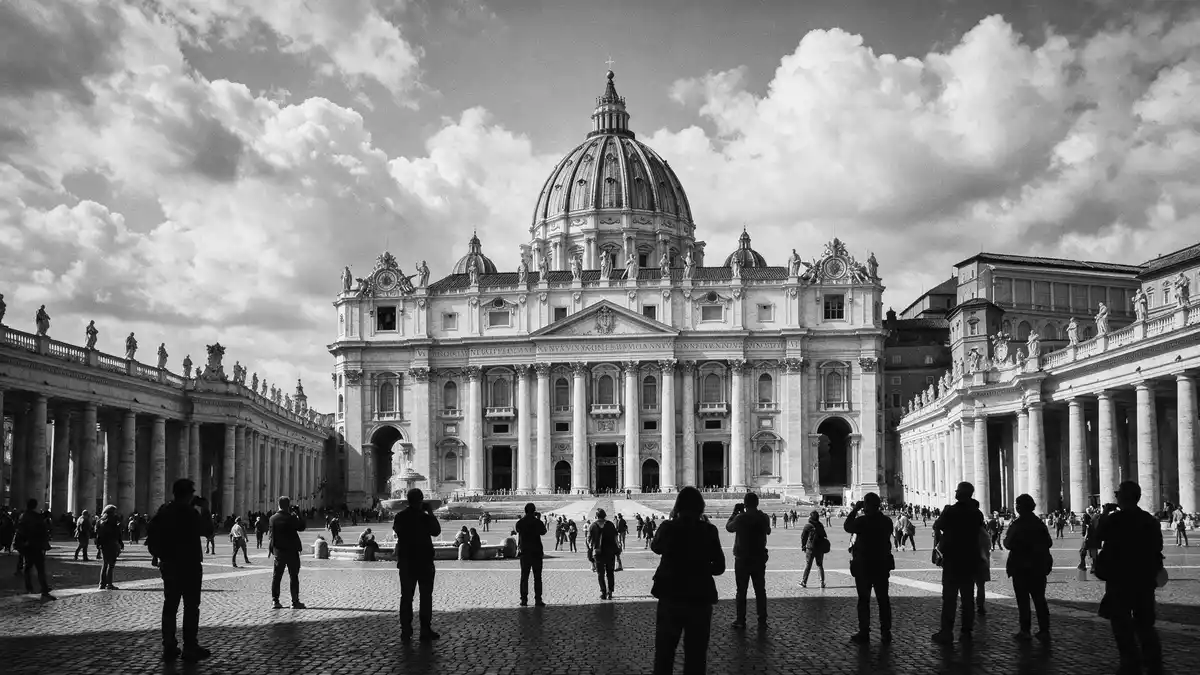
Basilica di San Pietro rises at the centre of Vatikanstadt as a vast meeting of Renaissance architecture and Baroque art. Its dome, begun under Michelangelo and completed by Giacomo della Porta, gives the church its most recognisable interior and exterior feature.
A dome shaped by several Renaissance masters
The present basilica began on 18 April 1506, when Pope Julius II laid its foundation stone. The building was completed in 1626, after more than a century of changing plans, architects and patrons.
Donato Bramante supplied the first major design, while Raphael, Antonio da Sangallo the Younger, Michelangelo Buonarroti and Carlo Maderno each contributed to the building’s development. The church therefore records several phases of Renaissance architecture rather than a single author’s style. Its history and principal designers are set out in the basilica’s historical account.
From Bramante’s plan to Maderno’s façade
Bramante’s early concept used a centralised plan with a major dome above the crossing. Michelangelo revised the central structure and developed the dome, whose drum and rising profile dominate the skyline around Piazza San Pietro.
Giacomo della Porta and Domenico Fontana brought the dome to completion between 1588 and 1590. Carlo Maderno extended the building with a long nave and designed the broad façade facing the piazza. The result combines a central Renaissance core with the longitudinal arrangement associated with a Latin-cross church.
Bernini’s piazza, altar and sacred interior
Basilica di San Pietro stands above the traditional burial place of Saint Peter, the apostle whose name the church carries. The high altar sits beneath the dome, while the interior contains chapels, tombs, sculpture, mosaics and architectural monuments.
Gian Lorenzo Bernini shaped the relationship between the basilica and Piazza San Pietro. His colonnade forms a sweeping boundary around the open space, and his Baldacchino rises above the papal altar inside. The basilica and its setting belong to the Vatican City World Heritage property, which identifies the building as the work of Bramante, Raphael, Michelangelo, Bernini and Maderno.Vatican City World Heritage
Visiting Basilica di San Pietro: what travellers from Western Europe should know
- Basilica di San Pietro stands in Piazza San Pietro, within Vatikanstadt. Rome’s public transport network reaches the Vatican district, with Ottaviano and Cipro metro stations among the named access points.
- The basilica contains broad ceremonial spaces, side chapels, steps and changes of level. The dome route includes a substantial stair section and is separate from the main floor.
- The official language is Italian and the currency is the euro.
- Nearby landmarks include the Vatican Museums, the Sistine Chapel and the Castel Sant’Angelo across the Tiber.
Searching for Basilica di San Pietro on social platforms
These links open searches for Basilica di San Pietro on each platform.
Frequently asked questions about Basilica di San Pietro
Where is Basilica di San Pietro?
It stands in Piazza San Pietro in Vatikanstadt, the independent city-state enclosed within Rome.
What can visitors expect inside?
The interior contains the papal altar, Bernini’s Baldacchino, chapels, tombs, mosaics and monumental sculpture beneath the central dome.
What makes the basilica distinctive?
Its distinctive character comes from the combination of a Renaissance dome, a Baroque interior and Bernini’s formal piazza outside.


