
Basilica di San Pietro and its vast Renaissance dome
Published on 08/21/2026 at 06:36 | Editorial responsibility: Rafael Müller, Editor-in-Chief AD HOC NEWS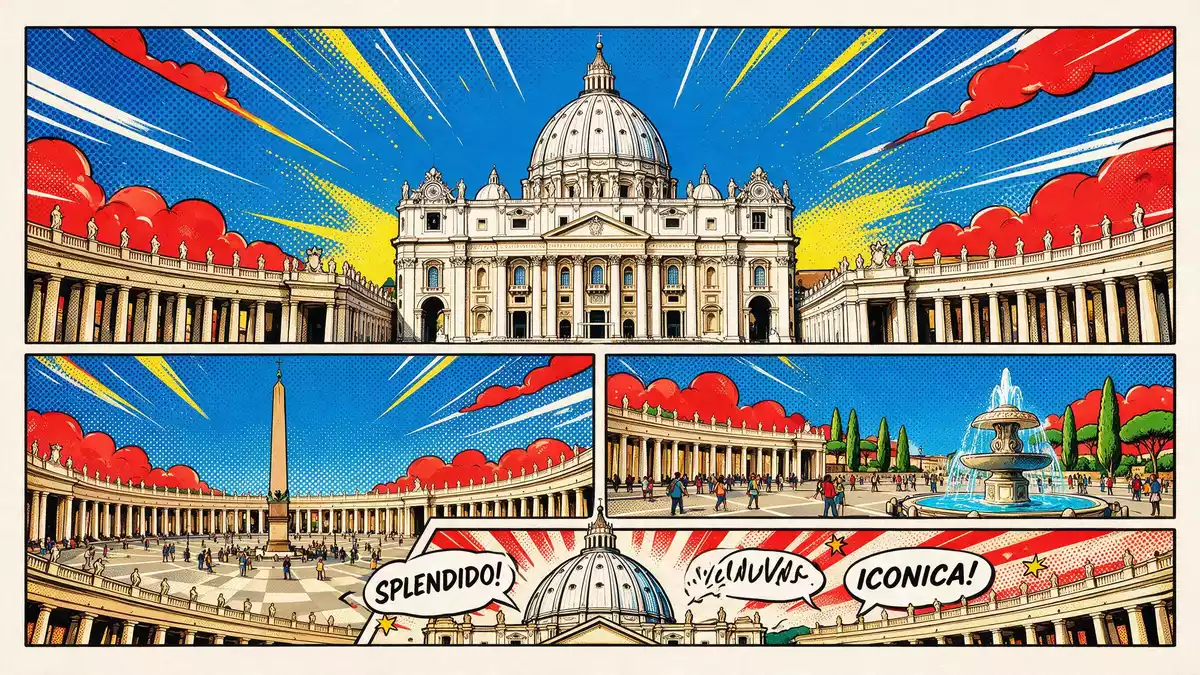
Basilica di San Pietro in Vatikanstadt is the principal church of Vatican City, rising over the traditional burial site of Saint Peter and dominated by a vast Renaissance dome. The present basilica was constructed between 1506 and 1626, replacing an earlier Constantinian church that had stood for more than a millennium.
A Renaissance basilica over an ancient tomb
Basilica di San Pietro stands within the independent microstate of Vatican City, enclaved in Rome on the western side of the River Tiber. It serves as a papal basilica and is closely associated with the role of the Bishop of Rome as head of the Catholic Church, making it a major place of pilgrimage for worshippers from many countries.Papal Basilica of Saint Peter in the Vatican
The basilica is built over what is regarded as the grave of Saint Peter, one of the Twelve Apostles and regarded as the first pope in Catholic tradition.built over the grave of Saint Peter The tomb lies beneath the high altar, anchoring the building’s religious significance to the early centuries of Christianity.tomb of Saint Peter beneath the main altar Before the current basilica, Emperor Constantine ordered the construction of a large church here in the fourth century, which became known as Old Saint Peter’s Basilica and stood for more than 1,100 years.
From Bramante to Bernini: architects of Basilica di San Pietro
The story of Basilica di San Pietro is closely tied to the leading architects and artists of the Italian Renaissance. Work on the present church began in 1506 under Pope Julius II, who commissioned Donato Bramante to design a new basilica to replace the ageing Constantinian structure.Pope Julius II commissioned Bramante Bramante’s centralised plan used a grand Greek-cross layout and was intended to create a monumental shrine over Peter’s tomb.
After Bramante’s death, the project passed through several hands, including Raphael and Antonio da Sangallo the Younger, each modifying the design. In the mid sixteenth century Michelangelo took charge of the architecture; he simplified earlier schemes and focused attention on the crossing and the great dome, which became the defining feature of the skyline above Vatican City.Michelangelo took over as chief architect Giacomo della Porta oversaw the completion of the cupola towards the end of the sixteenth century, while Carlo Maderno extended the nave and designed the grand façade facing the square.Carlo Maderno extended Michelangelo’s plan In the seventeenth century Gian Lorenzo Bernini added elements such as the monumental bronze baldachin over the high altar and the vast elliptical piazza framed by colonnades.
The dome and interior of Basilica di San Pietro
The dome of Basilica di San Pietro is one of the most recognisable features of the building and a landmark on the Roman skyline. Michelangelo’s design uses a double-shell structure, with masonry arranged to rise in a powerful profile above the crossing of the nave and transept.double masonry shell dome Figures published for the structure indicate an external height from street level to the top of the cross of more than 130 m (around 430 ft) and an interior diameter of over 40 m (about 130 ft), placing it among the largest domes constructed in the Renaissance period.Saint Peter’s dome dimensions
Inside, the basilica stretches over well in excess of 180 m (approximately 590 ft) in length, with a soaring nave, large side chapels and numerous altars.dimensions of St Peter’s Basilica The interior is richly decorated with marble, mosaics and sculptural works. Among the most renowned pieces is Michelangelo’s Pietà, a marble sculpture depicting the Virgin Mary with the body of Christ, positioned in a chapel near the entrance. Bernini’s bronze baldachin rises over the high altar, marking the axis above Peter’s tomb and drawing the eye towards the apse, where the Cathedra Petri frames the ceremonial throne of the Bishop of Rome.Pietà and Bernini’s Baldachin
Visiting Basilica di San Pietro: what travellers from Western Europe should know
- Basilica di San Pietro stands within Vatican City, reached from central Rome by crossing the River Tiber and approaching Piazza San Pietro along streets such as Via della Conciliazione.
- The interior covers a large area with long walking routes and numerous steps, particularly in the ascent towards the dome, where narrow staircases and confined passages form part of the route.
- Vatican City is a sovereign state where Italian is widely spoken; the euro is the official currency for transactions within its territory.
- Entry requirements depend on your nationality; UK travellers can check the FCDO travel advice at gov.uk/foreign-travel-advice, Irish travellers the Department of Foreign Affairs at ireland.ie.
Searching for Basilica di San Pietro on social platforms
These links open searches for Basilica di San Pietro on each platform.
Frequently asked questions about Basilica di San Pietro
Where is Basilica di San Pietro located?
Basilica di San Pietro stands in Vatican City, a sovereign enclave within Rome on the western side of the River Tiber.
What should visitors expect inside the basilica?
Visitors encounter an extensive nave, side chapels, richly decorated marble and mosaics, and major artworks such as Michelangelo’s Pietà and Bernini’s bronze baldachin.
What makes Basilica di San Pietro distinctive among churches?
The combination of its association with Saint Peter’s tomb, its role as a papal basilica and its vast Renaissance dome designed by Michelangelo gives the church a distinctive character.


