
Basilica di San Marco and its golden mosaic interior
Published on 09/23/2026 at 17:12 | Editorial responsibility: Rafael Müller, Editor-in-Chief AD HOC NEWS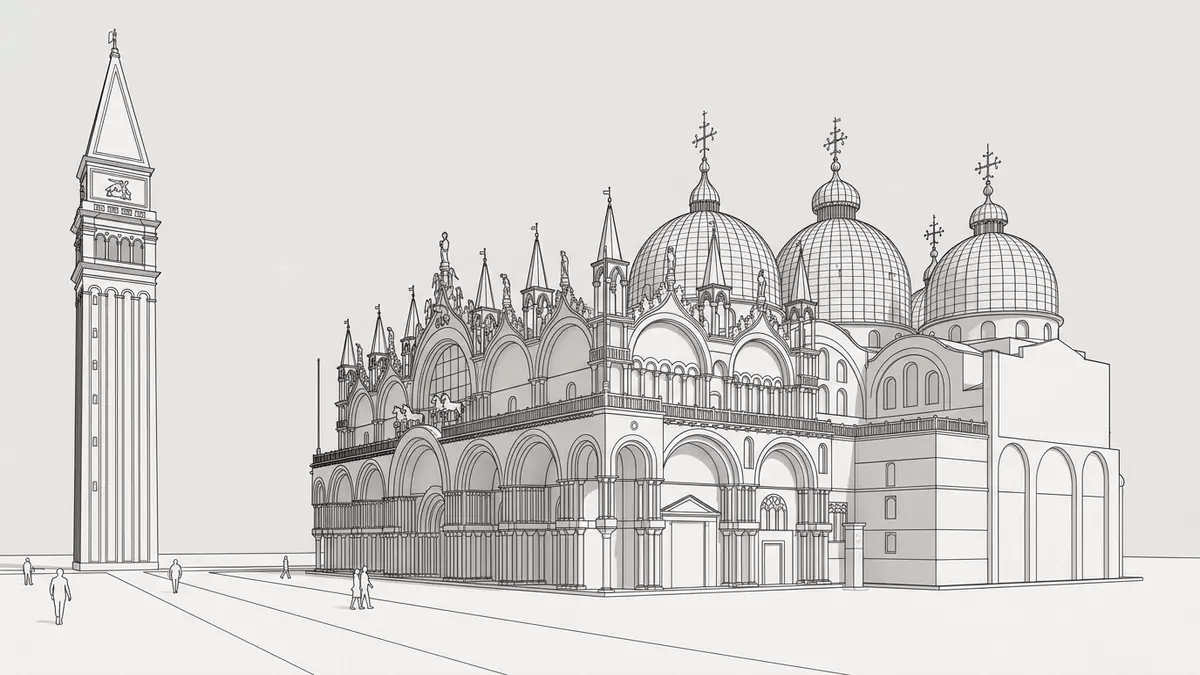
Basilica di San Marco rises beside the Doge’s Palace in Venedig as a church of domes, marble and shimmering glass mosaics. Its interior is not the product of a single campaign: rebuilding began in 1063, while the decoration developed across centuries.
Basilica di San Marco: a Byzantine form in Venedig
The present church began under Doge Domenico Contarini in 1063. It follows a Greek-cross plan with a central space, projecting arms and domes that give the building its recognisable profile. The architectural language combines Byzantine forms with Romanesque and Gothic additions.
Its position beside the Doge’s Palace reflects its historic role in Venetian public life. For centuries, Basilica di San Marco served as the doge’s chapel and church of state. It became Venice’s cathedral in 1807, giving the building a second institutional identity beside its older civic and ducal associations.
From Doge Domenico Contarini to the golden mosaics
The first church dedicated to Saint Mark was consecrated in 832. Fire damaged that building in 976, and reconstruction followed. The basilica’s chronology records the beginning of the present reconstruction in 1063.
Mosaic decoration began in the eleventh century under Doge Domenico Selvo. Gold tesserae cover vaults, domes and wall surfaces, while scenes from the Bible and the life of Christ organise the interior into a sequence of images. The mosaic decoration extends across about 8,000 square metres.
Marble, bronze and the relics of Saint Mark
Basilica di San Marco brings together marble columns, carved stone, bronze details and coloured glass. The façade is divided into arches and portals, with sculptural decoration and mosaics above the entrances. The interior’s gold ground changes the visual character of the architecture from solid masonry to a field of luminous images.
The basilica is dedicated to Saint Mark the Evangelist and contains relics associated with him. Venetian tradition connects their arrival with Alexandria in the ninth century. The winged lion of Saint Mark became a symbol of Venice, linking the saint, the church and the former Venetian Republic.
The building also preserves the marks of Venice’s connections with the eastern Mediterranean. Its forms belong to a Christian architectural tradition shaped by Byzantium, while later additions record Venetian Gothic and other influences. The result is a layered church whose exterior and interior belong to several periods.
Visiting Basilica di San Marco: what travellers from Western Europe should know
- Basilica di San Marco stands on Piazza San Marco beside the Doge’s Palace, in the historic centre of Venedig. The vaporetto network serves stops along the Grand Canal and the lagoon-facing waterfront.
- The approach crosses pedestrian lanes, bridges and stone paving in the historic centre. The basilica’s interior includes steps and uneven historic surfaces.
- The official language is Italian and the currency is the euro.
Searching for Basilica di San Marco on social platforms
These links open searches for Basilica di San Marco on each platform.
Frequently asked questions about Basilica di San Marco
Where is Basilica di San Marco?
It stands on Piazza San Marco in the historic centre of Venedig, beside the Doge’s Palace and close to the Grand Canal.
What can visitors expect inside?
The interior contains domes, marble surfaces, sculptural details and extensive biblical mosaics made with gold tesserae and coloured glass.
What makes Basilica di San Marco distinctive?
Its Byzantine plan, Venetian setting and layered mosaic decoration bring together architecture and images from several centuries.


