
Basilica di San Francesco and the art of two churches
Published on 09/24/2026 at 02:29 | Editorial responsibility: Rafael Müller, Editor-in-Chief AD HOC NEWS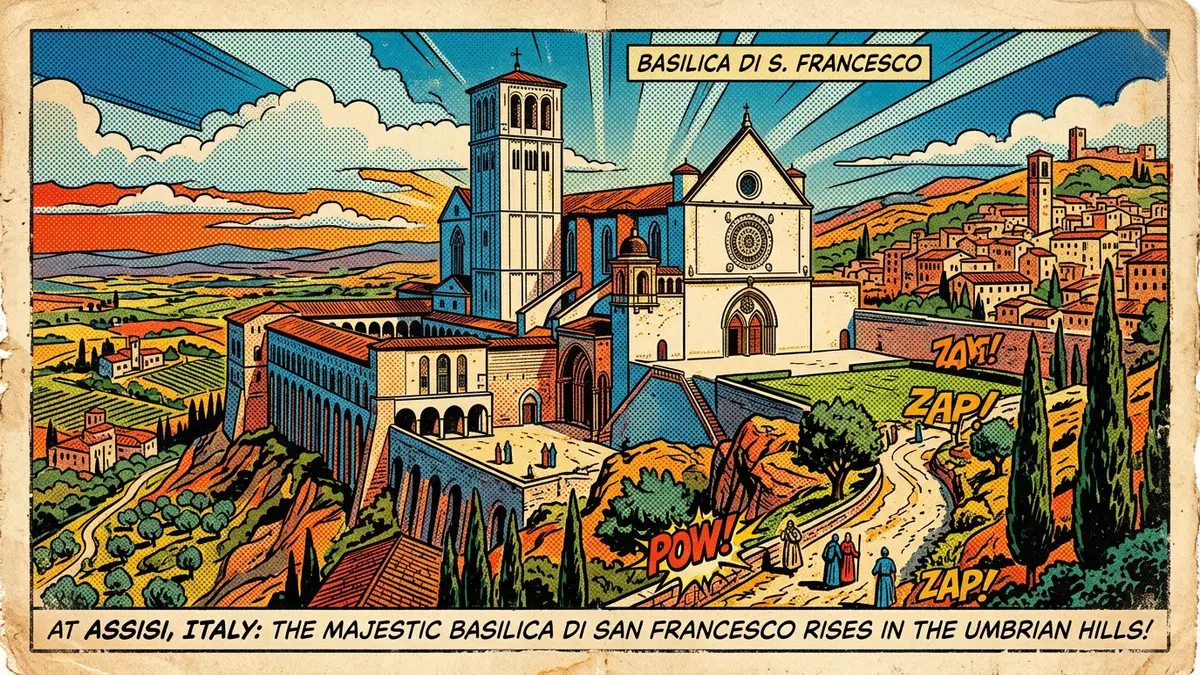
Basilica di San Francesco rises at the western edge of Assisi as a layered building of stone, paint and memory. Its two superimposed churches hold the tomb of Francis of Assisi, while frescoes by Giotto, Cimabue, Pietro Lorenzetti and Simone Martini cover the medieval interior.
Two churches within Basilica di San Francesco
The basilica began in 1228, two years after the death of Francis in Assisi. Pope Gregory IX placed its foundation stone after Francis’s canonisation, and the building became closely connected with the Franciscan Order.
The Lower Basilica was completed in 1230, while the Upper Basilica was consecrated in 1253. Together with the crypt, the churches form a vertical sequence of Romanesque and Italian Gothic architecture. The tomb of Francis lies in the crypt, where his remains rest in a simple stone setting.
The lower building has a more enclosed character, with substantial walls, low vaults and side chapels. The upper building has a taller nave, pointed arches and broad painted surfaces. The change from one church to the other is visible in the proportions, decoration and treatment of light.
Frescoes by Giotto, Cimabue and their contemporaries
Basilica di San Francesco is also a record of the artistic language of thirteenth- and fourteenth-century Italy. The names associated with its decoration include Giotto and Cimabue, alongside Pietro Lorenzetti and Simone Martini.
The Upper Basilica contains a celebrated cycle showing episodes from the life of Francis. The scenes occupy the nave walls beneath the timber roof, creating a continuous visual sequence around the central space. Their scale links the saint’s biography with the architecture surrounding it.
The Lower Basilica contains paintings connected with the Master of Saint Francis, Cimabue, Giotto, Lorenzetti and Martini. Chapels, transepts and vaults bring together different styles, periods and approaches to sacred painting. The result is not a single artist’s interior, but a medieval ensemble assembled through successive campaigns.
The building’s importance extends beyond individual images. Assisi’s medieval works, including the basilica’s frescoes, influenced the development of Italian and European art and architecture. The UNESCO designation records the wider relationship between the Franciscan sites, the town and their cultural landscape.
Subasio stone and the Franciscan setting
The basilica stands in Umbria, on the slopes of the hill town of Assisi and below Mount Subasio. White and pink limestone from the local area appears across the town’s religious buildings, giving the historic centre a shared material character.
Its exterior presents a strong contrast between the lower church, the upper church and the convent buildings beside them. The façade of the Upper Basilica is framed by a rose window and a pointed entrance, while the adjoining bell tower rises above the complex.
Assisi’s relationship with Francis began before the basilica’s construction. Francis was born in Assisi in 1182 and died there in 1226. His life gave the town a lasting connection with the Franciscan movement, whose houses, sanctuaries and churches extend across the surrounding landscape.
In 2000, Assisi, Basilica di San Francesco and other Franciscan sites entered the UNESCO World Heritage List. The protected property includes the medieval town, the basilica and associated places such as Santa Chiara, San Damiano, Rivotorto, the Eremo delle Carceri and Santa Maria degli Angeli.
The basilica therefore works on several scales. It is a church with a crypt, a complex of two superimposed buildings, a home for major medieval paintings and part of a wider Umbrian cultural landscape.
Visiting Basilica di San Francesco: what travellers from Western Europe should know
- Basilica di San Francesco stands at the western edge of Assisi’s historic centre, below Mount Subasio. Assisi is in Umbria, in central Italy.
- Rail travellers reach Assisi station in the plain below the hill town. Local buses and roads connect the station area with the historic centre.
- The approach through Assisi includes sloping streets and changes in level. The basilica itself contains stairs between the Lower Basilica, Upper Basilica and crypt.
- The official language is Italian and the currency is the euro.
Searching for Basilica di San Francesco on social platforms
These links open searches for Basilica di San Francesco on each platform.
Frequently asked questions about Basilica di San Francesco
Where is Basilica di San Francesco?
It stands at the western edge of Assisi’s historic centre in Umbria, central Italy. Mount Subasio rises above the hill town.
What can visitors expect inside?
The complex contains a Lower Basilica, an Upper Basilica and a crypt. Medieval frescoes cover the churches, with works associated with Giotto, Cimabue, Pietro Lorenzetti and Simone Martini.
What makes the basilica distinctive?
Its identity comes from the combination of a Franciscan tomb, two superimposed churches and a major sequence of medieval paintings. The building is also part of the UNESCO World Heritage property covering Assisi and other Franciscan sites.


