
Basilica di San Francesco and its double church on the hill at Assisi
Published on 09/16/2026 at 14:25 | Editorial responsibility: Rafael Müller, Editor-in-Chief AD HOC NEWS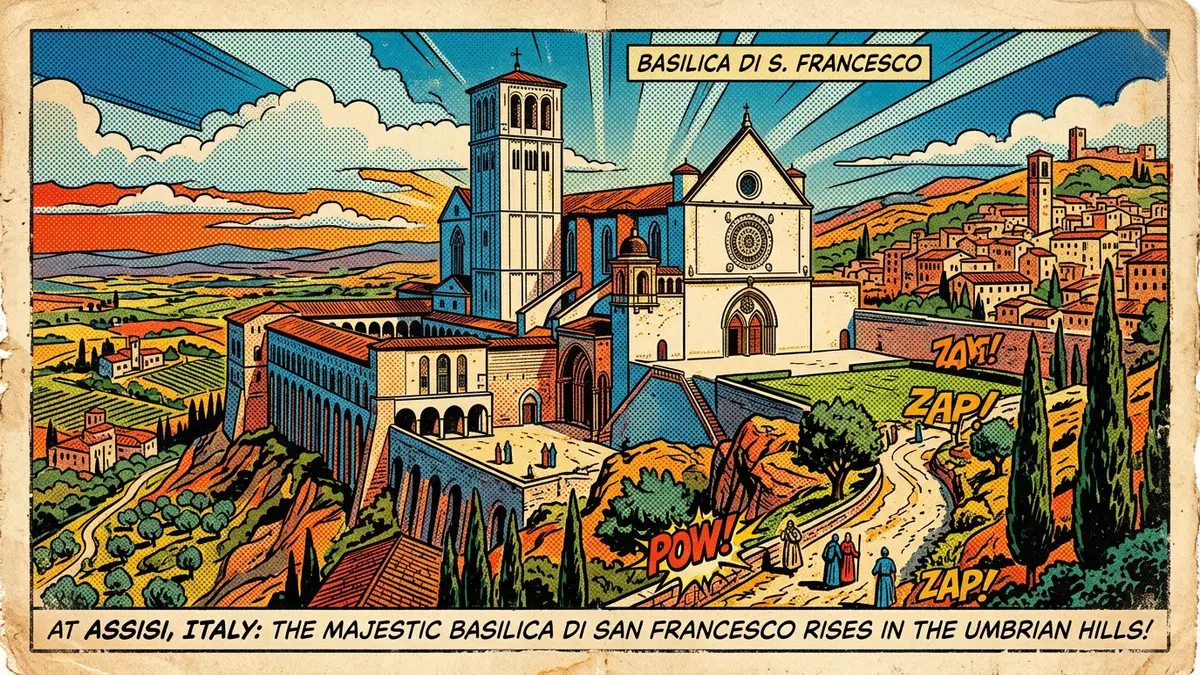
Basilica di San Francesco in Assisi is a Franciscan sanctuary built into the western hillside of the Umbrian town, where a double church and crypt rise above the slope in layered stone. The complex took shape in the thirteenth century under Franciscan patronage, bringing together a lower church, an upper church and the tomb of Francis of Assisi within a single architectural ensemble.
A double church built into the hillside
The defining feature of Basilica di San Francesco is its superimposed plan: an Lower Church and an Upper Church stacked one above the other on the flank of Monte Subasio, with the saint’s crypt beneath them. Construction began in 1228, the year after Francis of Assisi was canonised by Pope Gregory IX, when a foundation stone was laid on the hill at the western edge of Assisi.Construction began in 1228 The lower church reached completion around 1230, and the basilica was consecrated in 1253 under Pope Innocent IV, marking the end of its main building phase in the thirteenth century.Consecrated in 1253 under Pope Innocent IV
Approached from the town, the basilica appears as a compact mass of pale masonry projecting from the hillside, with the monastery buildings of the Sacro Convento extending behind it. Inside, the double church arrangement becomes clear: from the entrance level, visitors can move into the vaulted Lower Church or climb to the spacious Upper Church above, while stairways lead further down to the crypt housing the remains of Francis.lower and upper church with crypt This vertical layering gives Basilica di San Francesco an unusual internal sequence: a more enclosed, cave-like space below, a hall-like volume above and the tomb beneath them.
Romanesque and Italian Gothic under one roof
Basilica di San Francesco stands at the transition between Romanesque and Gothic architecture in Italy, combining heavy masonry and rounded arches with taller volumes and pointed forms that became characteristic of Italian Gothic. The architecture is often described as a synthesis of Romanesque solidity and French-influenced Gothic articulation, and it helped establish many of the typical features of Italian Gothic church design.synthesis of Romanesque and Gothic The Lower Church, built first between 1228 and 1230, has thick walls and low vaults springing from sturdy piers, while the Upper Church, completed by 1253, is taller and more light-filled, with a single nave and ribbed vaulting in the Gothic manner.lower and upper church dates
Externally, the basilica presents a relatively simple outline, with a broad façade and a bell tower rising beside it, but the detailing reflects the shift in style. The façades and portals show a mixture of Romanesque forms and Gothic tracery, and the interior elevations move from massive supporting elements in the lower level to more slender supports and higher vaults above. This stylistic combination made the church an early model for the architecture of mendicant orders and contributed to its recognition as a founding work of Franciscan Gothic.founding work of mendicant architecture
Painting cycles and World Heritage status
Beyond its structure, Basilica di San Francesco is renowned for extensive fresco cycles that cover the walls and vaults of both churches. In the Lower Church, painted decoration from the thirteenth and fourteenth centuries includes work associated with masters such as Cimabue, Pietro Lorenzetti and Simone Martini, while the Upper Church contains narrative frescoes widely attributed to Giotto and his workshop.frescoes by Cimabue, Giotto and others These cycles trace episodes from the life of Francis as well as biblical scenes, turning the interior into a painted chronicle of Franciscan spirituality and medieval Italian art.
Assisi, together with Basilica di San Francesco and other Franciscan sites in and around the town, is inscribed on the UNESCO World Heritage List. The inscription emphasises the ensemble of medieval art and architecture associated with the Franciscan Order, noting that the basilica and its paintings by Cimabue, Giotto, Simone Martini and Pietro Lorenzetti form a fundamental reference point for the development of Italian and European art and architecture.UNESCO World Heritage inscription Within this wider landscape of Assisi, Basilica di San Francesco stands as the central sanctuary where the tomb, double church and frescoed interiors come together on the hillside above the Umbrian plain.
Visiting Basilica di San Francesco: what travellers from Western Europe should know
- Basilica di San Francesco stands on the western edge of Assisi in central Italy, with approaches from the historic town centre and road access from the surrounding Umbrian countryside.
- The complex is built into a hillside, and movement between the Lower Church, Upper Church and crypt involves staircases, stone floors and changes in level inside the sanctuary.
- The surrounding Sacro Convento and the broader Assisi sanctuary form a large religious precinct, so a visit usually involves walking through monastic courtyards and the streets of the medieval town.
- The official language is Italian and the currency is the euro.
Searching for Basilica di San Francesco on social platforms
These links open searches for Basilica di San Francesco on each platform.
Frequently asked questions about Basilica di San Francesco
Where is Basilica di San Francesco located?
Basilica di San Francesco stands on the western hillside of Assisi in central Italy, built into the slope of Monte Subasio above the Umbrian plain.
What can visitors expect inside the basilica?
Visitors encounter a double church with a Lower Church and an Upper Church stacked one above the other, extensive medieval fresco decoration and a crypt with the tomb of Francis of Assisi.
What makes Basilica di San Francesco distinctive among churches in Italy?
The basilica’s superimposed plan, its combination of Romanesque and Italian Gothic architecture and its celebrated fresco cycles by masters such as Cimabue and Giotto give it a distinctive place in Italian art and architecture.


