
Basilica di San Francesco and its double church above the hill
Published on 09/15/2026 at 15:19 | Editorial responsibility: Rafael Müller, Editor-in-Chief AD HOC NEWS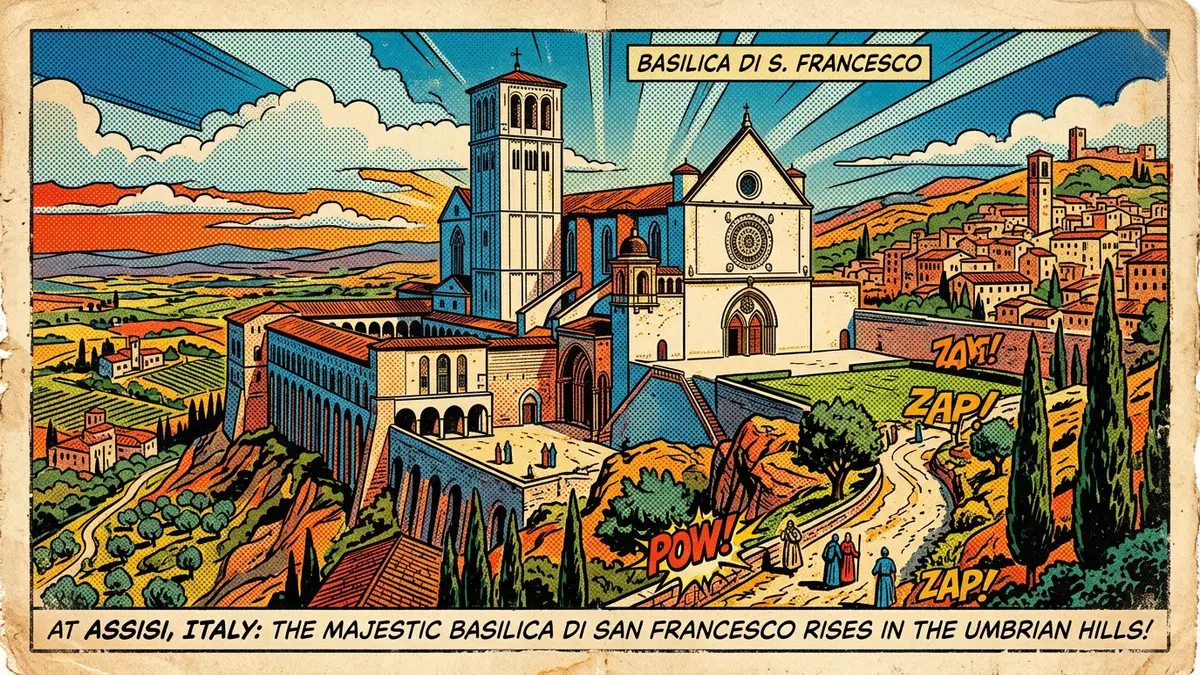
Basilica di San Francesco in Assisi is a layered church complex built into a hillside, with an upper church, a lower church and a crypt gathered above the western edge of the Umbrian town. The basilica was begun in 1228 under Pope Gregory IX, two years after the death of Saint Francis, giving this slope a new identity as the place where his tomb and the art of his followers came together in stone.Assisi, the Basilica of San Francesco and Other Franciscan Sites
A double church on the hillside
Basilica di San Francesco stands on the western flank of Assisi, built directly into the slope below Monte Subasio and organised as two superposed churches with a crypt beneath the lower floor.Basilica of Saint Francis of Assisi The lower church, constructed between 1228 and 1230, forms an enclosed, barrel-vaulted space resting on sturdy piers, while the upper church, completed and consecrated in 1253 under Pope Innocent IV, rises above it as a taller hall with ribbed vaulting.two churches superposed, Inferiore and Superiore
The unusual vertical arrangement gives the basilica a compact exterior, with a fortress-like block projecting from the hillside and a single, square campanile marking the complex against the Umbrian landscape.Basilika San Francesco Inside, the lower church houses the crypt where the body of Saint Francis has rested since 1230, in a simple stone tomb set into the rock, while the upper church opens into a longitudinal nave that carries the eye towards the high altar above the saint’s burial place.crypt with the tomb of Saint Francis
Thirteenth-century architecture and fresco cycles
Construction of Basilica di San Francesco began in July 1228, in the year of Francis’s canonisation, and the complex was consecrated in 1253 after a building campaign that spanned much of the thirteenth century.construction between 1228 and 1253 The architecture is a synthesis of Umbrian Romanesque and Italian Gothic, combining heavy masonry and round arches at the lower level with pointed arches, stained-glass windows and slender supports in the upper church.Romanesque lower church and Gothic upper hall
The interior decoration forms one of the most important ensembles of fourteenth- and late thirteenth-century painting in Europe, with extensive fresco cycles covering the walls and vaults.medieval art masterpieces in Assisi Artists including Cimabue, Giotto, Simone Martini, Pietro Lorenzetti and Jacopo Torriti contributed scenes that narrate the life of Saint Francis, episodes from the Bible and symbolic images, turning the upper and lower churches into layered picture books of Franciscan spirituality.decorative apparatus with major Italian painters
A World Heritage sanctuary linked to Saint Francis
Basilica di San Francesco forms the core of a World Heritage property recognised by UNESCO as “Assisi, the Basilica of San Francesco and Other Franciscan Sites”, reflecting its role in the history of art and the Franciscan movement.World Heritage listing 990 Saint Francis was born in Assisi in 1182, founded the Franciscan Order and died in 1226, and the basilica was raised partly to house his relics and to provide a monastic complex for the community around his cult.birth of San Francesco in 1182 and canonisation in 1228
The wider ensemble includes the Sacro Convento adjoining the church, Assisi’s medieval streets and other Franciscan sites, forming a cultural landscape where religious architecture, town fabric and surrounding countryside remain closely linked.principal religious complex of Assisi Within this setting, the basilica’s double church and fresco decoration have significantly influenced the development of Italian and European art, making Assisi an important point of reference for both pilgrimage and the study of medieval painting and architecture.exceptional architectural complex influencing art and architecture
Visiting Basilica di San Francesco: what travellers from Western Europe should know
- Basilica di San Francesco stands on the western edge of Assisi in central Italy, on the slope below Monte Subasio, a short walk uphill from the town’s medieval core.
- The complex climbs over a hillside platform, with terraces, internal stairways and the lower and upper churches stacked vertically, so a visit involves several changes in level on foot.
- The official language is Italian and the currency is the euro.
Searching for Basilica di San Francesco on social platforms
These links open searches for Basilica di San Francesco on each platform.
Frequently asked questions about Basilica di San Francesco
Where is Basilica di San Francesco located?
Basilica di San Francesco stands on the western slope of Assisi in central Italy, below Monte Subasio and above the medieval streets of the town.
What can visitors expect inside the basilica complex?
Visitors encounter a lower church with heavy stone vaults, an upper church with Gothic architecture and extensive fresco cycles, and a crypt containing the tomb of Saint Francis.
What makes Basilica di San Francesco distinctive among European churches?
Its double church arrangement, thirteenth-century blend of Romanesque and Italian Gothic and major fresco cycles by artists such as Giotto and Cimabue give it a singular place in medieval art.


