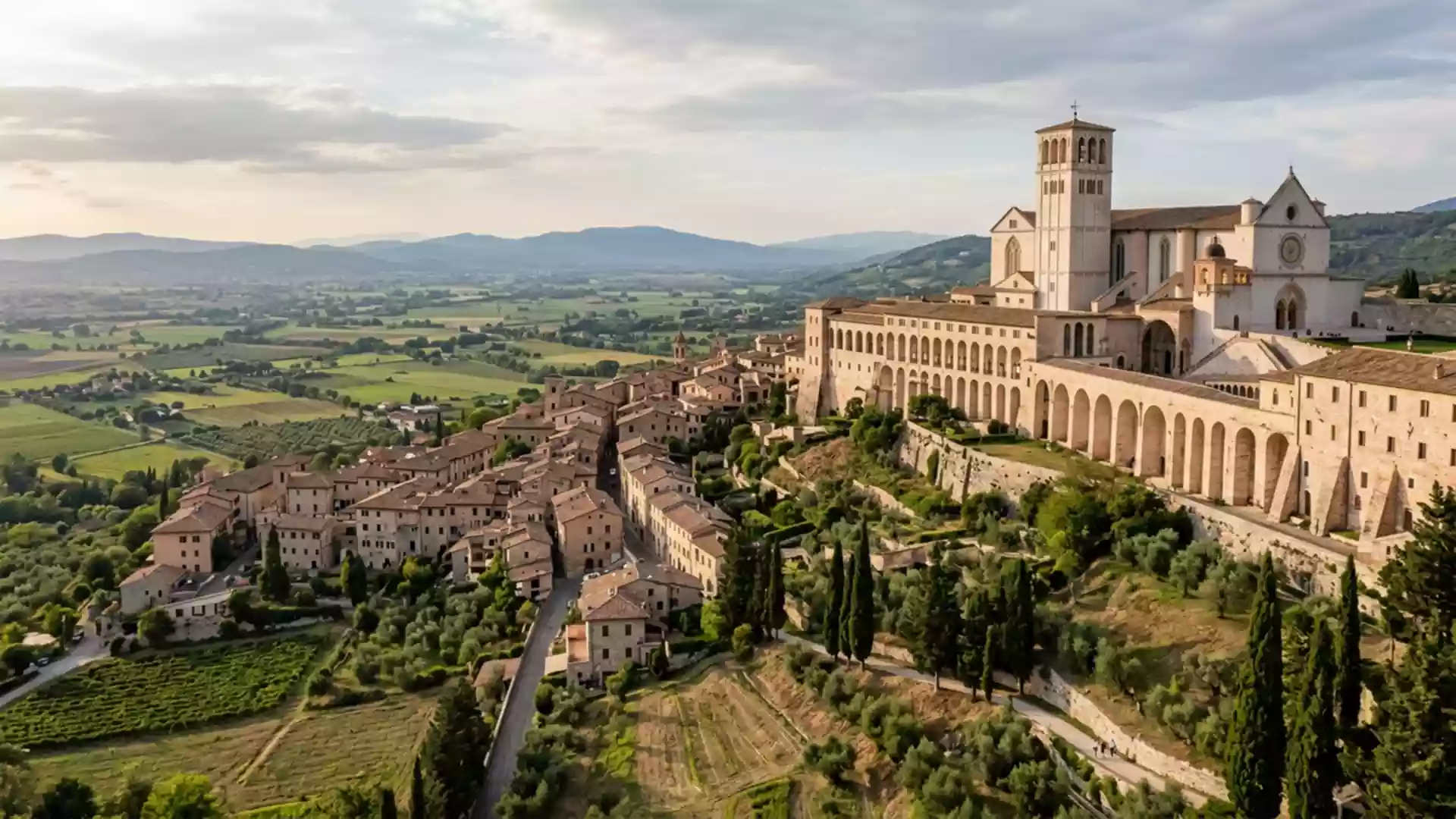
Basilica di San Francesco and its double church above the hill
Published on 09/03/2026 at 13:25 | Editorial responsibility: Rafael Müller, Editor-in-Chief AD HOC NEWS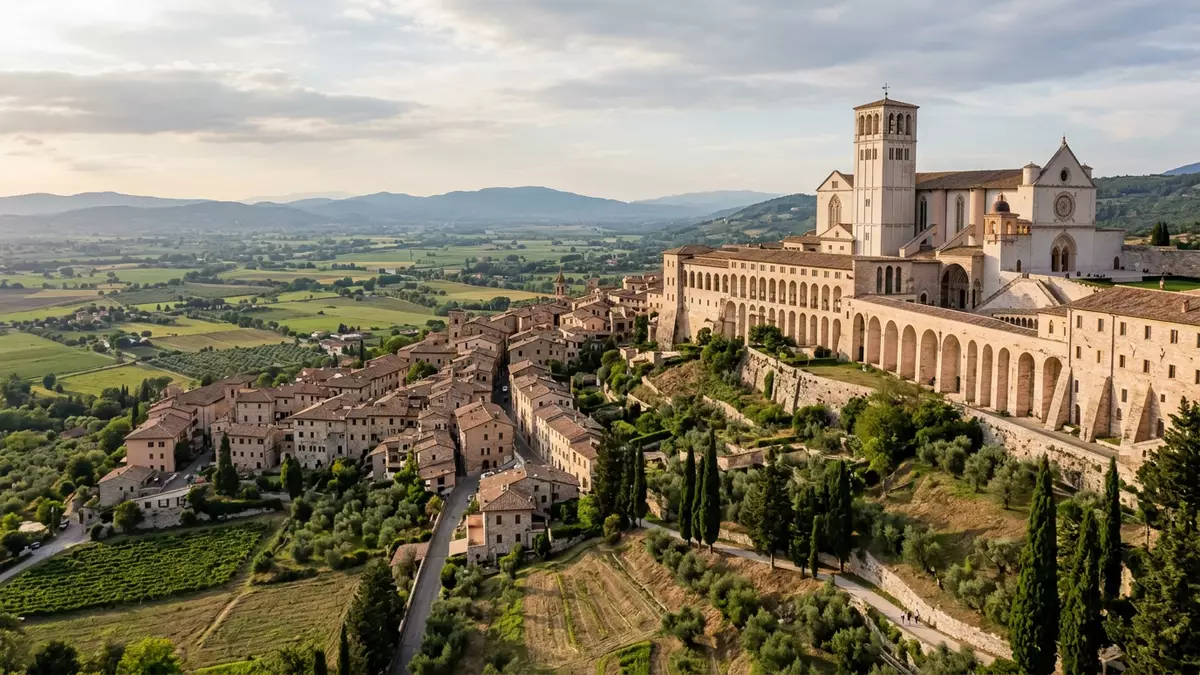
Basilica di San Francesco rises on the western flank of Assisi, built into a hillside and organised as a double church with a crypt holding the remains of Saint Francis. Conceived in the thirteenth century as both pilgrimage shrine and conventual centre, it combines a lower, earthbound church and a soaring upper hall within one compact stone envelope.
A hillside basilica built in layers of stone and space
The basilica stands at the edge of Assisi’s historic core, linked to the Franciscan Sacro Convento that extends along the same slope. Construction began in 1228, two years after the death of Francis of Assisi in 1226 and in the year of his canonisation by Pope Gregory IX.Construction began in 1228 The church complex was consecrated in 1253 under Pope Innocent IV, closing an intense building campaign that reshaped the entire western approach to the town.Consecrated in 1253
The building is traditionally attributed to Brother Elias of Cortona and the master builder Jacopo Tedesco, whose work helped to crystallise Italian Gothic forms.Elia da Cortona and Lapo Tedesco From outside, Basilica di San Francesco reads as a fortress-like mass of pale stone stepping down the hill, its bell tower and arcaded convent terraces aligned with the town walls and the Umbrian landscape beyond.
Two superimposed churches: Lower and Upper Basilica
The defining feature of Basilica di San Francesco is its vertical organisation into two complete churches, one above the other, with a crypt below. The Lower Church, completed around 1230, forms a broad, barrel-vaulted hall with side chapels and heavy piers that reflect Umbrian Romanesque traditions.Lower basilica finished in 1230 Beneath its floor, the remains of Saint Francis rest in a stone crypt that became a focus for pilgrims from across Europe.
Above, the Upper Church forms a single high nave with slender supports and pointed vaults that introduced the Gothic idiom to central Italy.Early Italian Gothic interior Its plan follows a simple Latin cross, with a nave, transept and polygonal apse, yet the stacking of two full churches on the same footprint gives the whole complex a density that visitors sense as they move between the dimmer spaces below and the taller hall above.
Fresco cycles that reshaped medieval painting
Inside both churches, fresco cycles from the thirteenth and fourteenth centuries line the walls and vaults, turning Basilica di San Francesco into a vast painted chronicle. Artists including Cimabue, Giotto, Simone Martini and Pietro Lorenzetti worked here, producing scenes that trace the life of Christ, the life of Saint Francis and key episodes from Christian history.Medieval art masterpieces in Assisi The frescoes of the Upper Church, particularly the narrative cycle associated with Giotto along the nave walls, are regarded as a turning point towards greater spatial realism and human presence in Italian art.
These artistic ensembles contributed to the inscription of Assisi and the Basilica di San Francesco as a UNESCO World Heritage Site, recognised for their role in the development of Italian and European art and architecture.UNESCO recognition for Assisi For visitors, the frescoes also structure the experience of moving through the complex, from the more enclosed chapels of the Lower Church to the high walls and vaults of the Upper Church, where bands of colour and narrative imagery run almost uninterrupted along the stone surfaces.
Visiting Basilica di San Francesco: what travellers from Western Europe should know
- Basilica di San Francesco stands on the western side of Assisi’s historic centre, within walking distance of the town’s main streets and the medieval gate on that flank.
- The approach from the town involves sloping streets and broad exterior stairways, and movement inside the complex includes stone steps between the Lower Church, Upper Church and crypt.
- Assisi lies in Umbria in central Italy and is served by regional rail links and roads connecting it with Perugia and other Umbrian towns.
- Italian is the official language and the currency is the euro.
Searching for Basilica di San Francesco on social platforms
These links open searches for Basilica di San Francesco on each platform.
Frequently asked questions about Basilica di San Francesco
Where is Basilica di San Francesco?
Basilica di San Francesco stands on the western side of Assisi, a hill town in Umbria in central Italy, attached to the Franciscan Sacro Convento.
What can visitors expect inside the basilica?
Visitors encounter two complete churches stacked one above the other, a crypt with the tomb of Saint Francis and extensive medieval fresco cycles across walls and vaults.
What makes Basilica di San Francesco distinctive compared with other churches?
The combination of a double church, early Italian Gothic architecture and vast fresco programmes by artists such as Giotto and Cimabue gives the complex a singular character.