
Basilica de Guadalupe in Mexico City and its two basilicas
Published on 08/30/2026 at 13:47 | Editorial responsibility: Rafael Müller, Editor-in-Chief AD HOC NEWS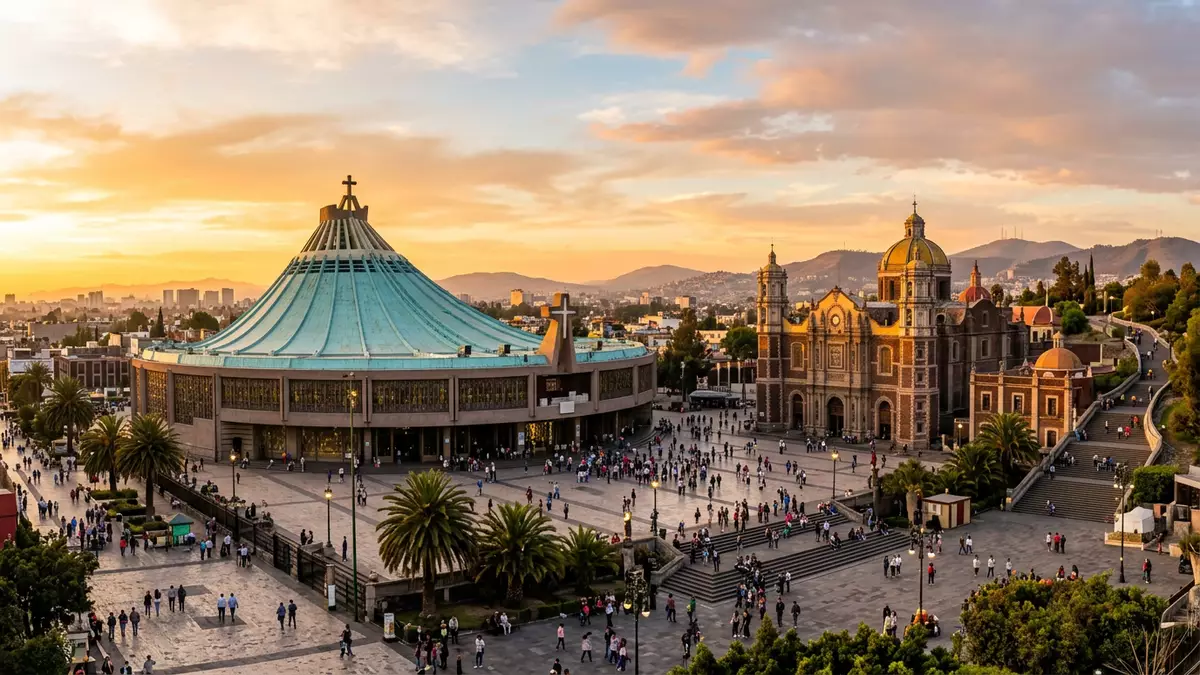
Basilica de Guadalupe in Mexiko-Stadt is best read as a dialogue between two churches. The older basilica finished in 1709, and the newer one by Pedro Ramírez Vázquez stands beside it as a broad modern counterpoint.
The old shrine and the modern basilica
The older building is a Roman Catholic church finished in 1709 and long known as the Old Basilica. The newer church belongs to the same pilgrimage complex and houses the image of the Virgin of Guadalupe.
That pairing gives the site its clearest visual contrast. One building belongs to the baroque world of heavy masonry and towers, while the other is a large twentieth-century structure with a ring-like plan.
Juan Diego, Tepeyac and the Guadalupe cult
The church is tied to December 1531, when Juan Diego was said to have received apparitions of the Virgin Mary on Tepeyac Hill. The basilica stands in Villa de Guadalupe Hidalgo, a northern district of Mexiko-Stadt, at the foot of that hill.Tepeyac Hill
This setting explains why the complex matters far beyond one neighbourhood. It is the chief religious centre of Mexico and a major place of pilgrimage, with the shrine and the hill forming one connected religious landscape.chief religious centre
Pedro Ramírez Vázquez and the circular plan
The newer basilica was designed by Pedro Ramírez Vázquez. Its open interior, broad roof and central altar space make it very different from the older church next door.
The building’s round plan is one of its defining features, and the Virgin’s image hangs above and behind the main altar. The result is a single large worship space rather than a sequence of side chapels and narrow aisles.Pedro Ramírez Vázquezfinished in 1709
The older basilica remains part of the same ensemble, and its presence keeps the site readable as a sequence of layers rather than a single monument. The complex brings together colonial religious architecture, modern Mexican design and a devotion rooted in a seventeenth-century cult of memory and image.
Visiting Basilica de Guadalupe: what travellers from Western Europe should know
- The basilica lies in Villa de Guadalupe Hidalgo in northern Mexiko-Stadt. Metro access is via La Villa–Basílica station, and Calzada de Guadalupe runs alongside the complex.La Villa–Basílica station
- The site spreads across a hill and a plaza, so the terrain changes between levels. Tepeyac Hill rises behind the basilicas, and stairs connect parts of the wider sanctuary.Tepeyac Hill rises
- The complex includes the Old Basilica and the newer basilica. It also contains the museum area linked to the older building and other devotional spaces on the hill.
- Spanish is the main language used in the surrounding city, and the currency is the Mexican peso.
- Entry requirements depend on your nationality; UK travellers can check the FCDO travel advice at gov.uk/foreign-travel-advice, Irish travellers the Department of Foreign Affairs at ireland.ie.
Searching for Basilica de Guadalupe on social platforms
These links open searches for Basilica de Guadalupe on each platform.
Frequently asked questions about Basilica de Guadalupe
Where is Basilica de Guadalupe?
It stands in Villa de Guadalupe Hidalgo, in northern Mexiko-Stadt, at Tepeyac Hill. The complex forms part of a wider religious landscape tied to the Virgin of Guadalupe.
What should a visit include?
The visit usually centres on the modern basilica and the older church beside it. The hill, the shrine spaces and the museum area add further layers to the complex.
What makes it distinctive?
The strongest feature is the contrast between the 1709 basilica and Pedro Ramírez Vázquez’s modern circular church. The site also carries the story of Juan Diego and the Guadalupe devotion.


