
Banaue Rice Terraces and the stepped slopes of Banaue
Published on 09/08/2026 at 12:10 | Editorial responsibility: Rafael Müller, Editor-in-Chief AD HOC NEWS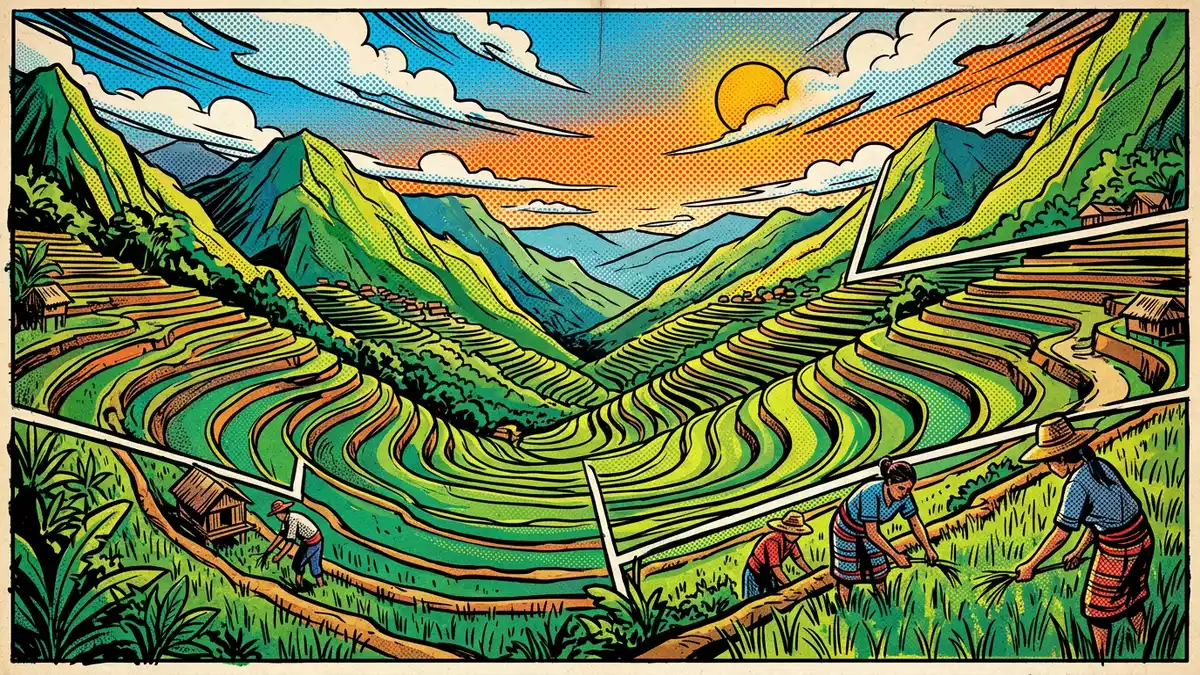
Banaue Rice Terraces rises in layered stone and earth above Banaue, in Ifugao, on Luzon in the Philippines. The stepped fields are part of a mountain landscape shaped by the Ifugao people and linked to the rice culture of the Cordilleras.
Stone walls and terraced slopes above Banaue
The terraces form broad bands across the mountainside, with retaining walls, field steps and narrow ridges between plots. Their profile is easy to read from a distance: a landscape built in layers rather than a single enclosure. two millennia ago marks the long history behind the wider terrace tradition, while Banaue remains the place most closely named with this scenery.
The rice terraces belong to the broader Ifugao terrace system in the mountains of north-central Luzon. They sit within a highland world of cultivated slopes, forested upper catchments and village settlements, with rice fields fitted to the contours of the land. Ifugao people and the mountain setting are the two names that anchor the place most securely.
Banaue, Ifugao and the wider terrace landscape
UNESCO’s World Heritage property for the Rice Terraces of the Philippine Cordilleras includes five clusters, among them Bangaan and Batad in the municipality of Banaue. The Banaue Rice Terraces name is used for the terraces around the Banaue poblacion and viewpoint, while the inscribed property covers the separate clusters that belong to the wider system. Bangaan and Batad place Banaue within that larger cultural landscape.
The terraces are also recognised as a National Cultural Treasure under the Ifugao Rice Terraces. That designation sits alongside the local significance of the Banaue slopes, which remain among the best-known visual expressions of Ifugao agricultural life. National Cultural Treasure is the formal status most directly associated with the Banaue terraces themselves.
Rice, irrigation and the Ifugao highlands
The terraces are fields rather than a single monument, and their appearance changes with planting cycles and water flow. Stone and earth retaining walls support the stepped plots, while channels carry water through the system from the upland catchments above. elaborate irrigation system and hand-built field edges define the place more clearly than any grand architectural label.
The Ifugao name belongs in any account of Banaue because it identifies both the people and the terrace tradition. The landscape is agricultural, but it is also a historic expression of labour, water management and settled mountain life. A visitor sees slopes, walls, steps and village edges rather than a single viewpoint framed for a single glance.
Visiting Banaue Rice Terraces: what travellers from Western Europe should know
- The terraces lie in Banaue, Ifugao, on northern Luzon. Banaue is the usual base for reaching the terrace clusters and the surrounding mountain villages.
- The ground is steep, with field walls, steps and uneven paths around the terraces. Walking here means moving across terraced slopes rather than level ground.
- Bangaan and Batad are the names most closely linked to the UNESCO-listed terrace clusters in the municipality. The Banaue viewpoint looks towards the terraces around the poblacion.
- The official language is Filipino and the currency is the Philippine peso.
- Entry requirements depend on your nationality; UK travellers can check the FCDO travel advice at gov.uk/foreign-travel-advice, Irish travellers the Department of Foreign Affairs at ireland.ie.
Searching for Banaue Rice Terraces on social platforms
These links open searches for Banaue Rice Terraces on each platform.
Frequently asked questions about Banaue Rice Terraces
Where are the Banaue Rice Terraces?
They are in Banaue, Ifugao, on Luzon in the Philippines. The name refers to the terraces around the Banaue poblacion and viewpoint.
What does a visit involve?
The site is a mountain landscape of stepped fields, so movement happens on slopes, paths and field edges. Bangaan and Batad are the names most closely associated with the wider terrace system in the municipality.
What makes Banaue Rice Terraces distinctive?
The terraces combine stone, earth and water in a highland agricultural landscape shaped by the Ifugao people. Their layered form and long-established rice culture give Banaue its best-known image.


