
Banaue Rice Terraces and the sculpted slopes of Ifugao
Published on 09/03/2026 at 21:41 | Editorial responsibility: Rafael Müller, Editor-in-Chief AD HOC NEWS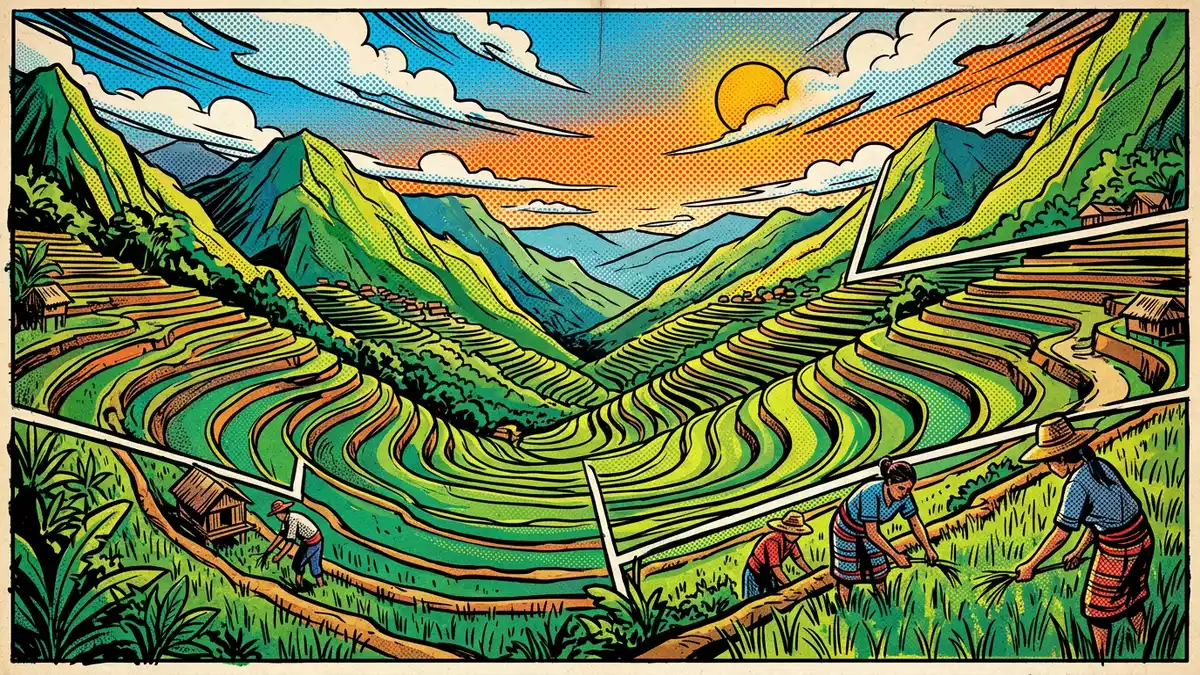
Banaue Rice Terraces in the mountains above Banaue in the Philippines form a stepped landscape carved into steep slopes by Ifugao farmers over many centuries. Stretching across the high ridges of the Cordillera Central on northern Luzon, they turn entire hillsides into narrow, irrigated fields at elevations that reach well above 1,000 m (3,281 ft). The terraces close to the town centre are part of a wider network of Ifugao rice terraces recognised internationally as a cultural landscape.
A hand-carved mountain landscape
The Banaue Rice Terraces occupy the high valley walls around Banaue in Ifugao Province, with fields cut into the mountains in long bands that follow the contours of the slopes. This stepped terrain sits within the Cordillera Administrative Region of Luzon, a chain of high mountains that runs across the island’s north and provides the setting for several terrace clusters.Ifugao Province in Luzon The terraced hillsides near the Banaue poblacion have become the best-known view of this landscape, with fields stacked above each other and narrow paths tracing the retaining walls.
These terraces were carved by ancestors of the indigenous Ifugao people, who adapted steep ridges and river valleys into irrigated fields generations before Spanish colonial rule in the archipelago.created more than 2,000 years ago Earthen embankments and stone-supported walls hold thin plots of soil, while channels bring water down from higher forested slopes. Seen from above, the terraces form bands and arcs around the valley, enclosing scattered hamlets and small clusters of traditional houses.
Banaue and the World Heritage terraces of Ifugao
Banaue lies in north-central Luzon and gives its name to several rice terrace clusters, including the celebrated amphitheatre of Batad and the terraces around Bangaan, which frame an Ifugao village. These clusters, together with terraces in Mayoyao, Hungduan and Nagacadan, form the property known as the Rice Terraces of the Philippine Cordilleras, inscribed on the UNESCO World Heritage List in 1995 as a cultural landscape.Rice Terraces of the Philippine Cordilleras Batad and Bangaan both fall within the municipality of Banaue and are part of this inscription.
The terraces seen from the main Banaue viewpoint, however, are not themselves part of the World Heritage inscription, largely because of the number of modern buildings within their area.Banaue viewpoint terraces They are instead recognised nationally, alongside other terrace systems in Ifugao, as an important cultural treasure. This distinction matters for heritage policy, but visitors standing at the viewpoint see a continuous terraced landscape that links Banaue visually with the more formally protected clusters beyond the town.
Terraces, altitude and terrain
The Banaue Rice Terraces and their neighbouring systems occupy high ground between deep river valleys, with elevations in the area reaching well over 1,000 m (3,281 ft) above sea level and local peaks rising higher.topographic map of Banaue Rice Terraces In practical terms, this means that access routes from Banaue climb steeply, and paths along the terraces are narrow and uneven. Retaining walls form mini-cliffs between levels, with steps cut into earth or stone and occasional sections of concrete added as reinforcement.
Within the wider World Heritage property, each terrace cluster has its own layout. Nagacadan near Kiangan forms two distinct ascending rows of terraces divided by a river, Hungduan’s terraces create patterns compared with a web, and the Mayoyao cluster includes terraces interspersed with farmers’ houses and granaries.inscribed terrace clusters Around Bangaan, terraces backdrop an Ifugao village, and at Batad semi-circular terraces surround a settlement set at their base. The Banaue terraces close to town share the same basic elements of embanked fields fed by gravity irrigation, but they face a denser band of roadside development.
Visiting Banaue Rice Terraces: what travellers from Western Europe should know
- Banaue is reached by road in the Cordillera Administrative Region of northern Luzon, with the main viewpoints for Banaue Rice Terraces lying above the town along the upland highway.
- Paths along the terraces involve steep gradients, uneven stone or earth steps and narrow ledges beside the retaining walls, so walks often require steady footing and a readiness for wet ground.
- The highland setting brings cooler air than the lowland plains, and mist can wrap the upper slopes around Banaue Rice Terraces, affecting visibility across the valley.
- The town of Banaue serves as a base for onward journeys to Batad and Bangaan, two terrace clusters within the municipality that form part of the Rice Terraces of the Philippine Cordilleras World Heritage property.
- The official language is Filipino alongside regional languages, and the currency is the Philippine peso; entry requirements depend on your nationality, UK travellers can check the FCDO travel advice at gov.uk/foreign-travel-advice, Irish travellers the Department of Foreign Affairs at ireland.ie.
Searching for Banaue Rice Terraces on social platforms
These links open searches for Banaue Rice Terraces on each platform.
Frequently asked questions about Banaue Rice Terraces
Where are Banaue Rice Terraces located?
Banaue Rice Terraces are in the municipality of Banaue in Ifugao Province, part of the Cordillera Administrative Region on the island of Luzon in the Philippines.
What should visitors expect when exploring the terraces?
Visitors encounter steep, stepped terrain with narrow paths along irrigated fields, retaining walls between levels and access routes that climb from Banaue’s town centre to higher viewpoints.
What makes Banaue Rice Terraces distinctive among rice terraces?
They form part of a wider network of ancient Ifugao terraces, with nearby clusters such as Batad and Bangaan recognised as a UNESCO World Heritage cultural landscape and displaying dramatic amphitheatre-like layouts.


