
Banaue Rice Terraces and the broad mountain steps of Ifugao
Published on 08/31/2026 at 16:48 | Editorial responsibility: Rafael Müller, Editor-in-Chief AD HOC NEWS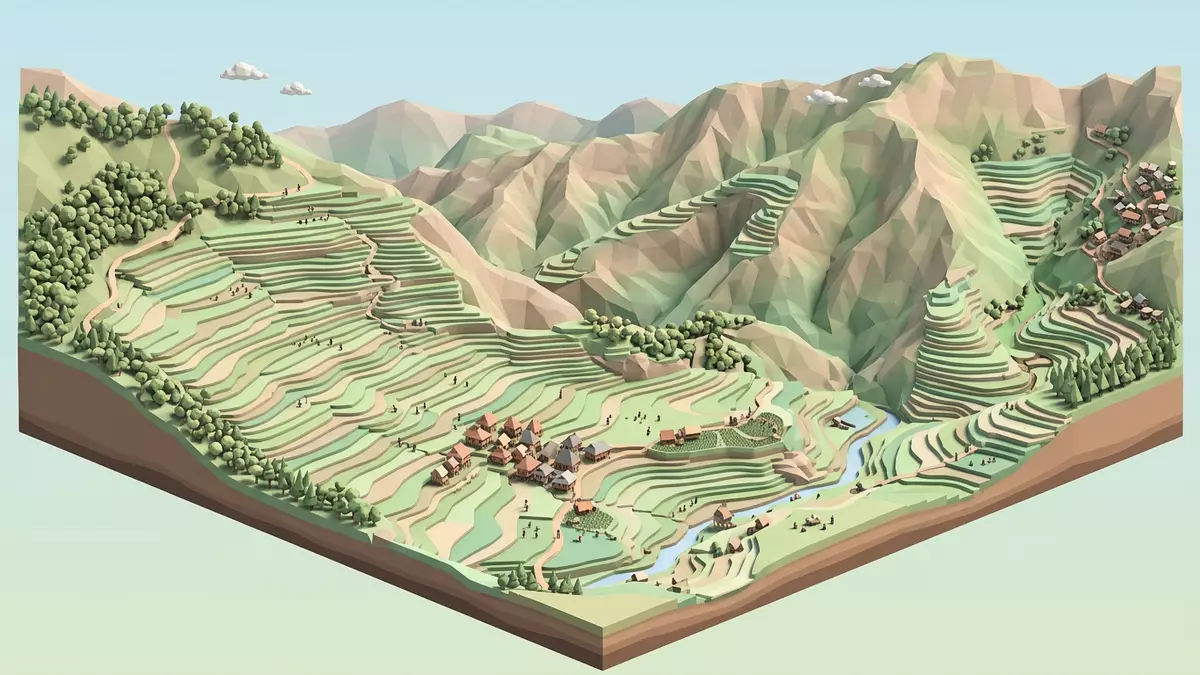
Banaue Rice Terraces in Banaue present a vast mountain landscape of stepped fields, stone walls and water channels. The Ifugao terraces are part of a long agricultural tradition in northern Luzon and remain the defining sight of the municipality.
Banaue Rice Terraces and the Ifugao landscape
The terraces belong to the broader Rice Terraces of the Philippine Cordilleras, inscribed by UNESCO in 1995, with Banaue among the municipalities represented in that cultural landscape.UNESCO inscription The Banaue area is closely linked with the Ifugao people, whose terraced agriculture has shaped the mountains for centuries.
The terraces form a layered surface of retaining walls and planted benches across steep slopes. Their scale is best read from the contour of the hills themselves, where the fields rise in long, broken steps rather than in one uniform plane.
Bangaan, Batad and the wider terrace system
Within Banaue, Bangaan and Batad are the names most closely associated with the terrace country. Bangaan appears in the UNESCO-listed group as a terrace cluster with a traditional village at its base, while Batad is set in amphitheatre-like terraces.
The Ifugao rice terraces are also recognised in the Philippines as a National Cultural Treasure.National Cultural Treasure That status underlines the terraces as a living agricultural landscape rather than a single monument.
Stone walls, water and mountain farming
The terraces combine earth, stone and irrigation in a pattern that follows the mountain slopes. The result is a patchwork of fields, edges and narrow alignments that sits within the Cordillera highlands of Luzon.
UNESCO describes the rice terraces as an evolved cultural landscape with roots reaching back about two millennia.two millennia ago Britannica likewise identifies the Banaue rice terraces as a system created more than 2,000 years ago by the Ifugao people.Ifugao people
Visiting Banaue Rice Terraces: what travellers from Western Europe should know
- The terraces lie in Banaue, Ifugao, in the Cordillera highlands of northern Luzon. Banaue is the usual base for reaching the terraces and the surrounding villages.
- The ground is steep and broken by field walls, stone steps and narrow paths. Batad sits in a bowl-like hollow of terraces, while Bangaan forms part of the wider terrace country.
- English is not the official language. The official language is Filipino and the currency is the Philippine peso.
- Entry requirements depend on your nationality; UK travellers can check the FCDO travel advice at gov.uk/foreign-travel-advice, Irish travellers the Department of Foreign Affairs at ireland.ie.
Searching for Banaue Rice Terraces on social platforms
These links open searches for Banaue Rice Terraces on each platform.
Frequently asked questions about Banaue Rice Terraces
Where are the Banaue Rice Terraces?
They are in Banaue, in Ifugao province on Luzon in the northern Philippines. The terraced slopes spread across the mountains rather than forming a single enclosed site.
What does a visit involve?
A visit means encountering steep fields, paths and village edges in mountain terrain. The setting is rural, elevated and shaped by agriculture.
What makes them distinctive?
The terraces are defined by their scale, stone retaining walls and long agricultural use under the Ifugao. Their association with the broader Cordillera terrace landscape gives them their historical depth.


