
Banaue Rice Terraces, a living staircase of fields in Banaue
Published on 09/16/2026 at 13:04 | Editorial responsibility: Rafael Müller, Editor-in-Chief AD HOC NEWS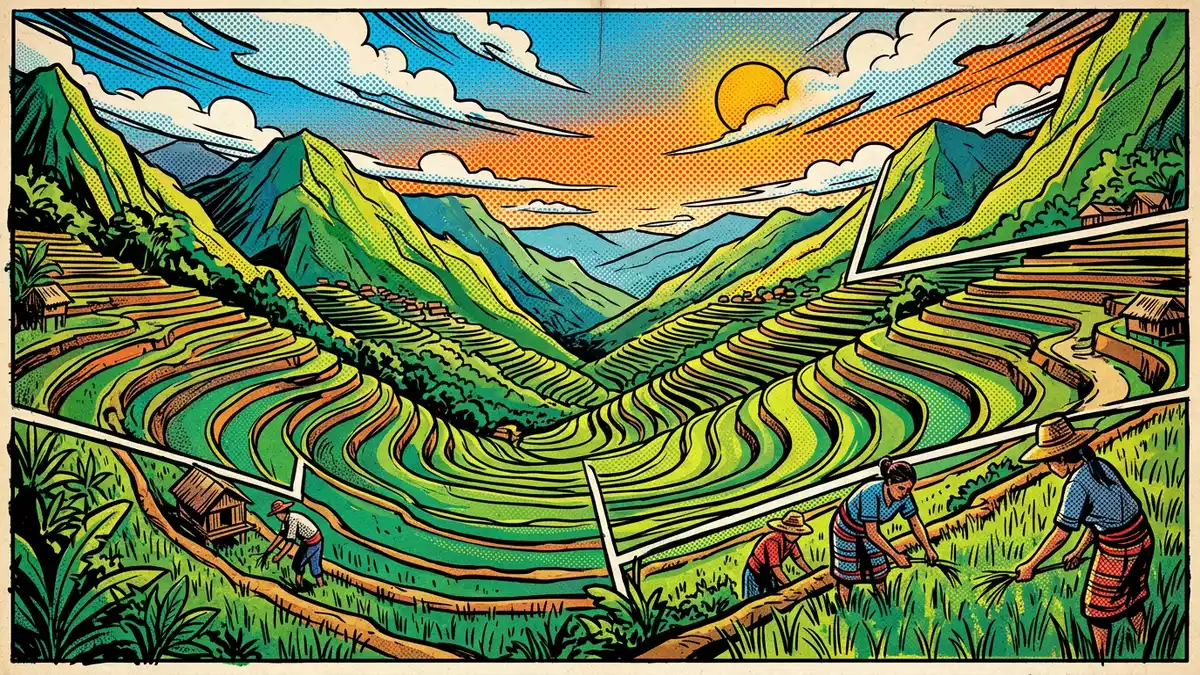
High above the town of Banaue in northern Luzon, the Banaue Rice Terraces form a sweeping staircase of irrigated fields cut directly into the mountainsides. Across the valleys of Ifugao Province, terrace clusters around Banaue have become a recognised cultural landscape tied to traditional rice farming that stretches back many centuries.
Shaped by Ifugao engineering on Luzon’s Cordillera slopes
The Banaue Rice Terraces lie within the Cordillera mountain range on the island of Luzon in the Philippines, where steep slopes rise above river valleys in the interior of the country.Cordillera mountain range The terraces are associated with the Ifugao people, who developed irrigated fields on the high terrain of this province and arranged them in successive levels following the contours of the hillsides.Ifugao people developed irrigated fields Fields sit above and below each other in long bands, edged by retaining walls that hold the earth in place and define the steps.
In Banaue and neighbouring municipalities, terrace systems span large areas of mountain slopes, creating continuous cultivated surfaces from valley floors up towards higher ridgelines.Ifugao rice terraces cover an extensive area The stone and mud structures are linked by narrow paths, channels and small embankments, forming a network that connects fields with water sources and villages. In several clusters around Banaue, terrace walls rise to elevations of around 1,500 m (4,921 ft) above sea level, placing rice cultivation within cool mountain air above lowland plains.terrace walls rise to high elevations
Heritage terraces around Banaue, Batad and Bangaan
Rice terraces in the wider Ifugao Cordilleras were inscribed on the UNESCO World Heritage List in 1995 as “Rice Terraces of the Philippine Cordilleras”, recognising selected clusters as a cultural landscape shaped over millennia.1995 UNESCO inscription Within Banaue municipality, the Batad and Bangaan terrace clusters form part of this inscription, alongside terraces in Hungduan, Mayoyao and Kiangan.Batad and Bangaan clusters Batad’s terraces curve around a basin in semi?circular tiers with a village at the base, while Bangaan’s cluster provides a cultivated backdrop to an Ifugao settlement of traditional houses.
The terrace system close to Banaue’s main population centre, often photographed from a roadside viewpoint, is commonly referred to as the Banaue Rice Terraces.terraces near Banaue poblacion This cluster does not form part of the UNESCO World Heritage property because modern structures extend across the landscape and affect the criteria of integrity used in the listing.modern structures affect integrity It is, however, included in national heritage recognition as part of the wider Ifugao terraces designated as a National Cultural Treasure, underlining its importance within the Philippine registry of cultural sites.National Cultural Treasure designation
A long tradition of high?mountain rice cultivation
Archaeological and historical studies attribute the origins of the Ifugao rice terraces, including those around Banaue, to an ancient period of terrace construction reaching back around two thousand years.created more than 2,000 years ago Over generations, Ifugao communities shaped the Cordillera slopes into cultivable steps, gradually extending the systems as populations adapted to the mountain environment.studies indicate long construction period Terraces are built from hand?placed stone and earth, with retaining walls supporting the paddies and narrow ledges providing access between levels.
The terraces form part of a wider region of rice cultivation across the Philippine Cordilleras, but the clusters in Ifugao are noted for their extent and continuity along mountain flanks.extensive use of terraces Stone?walled sections near Banaue are described in national records as among the highest and most extensive terrace constructions in Luzon, reflecting both the scale and the height at which fields have been maintained.stone?walled terraces among the highest The overall landscape reveals the close relationship between mountain settlement, irrigated agriculture and the shaping of slopes into orderly sequences of paddies.
Visiting Banaue Rice Terraces: what travellers from Western Europe should know
- Banaue lies in Ifugao Province on the island of Luzon in the northern Philippines, reached from lowland towns by mountain roads that climb into the Cordillera region.
- Paths and tracks between the terraces can be narrow, with uneven stone or earth surfaces and significant gradients, and approaches to viewpoints may involve walking on sloping ground.
- The terraces stand at elevations that can reach around 1,500 m (4,921 ft), where weather on the mountainsides can change quickly and clouds sometimes drift through cultivated slopes.
- The official language is Filipino and the currency is the Philippine peso.
- Entry requirements depend on your nationality; UK travellers can check the FCDO travel advice at gov.uk/foreign-travel-advice, Irish travellers the Department of Foreign Affairs at ireland.ie.
Searching for Banaue Rice Terraces on social platforms
These links open searches for Banaue Rice Terraces on each platform.
Frequently asked questions about Banaue Rice Terraces
Where are Banaue Rice Terraces located?
Banaue Rice Terraces are in Banaue municipality in Ifugao Province, within the Cordillera mountain range on the northern island of Luzon in the Philippines.
What should visitors expect on a visit?
Visitors encounter steep mountain terrain with layered rice paddies, stone and earth terrace walls, and footpaths that run alongside fields and descend towards villages and viewpoints.
What makes Banaue Rice Terraces distinctive?
The terraces are distinctive for their extensive hand?built structure on high mountain slopes around Banaue, their association with Ifugao rice cultivation and their role within the wider Cordillera terrace landscape.


